
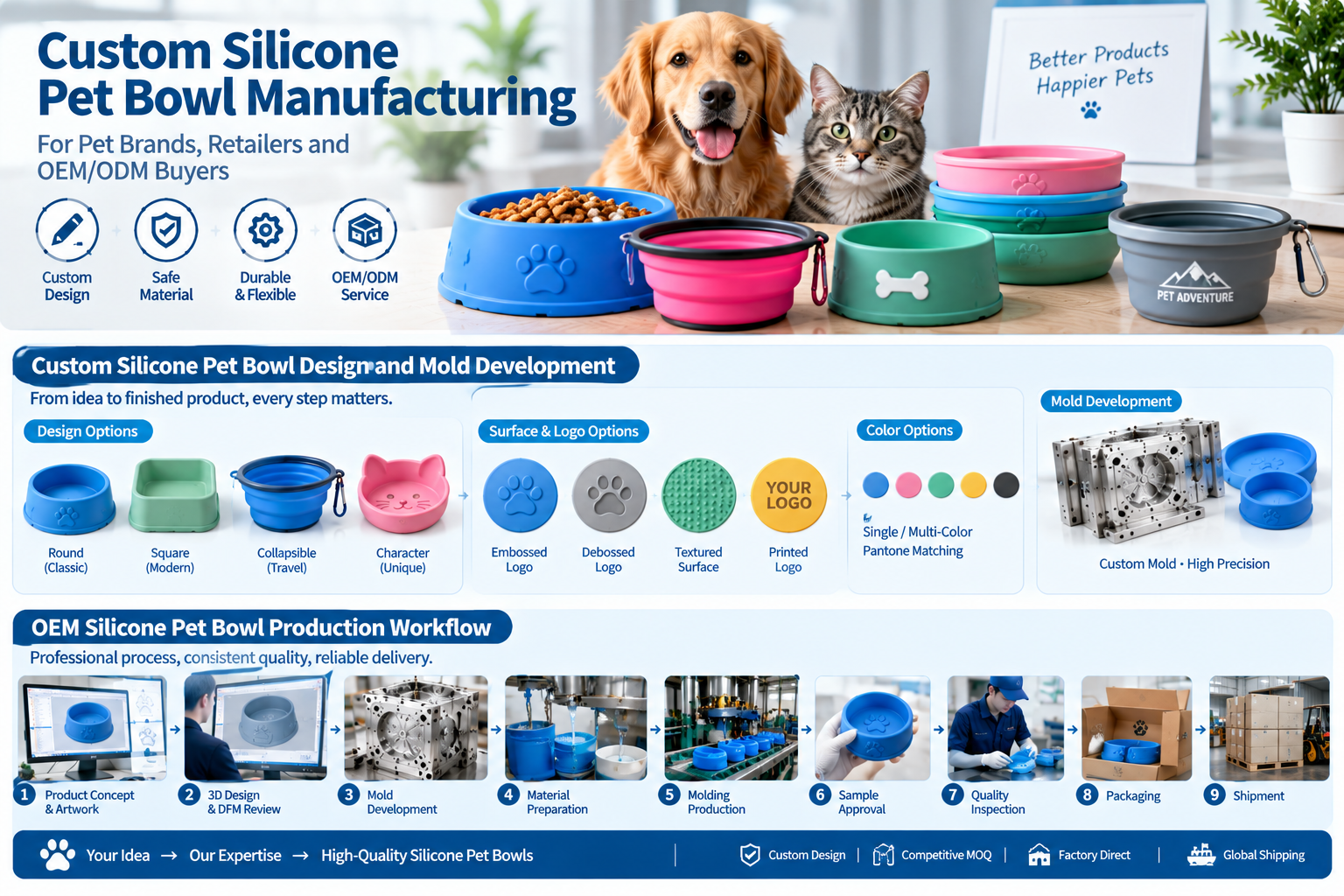
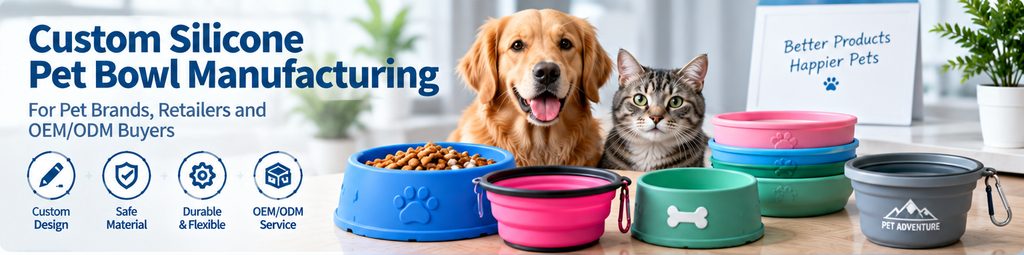
Custom silicone pet bowls are becoming an interesting product opportunity for pet brands, retailers, e-commerce sellers, and private-label businesses.Unlike standard stock pet bowls, custom silicone bowls allow brands to control the:
- Shape
- Size
- Color
- Logo
- Surface texture
- Product structure
- Packaging
Silicone can also be developed into flexible and foldable designs, making it suitable for everyday feeding as well as travel-oriented pet products.
However, creating a successful custom silicone pet bowl requires more than adding a logo to an existing product.
A professional OEM project may involve:
Product Design → DFM Review → Mold Development → Sample → Testing → Mass Production → Quality Inspection → Packaging
This guide explains what brands should consider before developing custom silicone pet bowls.
- Why Choose Silicone for Custom Pet Bowls?
Silicone offers several characteristics that make it useful for pet feeding products.
Flexible Product Structure
Silicone can be molded into flexible structures that are convenient for certain pet bowl designs.
This is especially useful for:
- Travel bowls
- Foldable bowls
- Collapsible bowls
- Portable feeding products
Easy-to-Clean Surface
Silicone surfaces can be designed with relatively simple geometries that are easier to clean than complicated structures.
For pet feeding products, this can be an important design consideration.
Custom Colors
Brands can develop pet bowls in their own: - Brand colors
- Seasonal colors
- Product collection colors
Pantone references can also be used when color matching is required.
Custom Shapes
Instead of producing a standard round bowl, brands can develop: - Round bowls
- Square bowls
- Character-shaped bowls
- Logo-inspired designs
- Foldable travel bowls
- What Types of Custom Silicone Pet Bowls Can You Manufacture?
There are several common directions for custom silicone pet bowl development.
Standard Silicone Pet Bowls
A simple bowl design can be customized with:
- Logo
- Color
- Size
- Surface texture
This type of product can be suitable for private-label pet brands.
Collapsible Silicone Pet Bowls
Collapsible bowls are designed for portability.
They can be useful for: - Travel
- Hiking
- Outdoor activities
- Pet walking
- Camping
The structure needs to be carefully designed so that the bowl can fold while still maintaining sufficient stability during use.
Silicone Dog Bowls
Custom dog bowls can be developed in different sizes according to the intended application.
The manufacturer may need to consider: - Bowl diameter
- Depth
- Base structure
- Product weight
- Raised edges
Silicone Cat Bowls
Cat products may use different shapes and dimensions depending on the product concept.
For example, brands may develop: - Low-profile bowls
- Wide bowls
- Character bowls
- Elevated feeding concepts
The final design should be developed around the intended pet and usage scenario.
- Custom Silicone Pet Bowl Design Options
The design of a custom pet bowl can go far beyond simply choosing a color.
Shape
Possible options include:
- Round
- Square
- Oval
- Custom geometric shape
- Character shape
Logo
Your logo can potentially be integrated into the product through: - Embossing
- Debossing
- Molded details
- Other suitable surface treatments
Color
Brands can request: - Single-color products
- Two-color products
- Multi-color designs
- Custom color matching
Texture
Different surface textures can create a distinctive appearance.
Possible options include: - Smooth
- Matte
- Textured
- Patterned
Functional Details
Depending on the design, a custom pet bowl may include: - Raised edges
- Anti-slip structures
- Foldable sections
- Handles
- Travel features
- How Are Custom Silicone Pet Bowls Manufactured?
The exact production method depends on the product design and required specifications.
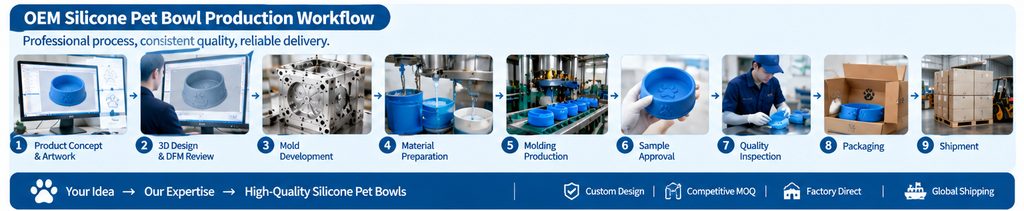
A typical OEM workflow includes several stages.
Step 1: Product Concept
The buyer provides:
- Product idea
- Sketch
- Reference product
- Dimensions
- Artwork
The manufacturer reviews the concept and discusses the production requirements.
Step 2: 3D Product Design
If necessary, engineers create a production-ready 3D model.
The design may need to consider: - Wall thickness
- Bowl geometry
- Base structure
- Folding areas
- Parting line
- Demolding
Step 3: Mold Development
After the design is approved, a custom mold is developed.
Step 4: Silicone Material Preparation
The selected silicone material is prepared and colored according to the approved specification.
Step 5: Molding
The silicone is formed into the final bowl shape.
Step 6: Sample Approval
Samples are produced for the buyer to evaluate.
Step 7: Mass Production
After sample approval, production can begin.
Step 8: Quality Inspection
Finished products are checked according to the agreed specifications.
Step 9: Packaging
The finished bowls are packed according to the customer’s requirements.

- How Silicone Pet Bowl Mold Design Affects Cost
The mold is one of the most important components of a custom silicone pet bowl project.
Mold cost can depend on:
- Product size
- Bowl geometry
- Wall thickness
- Surface details
- Logo complexity
- Undercuts
- Parting line
- Number of cavities
- Production quantity
A simple round bowl may require relatively straightforward tooling.
A collapsible bowl with multiple structural sections can require more careful mold engineering.
This is why the manufacturer should review the design before confirming the tooling cost.
- How Much Does a Custom Silicone Pet Bowl Cost?
The price of a custom silicone pet bowl depends on the complete product specification.
Important cost factors include:
Product Size
Larger bowls generally require more material.
Product Weight
The amount of silicone used directly affects material consumption.
Mold Structure
More complicated designs can require more expensive tooling.
Number of Colors
Multi-color designs may require additional manufacturing steps.
Logo and Surface Details
Complex molded details can increase production difficulty.
Order Quantity
Larger orders can distribute tooling costs across more units.
Packaging
Custom retail packaging can increase the total project cost.
Shipping
Shipping costs also depend on:
- Product weight
- Carton size
- Order quantity
- Destination
- What Is the MOQ for Custom Silicone Pet Bowls?
MOQ depends on the specific project.
A manufacturer may consider:
- Product size
- Mold investment
- Production process
- Material requirements
- Factory capacity
- Packaging
For a new pet brand, ordering too many units can create unnecessary inventory risk.
However, very small orders may make the mold investment more expensive on a per-unit basis.
This is why buyers should discuss the expected quantity with the manufacturer before finalizing the product design.
- Custom Silicone Pet Bowls for Private-Label Brands
Private-label pet brands often want their products to look different from standard catalog products.
Custom silicone bowls can be developed around a consistent brand identity.
For example:
Brand Color + Custom Shape + Logo + Custom Packaging
A brand may then build an entire pet feeding collection:
Pet Bowl → Feeding Mat → Storage Container → Travel Bowl
Using consistent design elements can help create a recognizable product family. - Custom Silicone Dog Bowls for Travel and Outdoor Use
Travel is one interesting application for custom silicone dog bowls.
A portable bowl can be designed with:
- Foldable structure
- Lightweight construction
- Compact storage
- Handle or hanging feature
- Custom branding
However, portability should not come at the expense of basic usability.
The product should be evaluated for: - Stability
- Folding behavior
- Structural strength
- Size
- Ease of cleaning
Sample testing is particularly useful for this type of product.
- Custom Silicone Cat Bowls: What Should Brands Consider?
Cat products may require a different design approach from larger dog bowls.
Potential design considerations include:
- Bowl height
- Bowl width
- Interior shape
- Product weight
- Stability
- Ease of cleaning
Brands developing cat feeding products should consider the actual use scenario rather than simply reducing the dimensions of a dog bowl.
A manufacturer can help evaluate whether the proposed structure is suitable for production.
- How to Choose a Custom Silicone Pet Bowl Manufacturer
When comparing suppliers, don’t look only at the quoted unit price.
Consider the complete manufacturing capability.
Product Development
Can the supplier review your design and suggest DFM improvements?
Mold Development
Does the supplier understand silicone mold design?
Sampling
Can they provide prototypes before mass production?
Color Matching
Can they reproduce your required colors consistently?
Quality Control
Ask how the factory checks:
- Dimensions
- Appearance
- Color
- Surface quality
- Product consistency
Packaging
Can the supplier provide: - Polybags
- Paper cards
- Retail boxes
- Custom packaging?
- Common Mistakes When Ordering Custom Silicone Pet Bowls
Mistake 1: Designing Only for Appearance
A beautiful design may still be difficult to manufacture.
The product must also be practical and manufacturable.
Mistake 2: Ignoring Wall Thickness
Different areas of the bowl may require different structural considerations.
Mistake 3: Adding Too Many Details
Unnecessary molded details can increase tooling complexity.
Mistake 4: Changing the Design After Tooling
Late changes can require mold modifications and increase costs.
Mistake 5: Not Testing the Prototype
A sample should be evaluated before mass production.
Mistake 6: Comparing Suppliers Only by Unit Price
Always compare the complete quotation. - How to Reduce Custom Silicone Pet Bowl Costs
There are several ways to control manufacturing costs.
Simplify the Mold
Avoid unnecessary complex structures.
Optimize Product Weight
Use an efficient design rather than adding excessive material.
Limit Unnecessary Colors
A simpler color structure can make production easier.
Confirm Artwork Early
Avoid changing the design after tooling begins.
Optimize Packaging
Choose packaging based on your sales channel.
Plan Quantity Carefully
Consider both expected demand and inventory requirements. - What Information Should You Send to a Silicone Pet Bowl Manufacturer?
For an accurate quotation, provide:
Product Type
For example:
- Dog bowl
- Cat bowl
- Travel bowl
- Collapsible bowl
Dimensions
Provide: - Diameter
- Height
- Thickness
- Weight if available
Artwork
Useful files include: - AI
- SVG
- PSD
- CAD
- 3D files
Colors
Provide Pantone references if exact color matching is required.
Quantity
Tell the manufacturer your expected order quantity.
Packaging
Specify whether you need: - Polybag
- Paper card
- Retail box
- Custom printed packaging
Target Market
Let the manufacturer know where the product will be sold.
- From Product Idea to Mass Production
A custom silicone pet bowl project can follow this workflow:
Product Concept
↓
2D / 3D Design
↓
DFM Review
↓
Mold Development
↓
Prototype
↓
Sample Approval
↓
Mass Production
↓
Quality Inspection
↓
Packaging
↓
Shipment
This workflow allows potential manufacturing problems to be identified before large-scale production. - Why Work With an OEM Silicone Pet Bowl Manufacturer?
An experienced OEM supplier can support more than production.
Depending on the supplier, services may include:
- Product development
- 3D design
- DFM review
- Mold development
- Sampling
- Color matching
- Mass production
- Quality inspection
- Packaging
For new brands, having these capabilities within one manufacturing workflow can simplify product development.
Instead of coordinating separate companies for design, tooling, sampling, and production, an integrated OEM supplier can manage more stages of the project.
Final Thoughts
Custom silicone pet bowls can be developed in many different shapes, colors, sizes, and structures.
For brands, the important considerations are not only the product’s appearance but also: - Manufacturing feasibility
- Mold cost
- Material usage
- Order quantity
- Quality requirements
- Packaging
- Production capability
The earlier these factors are considered, the easier it becomes to develop a product that is suitable for mass production.
Looking for a Custom Silicone Pet Bowl Manufacturer?
Have a custom pet bowl idea?
Send us your: - Product drawings
- Reference images
- Dimensions
- Quantity
- Colors
- Logo
- Packaging requirements
Our OEM/ODM team can help review the design, evaluate mold requirements, develop samples, and support mass production.
From product concept to finished silicone pet bowls, we provide complete OEM manufacturing solutions for pet brands and overseas buyers.
 English
 Chinese
 Japanese
 Spanish
 French
 Arabic
 Russian
 Portuguese
 Belarusian
[…] It can become part of a complete pet brand ecosystem. […]
[…] Custom silicone pet bowls […]
[…] brands developing custom silicone pet bowls, material hardness should be considered together with bowl thickness, rim design, base structure, […]