
When developing a custom silicone product, choosing the right silicone material is an important part of the product development process.
For products that may come into contact with food, beverages, pets, or other sensitive applications, buyers often ask an important question:
What is the difference between food grade silicone and regular silicone?
At first glance, the two materials may look almost identical.
They can have similar colors, textures, flexibility, and surface finishes. However, the material formulation, manufacturing requirements, testing, documentation, and intended applications can be different.
For OEM and private-label brands, choosing between food grade silicone and regular silicone should therefore be based on the actual product application rather than appearance alone.
In this guide, we will explain the differences between food grade silicone and regular silicone, where each material is commonly used, how certification requirements affect product development, and how to choose the right silicone for your custom product.
What Is Food Grade Silicone?
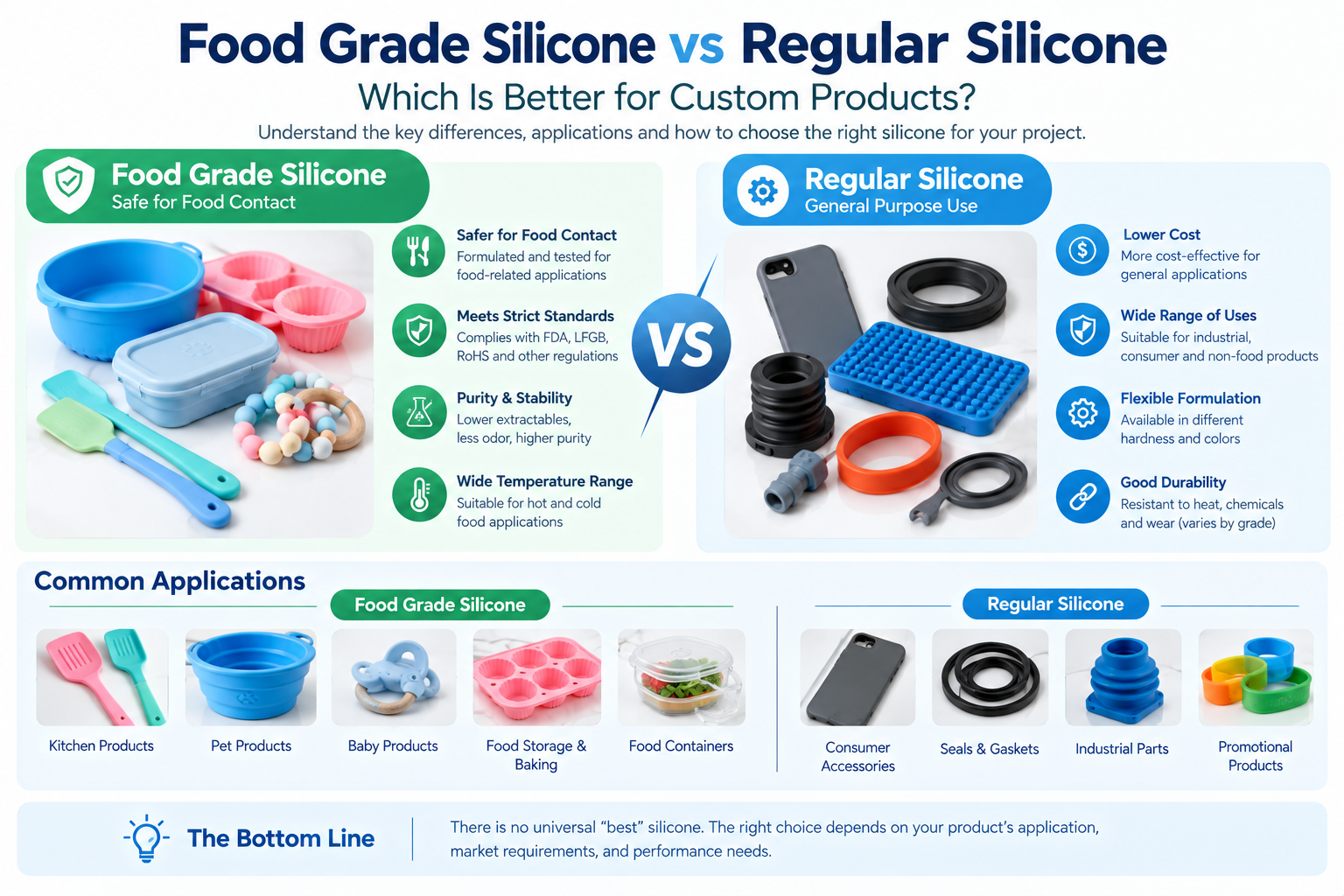
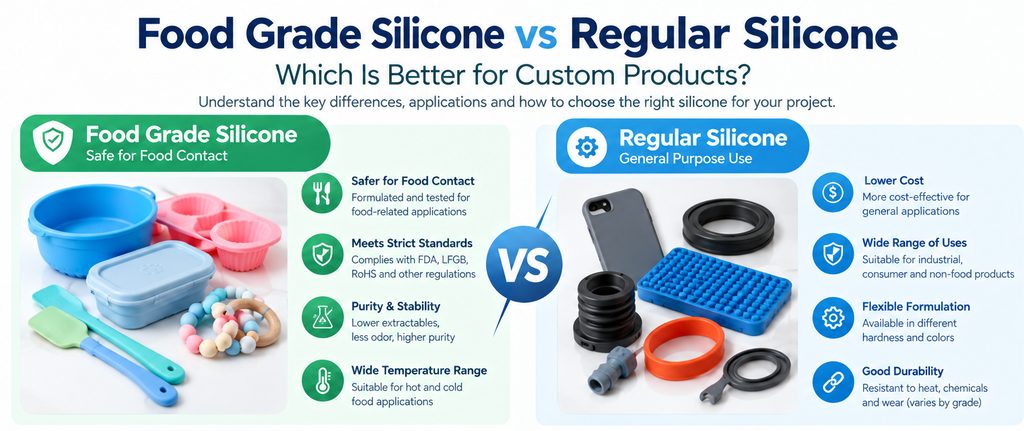
Food grade silicone is silicone that is formulated and manufactured for applications where the finished material is intended for contact with food or other regulated applications, subject to the applicable requirements.
It is commonly used for products such as:
- Silicone baking molds
- Spatulas
- Kitchen utensils
- Food storage accessories
- Baby feeding products
- Reusable food containers
- Silicone lids
- Food preparation tools
However, the term “food grade” should not be treated as a universal guarantee of safety for every market or application.
Different countries and regions may have different requirements for materials that come into contact with food.
Therefore, OEM buyers should confirm the specific regulatory requirements for their target market and product category.
What Is Regular Silicone?
Regular silicone is a broad term that is often used to describe silicone materials intended for applications that do not require food-contact specifications.
It may be used for:
- Consumer accessories
- Industrial components
- Seals and gaskets
- Promotional products
- Electronic accessories
- Household products
- Decorative products
- General molded silicone parts
Regular silicone is not necessarily “unsafe.”
The important point is that the material may not be formulated, tested, documented, or manufactured according to the requirements needed for a particular food-contact application.
This distinction is important when developing custom products.
Food Grade Silicone vs Regular Silicone: What Is the Difference?

The biggest difference is not simply how the material looks or feels.
The more important differences may include:
- Intended application
- Material formulation
- Raw material requirements
- Manufacturing controls
- Testing requirements
- Documentation
- Regulatory requirements
- Production procedures
- Cost
A food-contact product may require additional controls and documentation compared with a general-purpose silicone product.
This means that choosing food grade silicone can be more than simply choosing a different color or hardness.
Is Food Grade Silicone Safer Than Regular Silicone?
For a product designed for food contact, food grade silicone is generally the more appropriate material category because it is specifically selected and controlled for that intended application.
However, “food grade” should not be interpreted as meaning that every silicone product automatically meets every food-contact regulation worldwide.
The correct question is:
Does the finished product meet the requirements applicable to its intended use and target market?
This is why brands should discuss the product application, market, material specification, and required testing with their silicone manufacturer before production.
The question of silicone safety depends on the material, formulation, intended use, applicable standards, and manufacturing controls.
Does Food Grade Silicone Look Different?
Not necessarily.
Food grade silicone and other silicone materials can look very similar.
Both can be manufactured in:
- White
- Black
- Blue
- Pink
- Green
- Transparent or translucent colors
- Custom Pantone colors
They can also have similar surface finishes and textures.
This means you generally cannot determine whether a silicone product is food grade simply by looking at it.
For OEM products, the material specification and supporting documentation are much more important than appearance.
Does Food Grade Silicone Feel Different?
Not necessarily.
The feel of silicone depends on factors such as:
- Silicone hardness
- Product thickness
- Surface finish
- Product geometry
- Material formulation
A food grade silicone product can be soft, medium, or relatively firm depending on the formulation and application.
For example, a soft silicone kitchen tool and a firm silicone baking mold may both use food-contact silicone but have completely different physical characteristics.
This is why material grade and silicone hardness should be considered separately.
Food Grade Silicone and Temperature Resistance
Silicone is well known for its temperature resistance, which is one reason it is widely used in kitchen and food-related applications.
However, temperature performance depends on the specific silicone formulation and product design.
Food grade silicone products may be used in applications involving:
- Hot food
- Baking
- Freezing
- Refrigeration
- Microwave use
- Food preparation
But the actual temperature limits should always be confirmed according to the specific material specification and finished product.
A material being described as “food grade” does not automatically mean that every finished product can be used under every temperature condition.
For products exposed to high or low temperatures, brands should evaluate the silicone temperature limit together with product design and application conditions.
Food Grade Silicone for Kitchen Products
Kitchen products are one of the most common applications for food-contact silicone.
Examples include:
- Baking molds
- Spatulas
- Cooking utensils
- Kitchen mats
- Pot holders
- Food storage lids
- Ice cube molds
- Reusable food accessories
For these products, material selection is only one part of the development process.
Product design, wall thickness, hardness, mold structure, surface finish, and intended use should also be considered.
For brands developing custom food grade silicone products, the manufacturer should understand both the material requirements and the final application.
Food Grade Silicone for Pet Products
Food-contact silicone is not limited to human food applications.
Some pet products may also involve direct contact with food, water, or treats.
Examples include:
- Pet bowls
- Slow feeder bowls
- Lick mats
- Treat containers
- Feeding accessories
- Portable feeding products
The appropriate material depends on the intended use and the requirements of the target market.
For example, a silicone pet bowl intended for direct food contact may require a different material specification from a silicone toy that is not designed as a feeding product.
For custom silicone pet bowls, brands should discuss food-contact requirements, hardness, product thickness, cleaning conditions, and intended use before production.
Does Food Grade Silicone Cost More?
It can.
Food grade silicone products may have additional material, testing, documentation, and production requirements.
However, the total product cost depends on many factors.
These can include:
- Product size
- Product weight
- Silicone formulation
- Hardness
- Mold design
- Number of cavities
- Production quantity
- Colors
- Surface treatment
- Packaging
- Testing requirements
- Certification or documentation requirements
Therefore, food grade silicone should not be evaluated based on material price alone.
For an OEM project, the total manufacturing cost is usually more important than the price difference between two material options.
The final cost of custom silicone products depends on material, tooling, product design, production quantity, packaging, and other manufacturing requirements.
Does Food Grade Silicone Require Special Manufacturing?
The answer depends on the product and the requirements of the target market.
For food-contact products, manufacturers may need to pay closer attention to:
- Raw material control
- Production cleanliness
- Material traceability
- Processing conditions
- Product handling
- Quality inspection
- Testing
- Documentation
This is one reason why choosing an experienced manufacturer is important.
A manufacturer that produces general silicone promotional products may not necessarily have the same experience with food-contact product requirements.
Food Grade Silicone Certification: What Should Buyers Ask For?
This is one of the most important parts of custom silicone product development.
Different markets may have different requirements for food-contact materials.
Depending on the destination market and application, buyers may need specific testing, declarations, or compliance documentation.
Instead of simply asking:
“Is this silicone food grade?”
ask the manufacturer:
“Can you provide the documentation and test reports required for my target market and product application?”
This is a much more useful question.
Before placing a large production order, confirm:
- Applicable food-contact requirements
- Material specification
- Relevant test reports
- Manufacturer documentation
- Product application
- Target market
- Required testing
- Any customer-specific compliance requirements
Do not assume that a generic “food grade” statement automatically satisfies every market requirement.
Food Grade Silicone vs Regular Silicone for OEM Products
For OEM buyers, material selection should be connected to the final product application.
A simple decision process can look like this:
Choose Food Grade Silicone When:
The product is specifically intended for food contact.
Examples include:
- Kitchen utensils
- Baking products
- Food storage products
- Baby feeding accessories
- Food preparation tools
- Certain pet feeding products
Regular Silicone May Be Suitable When:
The product does not require food-contact performance.
Examples may include:
- Promotional products
- Decorative products
- General consumer accessories
- Industrial components
- Electronic accessories
- Certain seals and gaskets
The final decision should always be based on the product’s actual application and applicable requirements.
Food Grade Silicone vs Regular Silicone: Which One Should You Choose?
There is no universal answer.
The better material is the one that matches the product requirements.
If the product is intended for direct food contact, the appropriate food-contact silicone specification should be considered.
If the product has no food-contact requirement, using a suitable general-purpose silicone may be more practical and cost-effective.
The important point is to avoid choosing the material based only on price.
Material selection should consider:
- Product function
- Customer expectations
- Safety requirements
- Target market
- Temperature exposure
- Hardness
- Durability
- Manufacturing process
- Testing requirements
- Total product cost
How Product Design Affects Silicone Material Selection
Material selection should happen together with product design.
For example, a product with thin walls may need a different hardness from a thick silicone component.
A flexible product may require different material properties from a structural component.
A product exposed to repeated heating and cooling may require different testing from a product used only at room temperature.
This is why silicone product design and material selection should be evaluated together.
Good product design can help reduce manufacturing problems before the mold is produced.
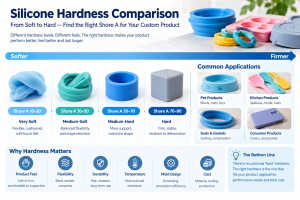
Does Silicone Hardness Matter for Food Grade Products?
Yes.
Food grade silicone does not have one universal hardness.
The material can be produced in different hardness levels depending on the application.
For example:
A flexible silicone lid may need a softer material.
A silicone baking mold may need a balance between flexibility and shape retention.
A kitchen utensil may need a firmer structure.
A sealing component may require specific compression characteristics.
Therefore, food grade silicone and hardness should be treated as two separate specifications.
The appropriate silicone hardness should be evaluated based on product geometry, flexibility, shape retention, and intended use.
Common Mistakes When Choosing Food Grade Silicone
Mistake 1: Assuming All Silicone Is Food Grade
Silicone is a broad material category.
Not every silicone product is automatically intended for food contact.
Mistake 2: Choosing the Cheapest Material
A lower material price does not necessarily mean a lower total project cost.
If the material does not meet the product requirements, changing materials later can create delays and additional costs.
Mistake 3: Asking Only for a “Food Grade” Statement
A verbal statement is not always enough.
Ask what documentation and testing are available for your target market.
Mistake 4: Ignoring the Finished Product
Material selection should consider the final product rather than only the raw material.
Product geometry, thickness, hardness, and manufacturing process can all affect performance.
Mistake 5: Choosing Material After Mold Development
Changing material requirements late in the project can create unnecessary delays.
It is better to discuss material selection before finalizing the mold.
Mistake 6: Ignoring the Target Market
Food-contact requirements can vary between markets.
Always confirm the requirements that apply to your intended sales region.
How to Choose a Food Grade Silicone Manufacturer
Choosing the right manufacturer is especially important for food-contact products.
Before placing an OEM order, ask the manufacturer:
- What silicone material do you recommend?
- What is the material specification?
- What food-contact documentation is available?
- What testing has been completed?
- Can you provide samples?
- Can you control the material specification during mass production?
- How do you handle quality inspection?
- Can you support custom colors and hardness?
- What production process is suitable for the product?
- Can you provide documentation required for the target market?
An experienced manufacturer should be able to discuss these questions clearly rather than simply giving you a material price.
When comparing suppliers, look beyond price and evaluate their silicone manufacturer capabilities, material knowledge, quality control, communication, and OEM experience.
Food Grade Silicone Manufacturing Process

The exact production process depends on the product and silicone material.
A typical custom silicone product project may include:
Step 1: Product concept
The buyer provides drawings, 3D files, reference samples, or product requirements.
Step 2: Material selection
The manufacturer recommends an appropriate silicone specification based on the product application.
Step 3: Product design review
The product geometry, thickness, hardness, and manufacturing requirements are reviewed.
Step 4: Mold development
The mold is designed and manufactured based on the final product specification.
Step 5: Sampling
Initial samples are produced for evaluation.
Step 6: Testing and approval
The buyer evaluates appearance, dimensions, hardness, function, and other requirements.
Step 7: Mass production
After sample approval, production begins according to the confirmed specifications.
Step 8: Quality inspection
Finished products are inspected before packaging and shipment.
This process helps reduce the risk of discovering major material or design problems after mass production has already started.
How to Reduce the Cost of Custom Food Grade Silicone Products
If your product requires food-contact silicone, cost reduction should focus on the entire product rather than simply selecting a cheaper material.
You can consider:
Optimize Product Weight
Reducing unnecessary material thickness can reduce material consumption.
However, structural performance must always be maintained.
Simplify Mold Design
Unnecessary complexity can increase tooling cost and production time.
Choose the Right Hardness
Using a hardness that matches the actual application can help avoid unnecessary material or design compromises.
Confirm Requirements Early
Clearly defining food-contact requirements before mold development can help reduce expensive changes later.
Optimize Production Quantity
Larger production quantities may improve tooling and unit-cost efficiency, depending on the project.
Reduce Unnecessary Customization
Complex colors, finishes, packaging, and secondary processes can increase the total product cost.
What Information Should You Send to a Silicone Manufacturer?
To receive a more accurate quotation and material recommendation, provide as much information as possible.
Useful information includes:
- Product drawings
- 3D files
- Product dimensions
- Product weight
- Intended application
- Target market
- Required silicone hardness
- Color requirements
- Food-contact requirements
- Expected order quantity
- Packaging requirements
- Testing requirements
- Reference samples
The more complete the information, the easier it is for the manufacturer to recommend a suitable material and production process.
Final Thoughts
Food grade silicone and regular silicone can look very similar, but they should not automatically be treated as interchangeable materials.
The key difference is the intended application and the material, manufacturing, testing, and documentation requirements associated with that application.
For food-contact products, the correct food-contact silicone specification should be selected based on the target market and product requirements.
For general-purpose products, a suitable regular silicone material may provide a more practical solution.
The best approach is to evaluate the complete project:
Application → Material → Hardness → Product Design → Mold → Testing → Mass Production
By making the material decision early, brands can reduce production risks, avoid unnecessary tooling changes, and develop a more reliable custom silicone product.
Ready to Develop Your Custom Silicone Product?
Whether you are developing silicone kitchenware, pet products, consumer accessories, promotional products, or other custom silicone items, choosing the right material is an important first step.
Share your product drawings, 3D files, reference samples, dimensions, target market, and application requirements with your silicone manufacturer.
The right material specification can help your product achieve the expected performance, appearance, durability, and manufacturing consistency from prototype to mass production.
 English
 Chinese
 Japanese
 Spanish
 French
 Arabic
 Russian
 Portuguese
 Belarusian
[…] food-contact products, choosing the appropriate food grade silicone specification is more important than simply asking whether a material is […]