
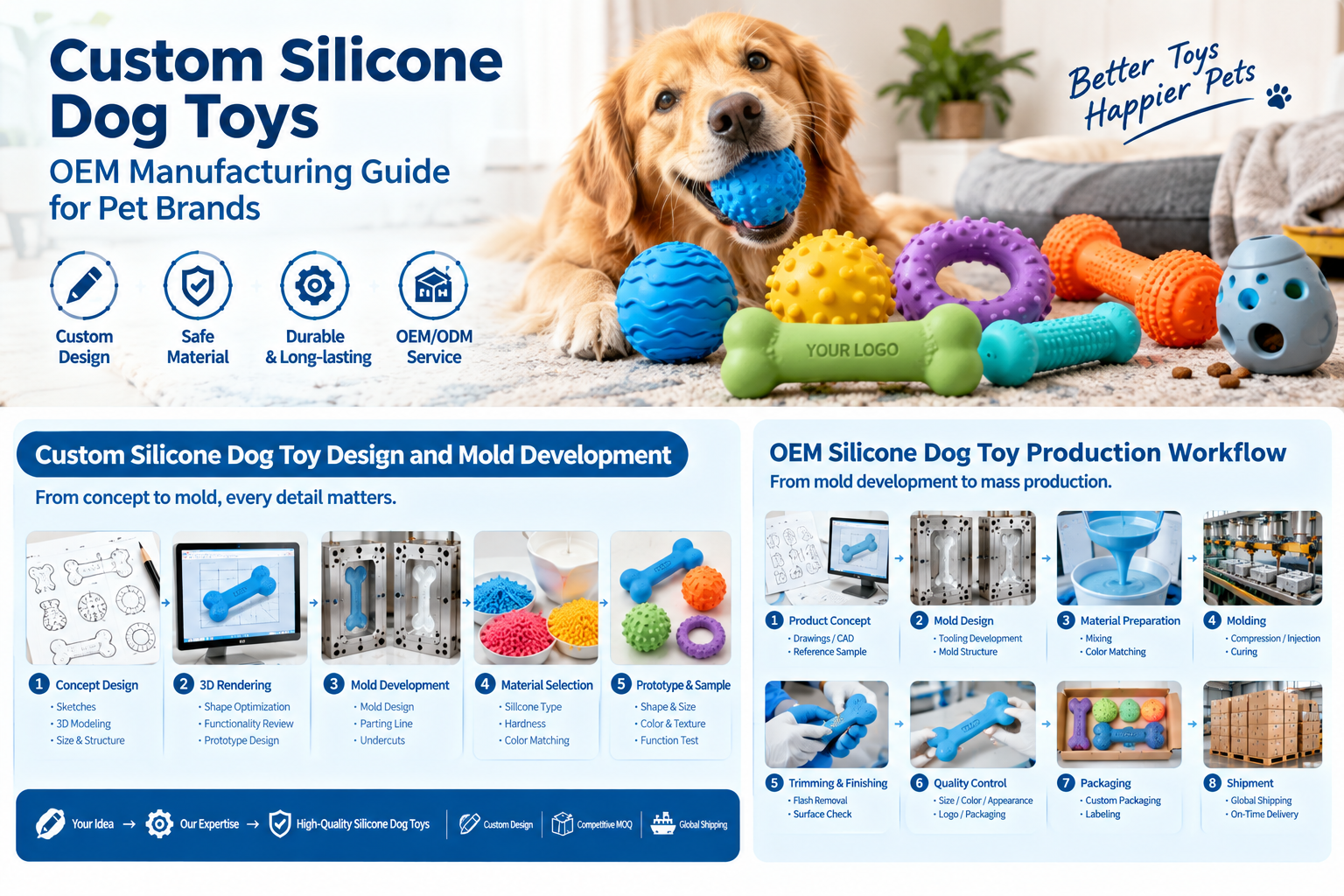
Custom silicone dog toys are becoming an interesting product category for pet brands, retailers, subscription-box companies, and private-label businesses looking to develop differentiated pet products.
Compared with generic stock toys, custom silicone dog toys allow brands to control the product shape, size, color, texture, logo, packaging, and overall product experience.
For companies developing their own pet product line, the main questions are usually:
- How are custom silicone dog toys manufactured?
- What type of silicone should be used?
- How much does a custom silicone dog toy cost?
- What is the MOQ?
- Can the toy be made in custom colors?
- Can a logo be added?
- How does mold design affect the cost?
- Can the product be private labeled?
- What should buyers consider before mass production?
This guide explains the custom silicone dog toy manufacturing process, from product concept and mold development to sampling, mass production, quality control, and packaging.
Why Use Silicone for Custom Dog Toys?
Silicone can be a useful material for certain pet products because it offers flexibility, durability, and a wide range of design possibilities.
For OEM pet brands, one of the biggest advantages is the ability to develop products with distinctive shapes and textures.
Flexible Product Design
Silicone can be molded into many different geometries.
This allows brands to create:
- Balls
- Rings
- Chew shapes
- Treat-dispensing toys
- Textured toys
- Interactive shapes
- Branded character designs
The product geometry can be developed around the intended use and target pet size.
Colores personalizados
Silicone products can be produced in a wide range of colors.
Brands can develop products around:
- Colores de la marca
- Seasonal collections
- Pet lifestyle themes
- Character colors
- Retail color systems
A consistent color system can also help create a recognizable product family.
Different Surface Textures
Surface texture is another important customization option.
A dog toy can be designed with:
- Smooth surfaces
- Motivos en relieve
- Grooves
- Dots
- Ridges
- Geometric textures
Texture can affect both appearance and how the product interacts with the pet.
Suitable for Branded Product Lines
A custom silicone dog toy can be designed as part of a larger pet product collection.
For example, a brand could develop:
- Silicone dog toys
- Silicone dog bowls
- Silicone feeding mats
- Silicone treat accessories
- Silicone travel products
What Types of Custom Silicone Dog Toys Can You Develop?
The product type should be selected before finalizing the mold and manufacturing process.
Different toy structures have different requirements for geometry, thickness, flexibility, and durability.
1. Silicone Chew Toys
Chew toys can be designed in a variety of shapes.
Common designs include:
- Rings
- Bones
- Balls
- Sticks
- Geometric shapes
- Character shapes
The geometry should be evaluated according to the intended pet size and use case.
2. Silicone Treat-Dispensing Toys
Treat-dispensing toys can include cavities or openings designed to hold pet treats.
The product may require:
- Internal cavities
- Controlled openings
- Different wall thicknesses
- Flexible sections
- Easy-clean geometry
These features can make the mold more complicated than a simple solid toy.
3. Textured Silicone Dog Toys
Textured toys can use raised or recessed surface patterns.
Possible patterns include:
- Ridges
- Dots
- Lines
- Waves
- Geometric shapes
Texture can also become part of the product’s visual identity.
4. Silicone Balls
Silicone balls can be developed in different sizes and surface structures.
A brand might create:
- Small balls
- Medium balls
- Large balls
- Textured balls
- Hollow balls
- Treat-compatible designs
5. Custom Character Dog Toys
Brands with their own IP can develop silicone dog toys around recognizable shapes or characters.
This can be particularly useful for:
- Pet brands
- Licensed characters
- Lifestyle brands
- Retail collaborations
- Subscription boxes
For character-based products, mold design becomes particularly important because small details need to survive the manufacturing process.
How to Design a Custom Silicone Dog Toy
A successful custom dog toy needs to balance appearance, functionality, manufacturing, and intended use.
The design should therefore be reviewed before the mold is created.
1. Define the Intended Use
Start by deciding what the toy is designed to do.
Por ejemplo:
- Chewing
- Fetching
- Treat dispensing
- Interactive play
- Training
- General entertainment
The intended use influences the geometry and material requirements.
2. Define the Target Dog Size
A toy for a small dog may have very different dimensions from one designed for a larger dog.
Consider:
- Overall dimensions
- Peso
- Opening size
- Product thickness
- Forma
- Grip area
3. Choose the Product Geometry
The geometry should be visually attractive while remaining suitable for manufacturing.
Simple shapes are generally easier to manufacture.
Complex shapes may require additional engineering and more complicated tooling.
4. Design the Surface Texture
Surface texture can differentiate one product from another.
It can also become part of a brand’s signature design language.
5. Add Branding
Possible branding options include:
- Logotipo en relieve
- Logotipo en relieve
- Molded logo
- Printed logo
- Embalaje personalizado
The logo should be considered during mold development rather than added at the very end.
Custom Silicone Dog Toy Mold Design
The mold is one of the most important components of a custom silicone dog toy project.
A good mold design can help improve:
- Consistencia del producto
- Calidad de la superficie
- Dimensional accuracy
- Eficiencia en la producción
- Repetibilidad
- Tooling life
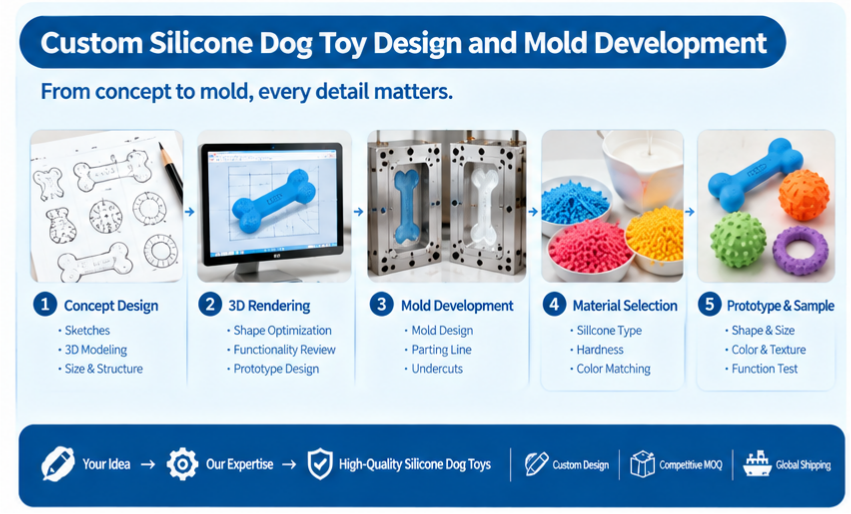
Parting Line
The parting line should be carefully considered during product development.
For consumer pet products, a poorly positioned parting line may create a visible seam or unwanted edge.
The manufacturer should review the mold structure before finalizing the product geometry.
Product Thickness
Wall thickness can affect:
- Flexibilidad
- Peso
- Material consumption
- Cooling or curing behavior
- Consistencia del producto
Large differences in thickness may also create manufacturing challenges.
Recortes
Complex undercuts can make the mold more difficult to manufacture and release.
If the product contains deep recesses or complex geometry, the mold engineer should review the design before tooling.
Mold Cavities
For larger production volumes, multi-cavity molds may improve production efficiency.
However, more cavities can also increase initial tooling complexity.
The right solution depends on:
- Expected quantity
- Tamaño del producto
- Tooling budget
- Production cycle
- Geometría del producto
What Silicone Material Should Be Used for Dog Toys?
Material selection should be based on the intended application and product requirements.
For pet products, brands should discuss the appropriate silicone specification with the manufacturer and request relevant material documentation and testing information for the intended market.
Important considerations may include:
- Silicone type
- Dureza
- Flexibilidad
- Tear resistance
- Acabado de la superficie
- Color stability
- Odor
- Intended application
- Applicable testing requirements
A manufacturer should be able to explain why a particular material specification is suitable for the product being developed.
How Are Custom Silicone Dog Toys Manufactured?
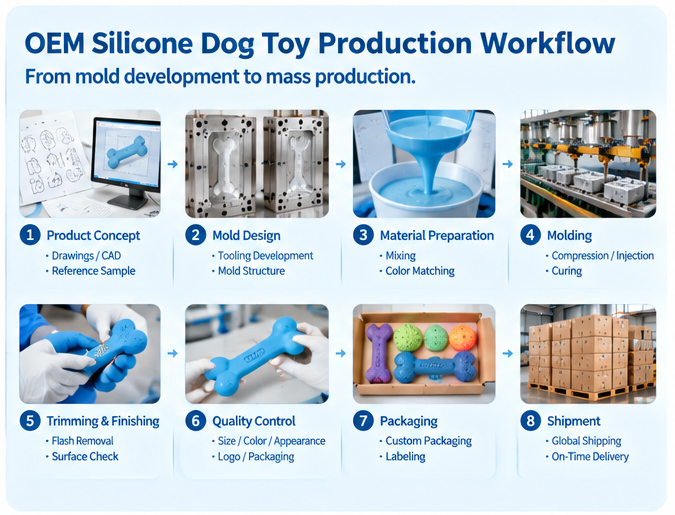
A typical OEM project can include several stages.
Paso 1: Concepto del producto
The brand provides the initial product idea.
This may include:
- Sketches
- Planos de productos
- 3D CAD files
- Reference products
- Product photos
- Dimensiones
- Logo files
Step 2: Engineering Review
The manufacturer reviews the concept for production feasibility.
The engineering team may evaluate:
- Espesor
- Geometry
- Recortes
- Líneas de separación
- Estructura del molde
- Material distribution
- Product release
Paso 3: Desarrollo del molde
Once the design is approved, the manufacturer develops the mold.
The mold structure should match the product design and expected production quantity.
Paso 4: Preparación del material de silicona
The selected silicone material is prepared according to the approved specification.
Custom color matching can also be completed during this stage.
Paso 5: Moldeado
The silicone is processed using the selected manufacturing method.
The exact process depends on the product design, material, tooling, and production requirements.
Step 6: Trimming and Finishing
After molding, excess material may need to be removed.
Products can then go through:
- Flash trimming
- Inspección de superficies
- Logo inspection
- Cleaning
- Montaje
Step 7: Quality Control
Los productos terminados se inspeccionan de acuerdo con las especificaciones acordadas.
Typical checks may include:
- Dimensiones
- Color
- Calidad de la superficie
- Flash
- Logo position
- Peso del producto
- Empaque
How Much Does a Custom Silicone Dog Toy Cost?
There is no universal price for custom silicone dog toys.
The final cost depends on multiple factors.
Tamaño del producto
Larger products normally require more material and may require larger molds.
Peso del producto
A heavier toy generally consumes more silicone per unit.
Product Complexity
A simple solid shape may be easier to manufacture than a multi-component or hollow design.
Estructura del molde
Tooling requirements can vary significantly depending on:
- Geometría del producto
- Cavities
- Recortes
- Líneas de separación
- Internal structures
Silicone Specification
Material specification, hardness, color, and other requirements can affect the final cost.
Logotipo
A molded logo may require changes to the mold.
Printed branding may involve additional production steps.
Empaque
Packaging can include:
- Bolsas de plástico
- Tarjetas de papel
- Printed boxes
- Retail packaging
- Custom inserts
Cantidad del pedido
Quantity is one of the most important factors affecting unit economics.
Higher production quantities can spread tooling and setup costs across more units.
What Is the MOQ for Custom Silicone Dog Toys?
MOQ varies from one manufacturer to another.
It can also depend on the product design and customization level.
A standard product with basic branding may have different production requirements from a fully custom product requiring:
- New tooling
- Colores personalizados
- Embalaje personalizado
- Multiple sizes
- Multiple designs
When requesting a quotation, ask the manufacturer to specify:
- Sample MOQ
- Trial order quantity
- Production MOQ
- MOQ per color
- MOQ per design
- Packaging MOQ
Can Silicone Dog Toys Be Private Labeled?
Sí.
Private-label silicone dog toys can be developed at several levels.
Basic Private Label
The manufacturer provides an existing product.
The brand adds:
- Logotipo
- Empaque
- Label
- Colores de la marca
This can reduce development time.
Semi-Custom Product
The brand modifies selected elements such as:
- Color
- Tamaño
- Logotipo
- Textura
- Empaque
Fully Custom Silicone Dog Toy
The brand develops an entirely new product.
This can include:
- Custom shape
- New mold
- Custom texture
- Colores personalizados
- Custom logo
- Embalaje personalizado
For brands building a unique product line, fully custom development provides more control over product differentiation.
Custom Silicone Dog Toys for Pet Brands
A custom dog toy can be more than a standalone product.
It can become part of a complete pet brand ecosystem.
For example, a brand may develop matching:
- Dog bowls
- Dog toys
- Alfombrillas para comer
- Treat accessories
- Travel products
- Storage products
Using consistent colors, logos, shapes, and packaging can create a recognizable product family.
Custom Silicone Dog Toys for Promotional Products
Custom pet toys can also be developed as promotional merchandise.
Potential customers include:
- Pet food brands
- Veterinary brands
- Pet stores
- Pet subscription companies
- Pet insurance companies
- Animal-related events
- Lifestyle brands
A promotional toy can be customized with:
- Brand logo
- Corporate colors
- Campaign artwork
- Embalaje personalizado
For promotional projects, the product should be designed around the campaign budget and required quantity.
How to Choose a Custom Silicone Dog Toy Manufacturer
Choosing a manufacturer is not only about finding a factory that can mold silicone.
The supplier should ideally be able to support the complete product development process.
1. Product Development Capability
The manufacturer should be able to review product concepts and identify potential manufacturing issues.
2. Mold Engineering
Ask about experience with:
- Silicone molds
- Complex geometries
- Textured surfaces
- Recortes
- Multi-cavity tooling
3. Material Knowledge
The supplier should be able to explain the selected silicone specification and provide appropriate documentation.
4. Sampling Capability
Before mass production, the brand should have the opportunity to evaluate samples.
Review:
- Forma
- Tamaño
- Peso
- Color
- Textura
- Logotipo
- Overall appearance
5. Quality Control
Ask how the factory controls:
- Raw materials
- Producción
- Dimensiones del producto
- Apariencia
- Color consistency
- Finished goods
6. Communication
Clear communication between the brand and manufacturer can prevent unnecessary tooling changes and production delays.
Common Mistakes When Developing Custom Silicone Dog Toys
Error n.º 1: Diseñar solo pensando en la apariencia
A visually attractive product still needs to be suitable for its intended application.
Consider size, shape, flexibility, durability, and the target pet.
Error n.º 2: Hacer que el producto sea demasiado complicado
Unnecessary details can increase mold complexity and production cost.
Mistake 3: Ignoring Product Thickness
Uneven thickness can affect product consistency and performance.
Mistake 4: Not Reviewing the Mold Before Tooling
A product design should be reviewed from a manufacturing perspective before the mold is produced.
Mistake 5: Skipping Prototype Testing
Samples allow the brand to evaluate the actual product before mass production.
Mistake 6: Choosing a Supplier Based Only on Unit Price
A low initial quotation does not necessarily represent the lowest total project cost.
Tooling, quality issues, rework, packaging, and production delays can all affect the final project.
How to Reduce Custom Silicone Dog Toy Costs
Cost reduction should focus on improving the design rather than simply choosing cheaper materials.
Simplify the Product Geometry
Avoid unnecessary complex features that do not add meaningful product value.
Optimizar el peso del producto
Reducing unnecessary material can reduce silicone consumption.
Optimize the Mold
Discuss:
- Cavity quantity
- Líneas de separación
- Estructura del molde
- Production cycle
with the manufacturer before tooling begins.
Standardize Colors
Using a smaller number of standard colors across a product collection may simplify production.
Standardize Packaging
Custom packaging can increase project cost.
A simpler packaging system may be more suitable for certain products.
Aumentar la cantidad del pedido
Higher production quantities may reduce the average tooling cost per unit.
What Information Should You Send to a Silicone Dog Toy Manufacturer?
For a more accurate quotation, prepare the following information.
Product Name:
Custom Silicone Dog Toy
Product Type:
Chew toy / ball / treat toy / interactive toy / other
Dimensions:
Length × width × height
Material:
Required silicone specification or intended application
Hardness:
If known
Color:
Pantone or physical reference
Logo:
Logo file and preferred branding method
Quantity:
Estimated order quantity
Packaging:
Bulk or individual packaging
Target Market:
US / Europe / Japan / Other
Reference:
Sketches, photos, samples, or 3D CAD files
Expected Timeline:
Target sampling and production schedule
The more complete the information, the easier it is for the manufacturer to evaluate the tooling, production process, MOQ, and cost.
De la idea del producto a la producción en masa
A typical custom silicone dog toy development process looks like this:
Idea de producto
↓
Product Design
↓
Engineering Review
↓
3D Model / Drawing Approval
↓
Mold Design
↓
Tooling
↓
Prototipo / Muestra
↓
Aprobación de muestras
↓
Producción en serie
↓
Inspección de calidad
↓
Empaque
↓
Envío
Why Work With an OEM Silicone Dog Toy Manufacturer?
Working directly with an OEM manufacturer allows pet brands to develop products according to their own specifications.
Depending on the supplier, the process can include:
- Desarrollo de productos
- Engineering
- Desarrollo del moho
- Silicone material selection
- Combinación de colores
- Muestreo
- Producción en masa
- Control de calidad
- Empaque
For brands planning multiple silicone pet products, an experienced manufacturer can also help maintain consistency across the product line.
Reflexiones finales
Custom silicone dog toys offer pet brands an opportunity to create products that are different from generic stock products.
The most important part of the process is not simply choosing silicone.
A successful OEM project requires careful attention to:
- Product application
- Geometría del producto
- Selección de materiales
- Mold design
- Product testing
- Cantidad mínima de pedido
- Coste
- Empaque
- Control de calidad
Starting with a manufacturable design can reduce unnecessary tooling changes and make the transition from prototype to mass production much smoother.
For brands building a larger silicone pet product collection, custom dog toys can also be developed alongside bowls, feeding accessories, mats, and other pet products.
Ready to Develop Your Own Custom Silicone Dog Toys?
Whether you already have a finished dog toy design or only have a product concept, an experienced silicone manufacturer can help turn your idea into a production-ready product.
When requesting a quotation, provide your product dimensions, reference images or CAD files, material requirements, colors, logo requirements, estimated quantity, and packaging preferences.
The more information you provide, the easier it is to evaluate the mold, production process, MOQ, and overall project cost.
Contact us to discuss your custom silicone dog toy project and develop an OEM manufacturing solution for your pet brand.
 English
 Chinese
 Japanese
 Spanish
 French
 Arabic
 Russian
 Portuguese
 Belarusian