
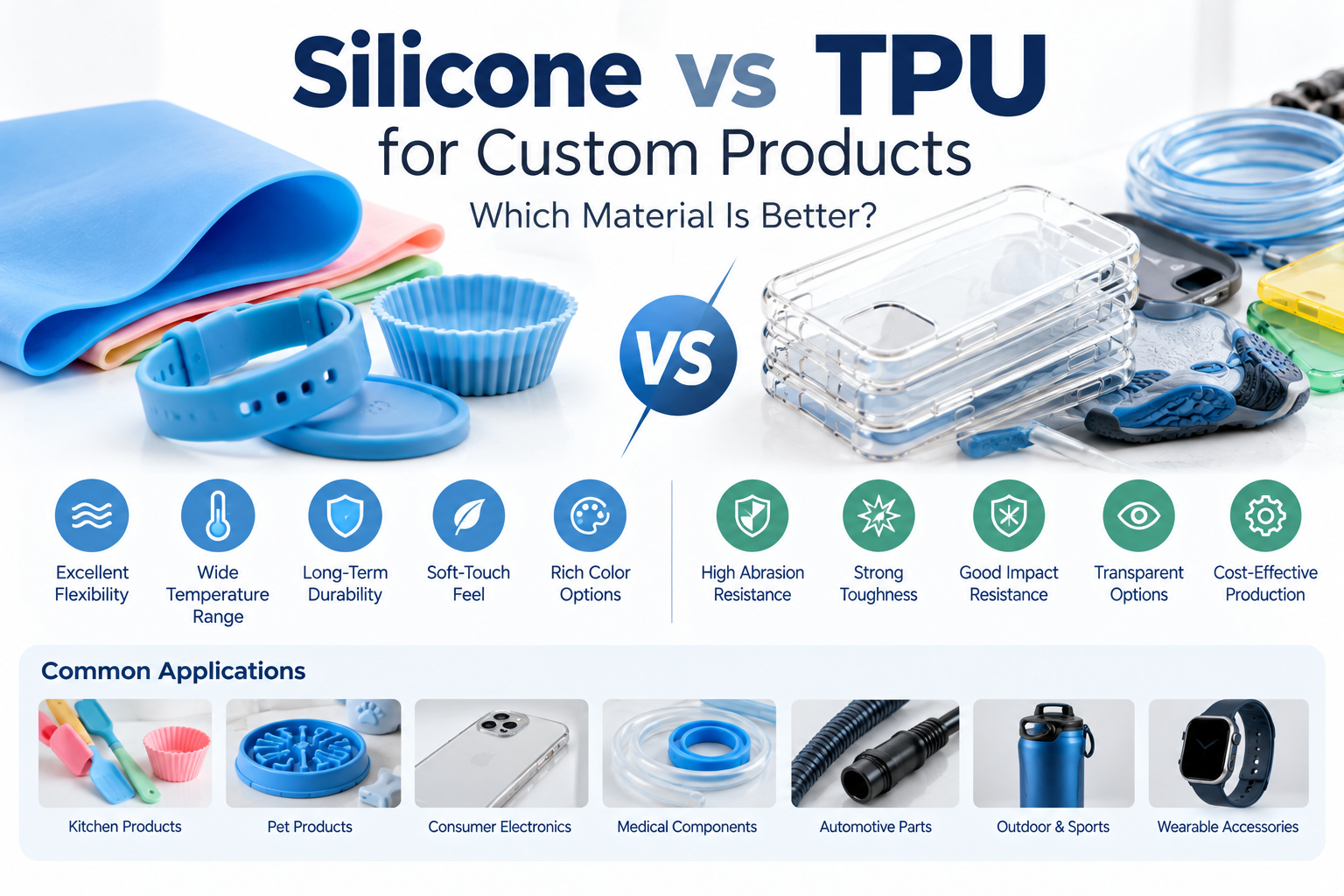
When developing a flexible or soft-touch product, material selection can have a major impact on product performance, appearance, manufacturing cost, and long-term durability.
Silicone and TPU are two materials commonly considered for flexible custom products.
Both can provide flexibility.
Both can be molded into complex shapes.
Both can be produced in different colors.
And both can be used for consumer products, protective components, accessories, and other applications.
But silicone and TPU have very different material characteristics.
So which one is better for a custom product?
The answer depends on what the product needs to do.
In this guide, we compare silicone vs TPU for custom products, including flexibility, temperature resistance, durability, surface feel, manufacturing, cost, and common OEM applications.
シリコーンとは何ですか?
Silicone is a synthetic polymer widely used for flexible products, seals, consumer goods, kitchen products, pet products, and many other applications.
One of the main reasons silicone is popular is its combination of flexibility, elasticity, temperature resistance, and long-term stability.
Silicone can be manufactured in different hardness levels and colors, making it suitable for both functional components and consumer-facing products.
Common silicone applications include:
- キッチンアクセサリー
- Pet products
- ベビー用品
- Seals and gaskets
- Flexible covers
- Soft-touch products
- ウェアラブル・アクセサリー
- 消費者製品
- プロモーション製品
What Is TPU?
TPU stands for Thermoplastic Polyurethane.
It is a thermoplastic elastomer that combines flexibility with the processing characteristics of thermoplastic materials.
TPU is known for its combination of flexibility, abrasion resistance, toughness, elasticity, and impact resistance.
TPU can be processed using thermoplastic manufacturing technologies such as injection molding and extrusion.
It is commonly used for:
- Phone cases
- Protective covers
- Flexible components
- Cable protection
- Wheels and rollers
- ウェアラブル製品
- 家電アクセサリー
- 自動車部品
- Industrial components
The exact performance of TPU depends heavily on its formulation and grade.
Silicone vs TPU: Quick Comparison
Before looking at each factor in detail, here is a simple comparison.
| Property | シリコーン | TPU |
|---|---|---|
| 柔軟性 | Excellent | Excellent |
| Elasticity | Excellent | Excellent |
| ソフトタッチ | Excellent | Very good to excellent |
| Temperature resistance | Generally excellent | Good, depending on grade |
| Abrasion resistance | いいね | Excellent |
| Tear resistance | Good to excellent | Excellent |
| 耐紫外線性 | Generally excellent | Depends on grade |
| 耐候性 | Generally excellent | Good to excellent |
| 耐薬品性 | Generally excellent | Good, depending on formulation |
| Transparency | Possible | Excellent options available |
| Color options | Excellent | Excellent |
| 射出成形 | Yes | Yes |
| 圧縮成形 | Common | Less typical |
| オーバーモールディング | Possible | Common |
| Recyclability | More limited | Generally better |
| Typical material cost | Often higher | Often competitive |
This table is only a general comparison.
Different silicone and TPU grades can have very different performance characteristics.
For an OEM project, the specific material grade should always be selected according to the product application.
Silicone vs TPU: Which Material Is More Flexible?
Both silicone and TPU can be highly flexible.
However, flexibility is not the only property that matters.
A product may need to bend easily while also returning to its original shape, resisting tearing, surviving repeated movement, or maintaining its properties over time.
Silicone is well known for its elastic behavior and soft rubber-like feel.
TPU can also provide excellent elasticity while offering higher mechanical strength in many applications.
When Silicone May Be Better
Silicone may be a better choice when the product requires:
- Repeated compression
- Long-term elasticity
- Soft rubber-like flexibility
- Stable performance across temperature changes
- A premium soft-touch surface
When TPU May Be Better
TPU may be a better choice when the product requires:
- High flexibility
- Strong mechanical performance
- Abrasion resistance
- Impact resistance
- Thin flexible structures
- A combination of flexibility and toughness
The best choice depends on how the product will actually be used.
Silicone vs TPU: Which Has Better Temperature Resistance?
Temperature performance is one of the areas where silicone can have a significant advantage.
Silicone can maintain useful properties across a relatively wide temperature range.
This makes silicone attractive for products exposed to:
- High temperatures
- Low temperatures
- Hot water
- Kitchen environments
- Outdoor conditions
- 温度サイクル試験
TPU also has good temperature performance, but the usable range depends strongly on the specific TPU grade.
Some TPU grades are designed for demanding environments, while others are intended primarily for normal consumer applications.
Therefore, buyers should always ask for the technical specifications of the exact TPU grade being proposed.
Silicone vs TPU: Which Is More Durable?
Durability is more complicated than simply asking which material is stronger.
Different products experience different types of stress.
例えば:
- A phone case may experience impact.
- A seal may experience compression.
- A handle may experience repeated flexing.
- A protective cover may experience abrasion.
- A kitchen product may experience heat and cleaning cycles.
TPU can be particularly attractive when abrasion resistance, toughness, and impact resistance are important.
Silicone can be highly durable when long-term flexibility, temperature resistance, and environmental stability are the main priorities.
Therefore, material selection should be based on the actual failure risks of the product.
Silicone vs TPU: Which Has Better Abrasion Resistance?
This is an area where TPU often has an advantage.
TPU is widely used in applications where the material experiences repeated rubbing, friction, or mechanical contact.
例としては、次のようなものがあります:
- Protective covers
- Wheels
- Rollers
- Flexible mechanical components
- Cable protection
- ウェアラブル製品
Silicone can still perform well in many applications, but if abrasion is one of the primary concerns, TPU should be evaluated carefully.
For a product that repeatedly contacts rough surfaces, TPU may provide a better balance of flexibility and wear resistance.
Silicone vs TPU: Which Has Better Tear Resistance?
Tear resistance depends on the exact material grade, hardness, product geometry, and manufacturing process.
TPU can provide excellent mechanical strength and tear resistance in many applications.
Silicone can also provide good to excellent tear resistance when the correct formulation and product design are used.
However, material properties alone do not determine the final result.
A poorly designed thin section can tear even when using a high-performance material.
This is why material selection should be considered together with product geometry and mold design.
Silicone vs TPU: Which Feels Better?
For consumer products, tactile feel can be just as important as technical performance.
Silicone is often associated with a soft, smooth, rubber-like feel.
This makes it popular for:
- キッチン用品
- Pet products
- Baby-related products
- Personal accessories
- Soft-touch products
- Flexible grips
TPU can provide a smooth and slightly more plastic-like flexible feel.
It can also be formulated for different levels of hardness and surface performance.
For consumer products, the final choice should be based on actual samples.
Do not rely entirely on material names.
Two materials with the same nominal hardness can still feel very different in the finished product.

Silicone vs TPU: Which Is Better for Transparent Products?
TPU can be a particularly attractive option when transparency is an important design requirement.
Transparent TPU is commonly used for products such as:
- Clear protective cases
- Flexible covers
- Electronics accessories
- Transparent components
Silicone can also be produced in translucent and certain transparent-looking grades.
However, the optical appearance and clarity will depend on the material formulation, thickness, surface finish, and molding process.
If optical clarity is a key product requirement, ask the manufacturer for actual samples before finalizing the material.
Silicone vs TPU: Which Is Better for Colorful Products?
Both silicone and TPU can support many colors.
Custom colors can be developed according to:
- Pantone references
- ブランドカラー
- Existing product samples
- Approved color standards
Silicone can create a soft and premium visual appearance, particularly for consumer products.
TPU can also produce strong and attractive colors and is often used in products where flexibility and transparency are combined.
The final appearance depends on:
- 材料のグレード
- Pigments
- 製品の厚さ
- 表面の質感
- Mold finish
- Processing conditions
For brand-sensitive products, always approve color using physical samples.
Silicone vs TPU: Which Is Easier to Manufacture?
Both silicone and TPU can be used for custom molded products, but their manufacturing processes are different.
Silicone Manufacturing
Custom silicone products can be manufactured using processes such as:
- 圧縮成形
- LSR injection molding
- Specialized silicone molding processes
Silicone molding is widely used for flexible rubber-like products.
The appropriate process depends on:
- 製品の形状
- Material type
- 生産量
- Product tolerance
- 金型に関する要件
- 生産効率
TPU Manufacturing
TPU is a thermoplastic material.
This means it can commonly be processed using thermoplastic manufacturing equipment.
Typical processes include:
- 射出成形
- Extrusion
- オーバーモールディング
- Other thermoplastic processing methods
This can make TPU particularly attractive for products requiring high-volume thermoplastic production.
Silicone vs TPU: Which Is Better for Overmolding?
Both materials can be considered for overmolding applications, but the specific design and bonding requirements are different.
TPU is commonly used for soft-touch overmolding and applications where a flexible thermoplastic layer is combined with a rigid plastic component.
例としては、次のようなものがあります:
- 電子アクセサリー
- Handles
- Grips
- Protective components
- 消費者製品
Silicone can also be used when its temperature resistance, elasticity, or long-term stability provides an advantage.
For overmolding projects, the manufacturer should evaluate:
- Substrate material
- Bonding requirements
- 金型の構造
- Material compatibility
- Processing temperature
- 製品の形状
- 生産量
Do not select the material based on softness alone.
Silicone vs TPU: Which Is More Cost-Effective?
Material cost is important, but it should not be the only consideration.
The final cost of a custom product can include:
- 原材料
- Mold tooling
- Production cycle time
- 製品の重量
- 製造工程
- 労働
- 組立
- Surface treatment
- 包装
- 品質管理
- 生産量
TPU can be attractive when high-volume thermoplastic production is required.
Silicone may have a higher material cost in some applications, but it can provide performance advantages that justify the additional cost.
The cheapest raw material does not necessarily create the lowest total product cost.
Silicone vs TPU for Consumer Products
Silicone and TPU are both widely applicable to consumer products, but they often suit different product requirements.
Silicone May Be Better for:
- キッチンアクセサリー
- Pet products
- Flexible mats
- Feeding products
- Heat-resistant products
- Soft-touch consumer goods
- Products requiring long-term elasticity
TPU May Be Better for:
- Phone cases
- Protective covers
- Flexible electronic accessories
- Transparent products
- Abrasion-resistant components
- Impact-resistant products
- Soft-touch plastic components
The actual application should always determine the material.
Silicone vs TPU for Pet Products
Both silicone and TPU can be used in pet products, but the best material depends on the specific application.
Silicone can be particularly attractive for:
- ペット用ボウル
- Slow feeder bowls
- Lick mats
- Feeding accessories
- 旅行用ボウル
- Pet mats
TPU may be more suitable for applications requiring:
- Higher abrasion resistance
- Greater mechanical toughness
- Flexible toys
- Protective components
- Certain chew-related applications
For pet products, the manufacturer should also consider:
- Cleaning requirements
- 硬度
- Bite resistance
- 製品の厚さ
- Material safety
- Intended use
- Applicable regulations
Do not select a material simply because it is soft.
Silicone vs TPU for Kitchen Products
Silicone has a strong advantage in many kitchen applications because of its temperature resistance and flexible rubber-like characteristics.
Typical applications include:
- ヘラ
- 焼き型
- Kitchen mats
- 食品保存アクセサリー
- Cooking tools
- Pot holders
TPU can be useful for selected kitchen-related components, particularly where flexibility, mechanical strength, or abrasion resistance is important.
However, food-contact requirements must always be evaluated separately.
Silicone vs TPU: Which Material Should You Choose?
There is no universal winner.
The better material depends on the product requirements.
次のような場合はシリコンを選びましょう:
- Temperature resistance is important
- Long-term elasticity is required
- A soft rubber-like feel is preferred
- The product needs repeated compression or flexing
- Environmental stability is important
- The product is used in kitchen or pet applications
- Long-term flexible performance is a priority
Consider TPU When:
- Abrasion resistance is important
- Impact resistance is important
- High mechanical strength is required
- Transparent or translucent products are needed
- Thermoplastic injection molding is preferred
- High-volume production is planned
- Flexible plastic performance is required
7 Questions to Ask Before Choosing Silicone or TPU
Before requesting a quotation, prepare answers to these questions.
1. What Is the Product Used For?
Explain the actual application and environment.
2. What Temperature Will the Product Experience?
Provide the expected minimum and maximum temperatures.
3. Does the Product Need High Abrasion Resistance?
If the product will frequently rub against other surfaces, this requirement should be clearly communicated.
4. Does the Product Need to Be Transparent?
If transparency is important, ask for actual material samples.
5. Does the Product Contact Food?
Food-contact applications require additional material and regulatory considerations.
6. What Production Quantity Do You Expect?
Material and manufacturing process decisions may change significantly between low-volume and high-volume production.
7. What Is Your Target Product Cost?
A target cost helps the manufacturer evaluate material, design, tooling, and production options.
Silicone vs TPU: Don’t Choose the Material Too Early
One of the most common mistakes in custom product development is selecting the material before defining the product requirements.
For example, a buyer may say:
“I want silicone because it is soft.”
But softness may not be the most important requirement.
The product may actually need:
- High abrasion resistance
- Transparency
- Impact resistance
- High-volume injection molding
- Low product weight
- Lower manufacturing cost
In that situation, TPU may deserve serious consideration.
A better development process is:
Product Requirements → Material Comparison → Product Design → Prototype → Material Testing → Mold Development → Mass Production
This approach helps reduce the risk of choosing a material that does not match the actual product application.
How a Manufacturer Can Help You Choose Between Silicone and TPU
An experienced manufacturer should evaluate more than your requested material.
Before recommending silicone or TPU, they should understand:
- Product application
- Required hardness
- 柔軟性
- Temperature range
- Abrasion requirements
- Tear resistance
- Surface requirements
- Transparency requirements
- カラー要件
- 生産量
- 目標コスト
- 金型の構造
- Assembly requirements
This information provides a much better basis for material selection.

最終的な感想
Silicone and TPU are both useful materials for custom products, but they have different strengths.
Silicone is often the better choice when you prioritize temperature resistance, long-term elasticity, environmental stability, and a soft rubber-like feel.
TPU can be an excellent option when abrasion resistance, toughness, transparency, impact resistance, and thermoplastic processing are more important.
The best material is not necessarily the cheapest material.
It is the material that provides the right combination of performance, appearance, manufacturing efficiency, durability, and total cost for your specific application.
Before investing in a production mold, compare the material requirements carefully and test actual samples whenever possible.
Ready to Choose the Right Material for Your Custom Product?
Not sure whether silicone or TPU is the right material for your next product?
Share your product design, application, target quantity, required hardness, temperature requirements, and expected performance with our team.
We can help evaluate the material, product design, molding process, and production requirements before you move into tooling and mass production.
Start your custom product development today and choose the right material before investing in production tooling.
 English
 Chinese
 Japanese
 Spanish
 French
 Arabic
 Russian
 Portuguese
 Belarusian