
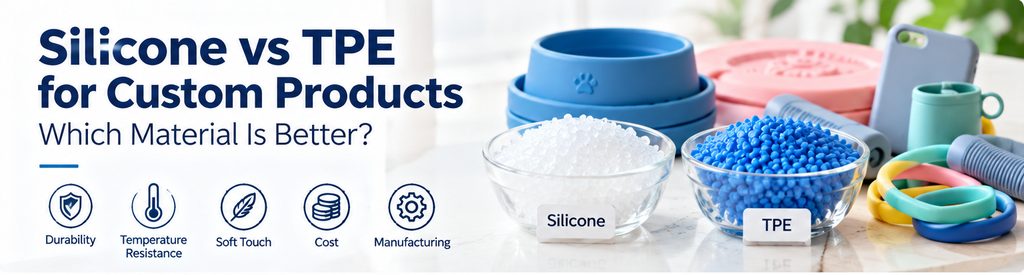
When developing a custom product, choosing the right material is one of the earliest and most important decisions.
Silicone and TPE are both widely used for flexible consumer products, soft-touch components, grips, seals, pet products, kitchen accessories, and many other applications.
At first glance, they can look very similar.
Both can be soft.
Both can be flexible.
Both can be molded into complex shapes.
Both are available in different colors and hardness levels.
However, silicone and TPE are not the same material, and they can behave very differently during product development and manufacturing.
So, which one should you choose?
The answer depends on your product application, temperature requirements, durability expectations, appearance, production process, order quantity, and target cost.
This guide compares silicone vs TPE for custom products and explains when each material may be the better choice.
Silicone is a synthetic polymer based on silicon, oxygen, carbon, and hydrogen.
It is widely used for products that require flexibility, durability, temperature resistance, and a soft rubber-like feel.
Depending on the application, different silicone materials and manufacturing processes can be selected.
Custom silicone products may be manufactured using processes such as compression molding and liquid silicone rubber injection molding.
Silicone is commonly used for:
منتجات المطبخ
Pet products
Seals and gaskets
المنتجات الاستهلاكية
Baby-related products
Medical-related components
إكسسوارات يمكن ارتداؤها
المنتجات الترويجية
Soft-touch components
What Is TPE?
TPE stands for Thermoplastic Elastomer.
TPE combines characteristics of thermoplastic materials with rubber-like flexibility.
Unlike traditional silicone rubber, many TPE materials can be processed using thermoplastic manufacturing methods such as injection molding and extrusion.
TPE is available in many different formulations, so its properties can vary significantly depending on the specific grade.
TPE is commonly used for:
Soft-touch grips
ملحقات الإلكترونيات الاستهلاكية
مكونات السيارات
Flexible housings
المقابض
Seals
Toys
المنتجات الاستهلاكية
Overmolded components
This flexibility makes TPE an attractive option for products where manufacturing efficiency, soft-touch performance, and target cost are important.
Silicone vs TPE: Quick Comparison
Before looking at each factor in detail, here is a simplified comparison.
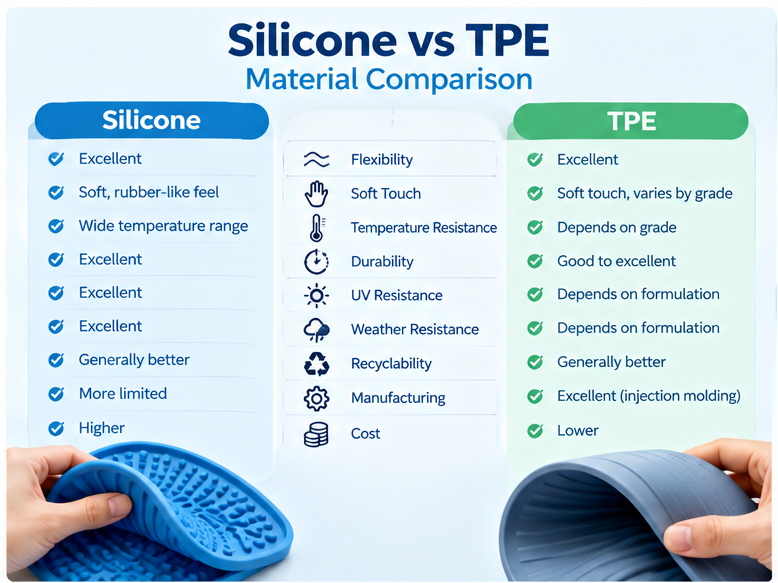
Property Silicone TPE
Flexibility Excellent Excellent
Soft-touch feel Excellent Excellent
Temperature resistance Generally excellent Depends on grade
Long-term elasticity Excellent Good to excellent
UV resistance Generally excellent Depends on formulation
Weather resistance Generally excellent Depends on formulation
Chemical resistance Generally excellent Depends on formulation
Recyclability More limited Generally better
Injection molding Yes, with suitable silicone processes Yes
Compression molding Common Less typical
Material cost Often higher Often lower
Color options Excellent Excellent
Overmolding Possible Very common
Design flexibility Excellent Excellent
The most important point is that TPE is a broad material family.
There is no single TPE performance profile.
A specific TPE grade may outperform silicone in one application, while silicone may be a much better choice in another.
Silicone vs TPE: Which Material Is More Flexible?
Both silicone and TPE can be manufactured in a wide range of hardness levels.
This means both materials can be used for:
Soft grips
Flexible covers
Flexible seals
Bending components
Protective parts
Soft-touch products
However, the type of flexibility can feel different.
Silicone often provides a more rubber-like and elastic feel.
TPE can also provide excellent flexibility, but its tactile characteristics depend heavily on the formulation.
For products where the user frequently squeezes, bends, stretches, or handles the material, physical testing is usually more useful than simply comparing material names.
When Silicone May Be Better
Silicone can be a strong choice when you need:
High elasticity
Consistent soft-touch performance
Long-term flexibility
Repeated deformation
Good performance across changing temperatures
When TPE May Be Better
TPE may be attractive when you need:
Flexible thermoplastic processing
Soft-touch overmolding
High-volume injection molding
Lower material cost
Easy integration with rigid plastic components
Silicone vs TPE: Which Has Better Temperature Resistance?
Temperature resistance is one area where silicone often has a major advantage.
Silicone can maintain useful mechanical properties across a relatively wide temperature range.
This makes silicone particularly attractive for products exposed to:
Heat
Cold
Hot water
Kitchen environments
Outdoor environments
Temperature cycling
TPE performance varies significantly by grade.
Some TPE materials have good temperature resistance, while others are better suited to normal room-temperature applications.
Therefore, you should not choose a TPE material based only on the general label “TPE.”
Ask your manufacturer for the specific material grade and technical specifications.
Silicone vs TPE: Which Is More Durable?
Durability depends on the application, but silicone is often selected when long-term environmental stability is important.
Silicone generally performs well against:
UV exposure
Weathering
Temperature changes
Repeated flexing
Aging
TPE can also be highly durable.
However, performance depends heavily on its formulation and the environment in which the product will be used.
For example, a TPE product designed for indoor consumer use may have very different performance characteristics from a specialized TPE used in automotive applications.
For an OEM project, the better question is not simply:
“Is TPE durable?”
Instead, ask:
“Does this specific TPE grade provide the required durability for my application?”
The same principle applies to silicone.
Silicone vs TPE: Which Feels Better?
Material feel is extremely important for consumer products.
Customers may immediately notice:
Softness
Grip
نسيج السطح
Stickiness
Elasticity
Smoothness
Friction
Tactile response
Silicone often has a distinctive soft, rubber-like feel.
TPE can also create an attractive soft-touch surface and may be easier to combine with rigid plastic components.
For products such as handles, grips, phone accessories, wearable products, consumer electronics accessories, and pet products, the final surface feel should be evaluated using physical samples.
A Practical Tip for OEM Buyers
Do not approve the material based only on a technical data sheet.
Ask your manufacturer to produce samples using the actual material and hardness you plan to use.
The difference between a specification sheet and a real product in your hand can be surprisingly large.
Silicone vs TPE: Which Is Better for Overmolding?
This is an area where TPE can have a strong advantage.
TPE is widely used for two-shot molding and overmolding applications, especially when combining soft material with rigid plastic components.
Examples include:
Soft-touch handles
Tool grips
Electronic housings
Consumer product handles
مكونات السيارات
TPE can often be processed together with thermoplastic substrates using established injection molding technologies.
Silicone can also be used in overmolding applications when its specific performance characteristics are required.
However, the bonding strategy, substrate compatibility, tooling, and production process need to be carefully evaluated.
Silicone vs TPE: Which Is Easier to Manufacture?
There is no universal winner because the manufacturing processes are different.
Silicone Manufacturing
Custom silicone products may use processes such as:
القولبة بالضغط
LSR injection molding
Specialized silicone molding processes
These processes are well suited to flexible rubber-like products.
TPE Manufacturing
TPE is a thermoplastic elastomer, so it can often be processed using conventional thermoplastic equipment.
Common processes include:
القولبة بالحقن
Extrusion
Blow molding for selected grades and applications
التشكيل الزائد
This can make TPE particularly attractive for high-volume production and products that integrate soft and rigid thermoplastic components.
Silicone vs TPE: Which Is More Cost-Effective?
Cost is one of the biggest reasons buyers compare silicone and TPE.
In many applications, TPE can offer a lower material and processing cost.
However, total project cost depends on much more than the raw material.
Important factors include:
التكلفة المادية
تكلفة العفن
وزن المنتج
حجم الإنتاج
Cycle time
عملية التصنيع
تعقيد المنتج
Number of components
التجميع
تشطيب السطح
التغليف
متطلبات الجودة
A cheaper material does not automatically create a cheaper finished product.
For example, a TPE product may have attractive material pricing but require a more complicated multi-material molding process.
Similarly, a silicone product may have a higher material cost but provide better durability or temperature performance for the intended application.
Silicone vs TPE for Food-Related Products
This is an important distinction.
Silicone is widely used for food-contact products when the correct food-contact grade and applicable regulatory requirements are selected.
Common examples include:
قوالب الخَبز
Kitchen tools
ملحقات تخزين الطعام
Feeding products
Kitchen mats
However, you should not assume that every silicone product is automatically food safe.
The specific material grade, manufacturing process, pigments, additives, and applicable regulations all matter.
TPE also includes grades suitable for certain food-contact applications, but suitability must be confirmed for the specific formulation and target market.
If food contact is involved, always tell the manufacturer this requirement before material selection.
Silicone vs TPE for Pet Products
Both materials can be used in pet products.
TPE may be suitable for:
Soft-touch toys
Flexible grips
Certain molded accessories
Overmolded pet products
Silicone can be especially attractive for:
Pet bowls
Slow feeder bowls
Lick mats
Feeding accessories
Flexible travel bowls
Pet mats
The right choice depends on the intended use, durability requirements, cleaning conditions, hardness, and applicable safety requirements.
For example, a silicone slow feeder bowl may prioritize flexibility, cleanability, temperature resistance, and long-term durability.
That is a very different requirement from a soft-touch toy component.
Silicone vs TPE for Consumer Products
For consumer products, the decision often comes down to the balance between performance, appearance, manufacturing process, and cost.
Silicone may be preferable when:
Temperature resistance is important
Long-term elasticity is required
Environmental stability matters
A premium rubber-like feel is desired
The product needs repeated deformation
TPE may be preferable when:
Cost is highly important
High-volume injection molding is required
Soft-touch overmolding is important
The product combines rigid plastic and soft material
Thermoplastic processing provides manufacturing advantages
Silicone vs TPE: Which Material Should You Choose?
There is no universal answer.
Instead, choose based on your product requirements.
Choose Silicone When:
High temperature resistance is important
Long-term elasticity is required
UV and weather resistance matter
The product needs a rubber-like premium feel
The product will be repeatedly flexed or squeezed
Food-contact or demanding consumer applications are involved
Long-term environmental stability is important
Consider TPE When:
Cost optimization is a major priority
High-volume injection molding is required
Soft-touch overmolding is important
A rigid plastic substrate will be combined with a flexible material
Thermoplastic manufacturing is advantageous
Recycling or thermoplastic processing requirements influence material selection
7 Questions to Ask Before Choosing Silicone or TPE
Before asking a manufacturer for a quotation, prepare answers to these questions.
- What Will the Product Be Used For?
Explain the actual application.
A kitchen product, pet accessory, electronic component, and automotive part may require completely different material properties.
- What Temperature Will the Product Experience?
Tell your manufacturer the expected minimum and maximum operating temperatures.
- Does the Product Contact Food?
If yes, state this before material selection.
- Does the Product Need to Be Very Flexible?
Explain how the product will bend, stretch, compress, or deform.
- Does the Product Need Soft-Touch Overmolding?
If the product combines rigid plastic with a soft exterior, TPE may deserve closer consideration.
- What Is the Expected Production Quantity?
Material and process selection can change depending on whether you need 1,000 pieces, 10,000 pieces, 100,000 pieces, or more.
- What Is Your Target Product Cost?
Your target price helps the manufacturer evaluate material, construction, tooling, and manufacturing options.
Silicone vs TPE: Don’t Choose the Material Too Early
One common mistake is deciding:
“I want silicone.”
before discussing the actual product requirements.
A better development process is:
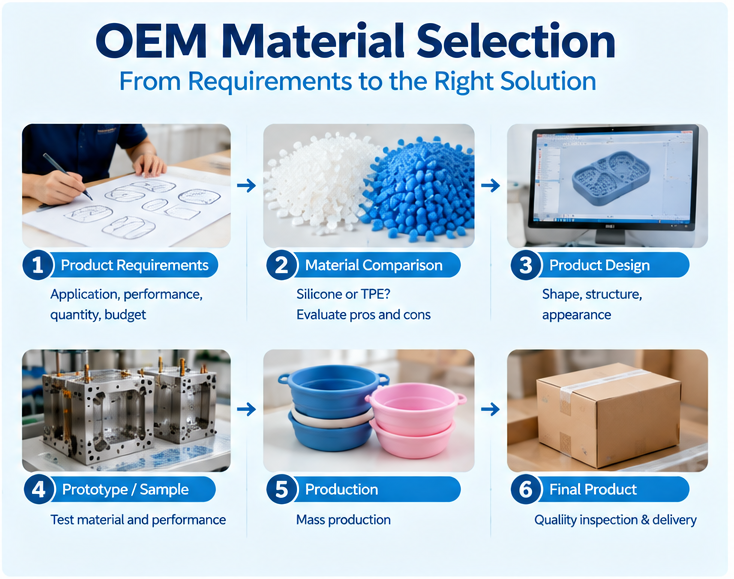
Product Requirements → Material Comparison → Product Design → Prototype → Material Testing → Mold Development → Mass Production
This approach allows the manufacturer to evaluate whether silicone, TPE, or another material is the best technical and commercial solution.
In some projects, silicone will clearly be the better choice.
In others, TPE may provide a better combination of cost and manufacturing efficiency.
And sometimes the best answer may be another material altogether.
How a Silicone Manufacturer Can Help With Material Selection
If you are developing a custom product, an experienced manufacturer should not simply ask:
“How many pieces do you need?”
They should also understand:
تطبيق المنتج
Required hardness
Temperature range
المرونة
Surface requirements
متطلبات اللون
Food-contact requirements
حجم الإنتاج
Target cost
هيكل القالب
Assembly requirements
This information helps determine whether silicone is actually the right material for your project.
الأفكار النهائية
Silicone and TPE are both valuable materials for custom products, but they are designed around different manufacturing and performance characteristics.
Silicone is often the stronger choice when you prioritize temperature resistance, long-term elasticity, environmental stability, and a premium rubber-like feel.
TPE can be an excellent option when cost efficiency, thermoplastic processing, soft-touch overmolding, and high-volume production are more important.
The best material is not necessarily the cheapest material.
It is the material that provides the right combination of performance, manufacturing efficiency, product appearance, durability, and total cost for your application.
If you are developing a new custom product and are unsure whether silicone or TPE is the better option, discussing the product requirements with an experienced manufacturer before finalizing the design can help you avoid expensive changes later.
Ready to Choose the Right Material for Your Custom Product?
Have a custom product idea but are not sure whether silicone or TPE is the right material?
Share your product design, application, target quantity, required hardness, and expected performance requirements with our team.
We can help evaluate the material, product design, molding process, and production requirements for your project.
Start your custom product development today and find the right material before investing in tooling.
 English
 Chinese
 Japanese
 Spanish
 French
 Arabic
 Russian
 Portuguese
 Belarusian