
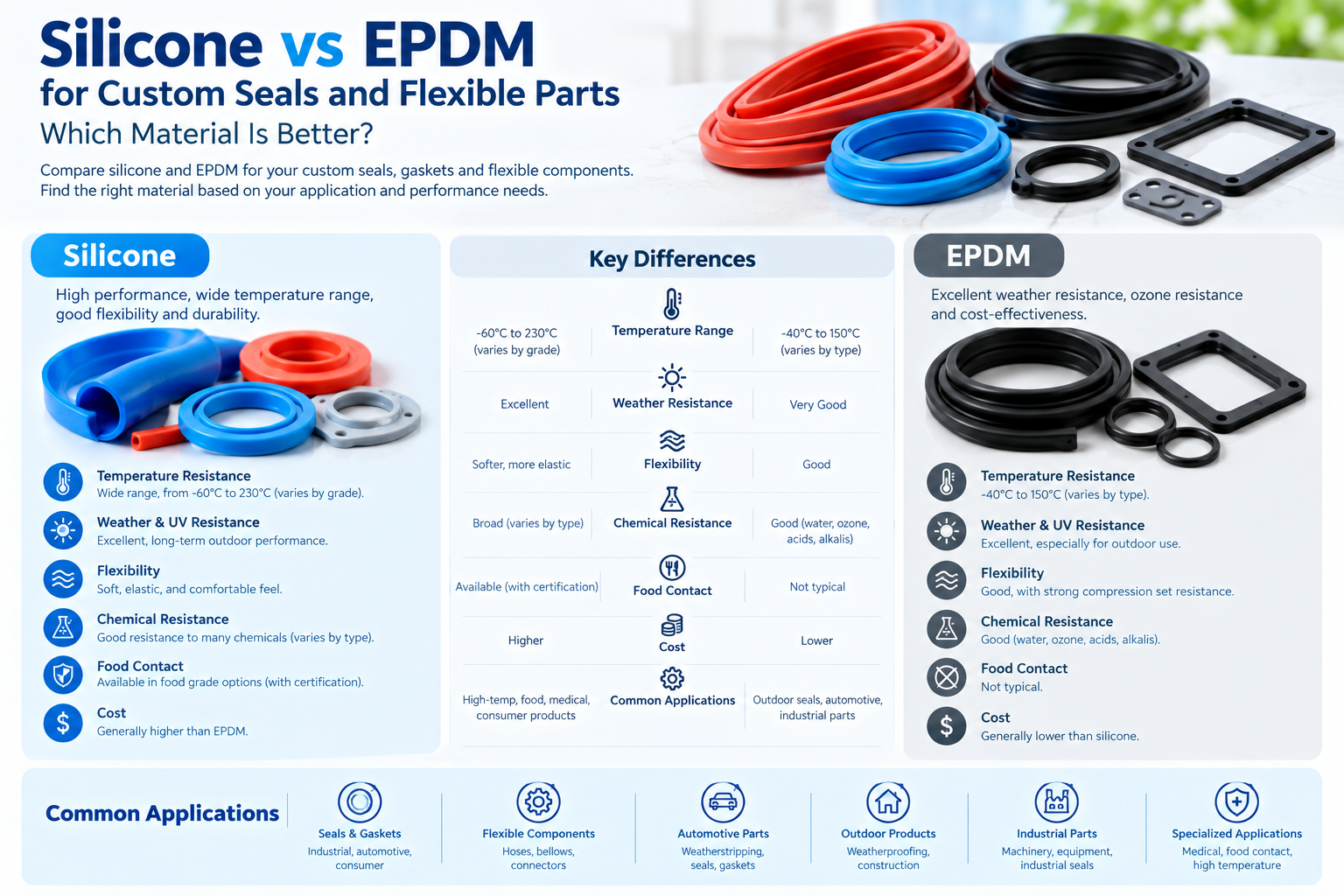

When developing a custom seal, gasket, flexible component, or rubber-like part, choosing the right material can have a major impact on product performance.
Silicone and EPDM are both widely used elastomeric materials, but they are not interchangeable in every application.
They can both provide flexibility, weather resistance, and sealing performance, but their strengths are different.
For OEM buyers, the right choice depends on factors such as operating temperature, outdoor exposure, flexibility, compression, chemical environment, product geometry, and total cost.
So, which is better: silicone or EPDM?
The answer depends on what your custom product needs to do.
This guide compares silicone vs EPDM for custom seals and flexible parts, including temperature resistance, weather resistance, flexibility, durability, chemical performance, cost, manufacturing, and common OEM applications.
What Is Silicone?
Silicone is a high-performance elastomer widely used for custom molded products, seals, gaskets, flexible components, consumer products, and many other applications.
One of its most important advantages is its broad temperature performance.
Silicone can also provide:
- Good flexibility
- Good weather resistance
- Good UV resistance
- Good aging resistance
- Soft-touch performance
- Stable performance across a wide temperature range
- Customizable hardness
- Good electrical insulation
Silicone is available in different formulations and hardness levels, allowing manufacturers to develop products with different combinations of flexibility, firmness, and durability.
For OEM products, silicone can also be molded into complex shapes and customized with different colors, textures, logos, and surface finishes.
What Is EPDM?
EPDM stands for ethylene propylene diene monomer.
It is a synthetic rubber commonly used for seals, gaskets, weatherstripping, hoses, automotive components, and industrial applications.
EPDM is particularly well known for its resistance to:
- Weather
- Ozone
- UV exposure
- Water
- Moisture
- Outdoor environmental conditions
This makes EPDM a popular material for outdoor sealing applications.
EPDM can also provide good flexibility and compression performance, making it suitable for many gasket and sealing applications.
However, EPDM and silicone have different temperature and chemical performance characteristics.
Silicone vs EPDM: Quick Comparison
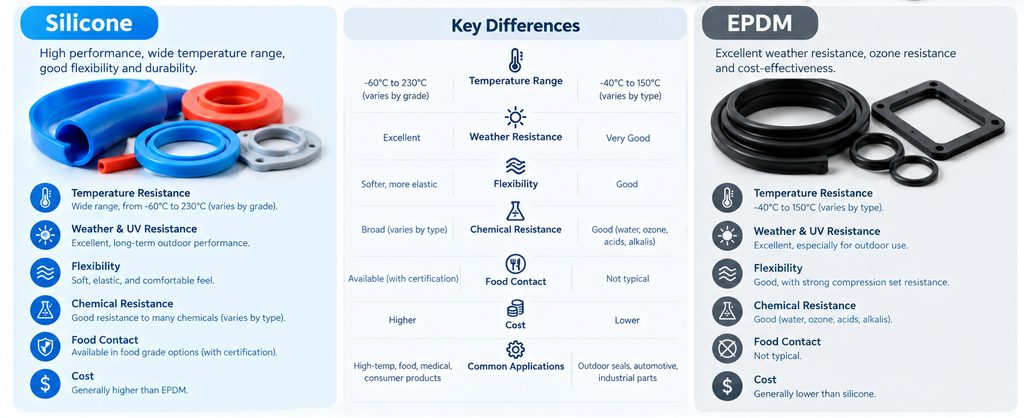
The two materials can both be suitable for custom seals and flexible components, but their strengths are different.
سيليكون
Best known for:
- Wide temperature performance
- المرونة
- Weather resistance
- UV and ozone resistance
- Soft-touch applications
- Electrical insulation
- المنتجات الاستهلاكية
- Food-contact applications when the appropriate grade is used
EPDM
Best known for:
- Outdoor applications
- Weather resistance
- Ozone resistance
- Water resistance
- Automotive applications
- Industrial sealing
- Cost-effective rubber components
There is no universal winner.
The correct material depends on the environment where the finished product will be used.
Silicone vs EPDM Temperature Resistance
Temperature is one of the most important differences to consider.
Silicone is generally well suited to applications involving a wide range of temperatures.
It can maintain useful flexibility under both high and low temperature conditions, depending on the specific silicone formulation.
EPDM also has good temperature performance, but its practical operating range depends on the formulation and application.
For applications involving repeated exposure to high temperatures, silicone may provide an advantage.
For outdoor applications where temperature exposure is moderate and weather resistance is the main concern, EPDM can be a very practical choice.
The actual temperature requirements should always be confirmed using the specific material specification rather than relying on a general material label.
🔗 INTERNAL LINK → silicone temperature limit
For a custom product exposed to heat or cold, understanding the حد درجة حرارة السيليكون is an important part of material selection.
Silicone vs EPDM for Outdoor Applications
Both silicone and EPDM can perform well outdoors.
EPDM is particularly well known for outdoor sealing because of its strong resistance to:
- Ozone
- UV exposure
- Rain
- Moisture
- Weathering
This is one reason EPDM is commonly used for automotive weatherstripping, outdoor seals, and building-related applications.
Silicone also provides strong resistance to weathering, UV exposure, and aging.
Therefore, the decision should not be based on outdoor exposure alone.
Other factors such as temperature, mechanical requirements, product design, and chemical exposure should also be considered.
Silicone vs EPDM UV Resistance
UV exposure can cause some rubber materials to age, harden, crack, or lose their mechanical properties over time.
Both silicone and EPDM can provide good resistance to UV exposure.
EPDM is especially well known for outdoor weather resistance.
Silicone is also highly resistant to environmental aging and can be a good option when outdoor exposure is combined with demanding temperature conditions.
For outdoor products, the actual material formulation and product design are just as important as the basic material category.
Silicone vs EPDM Flexibility
Both materials can be flexible.
However, the final flexibility of a custom product depends on more than material selection.
It can also be affected by:
- Material hardness
- سماكة المنتج
- الهندسة
- سماكة الجدار
- حجم المنتج
- Reinforcement
- تصميم القوالب
A thin EPDM gasket may be very flexible.
A thick silicone component may feel much firmer even when the silicone material itself is relatively soft.
This is why OEM buyers should evaluate material hardness and product geometry together.
For custom silicone parts, the appropriate silicone hardness should be selected according to the product’s function, thickness, flexibility, and application.
Silicone vs EPDM for Seals and Gaskets
Both materials can be used for seals and gaskets.
The better choice depends on the sealing environment.
Silicone may be suitable when the product requires:
- Wide temperature performance
- Flexible sealing
- Long-term environmental stability
- Soft-touch characteristics
- Certain electrical insulation properties
EPDM may be suitable when the product requires:
- Strong outdoor weather resistance
- Water resistance
- Ozone resistance
- Automotive sealing
- Cost-effective gasket production
The seal geometry is also extremely important.
A material that performs well in one gasket design may not perform equally well in another.
Silicone vs EPDM Chemical Resistance
Chemical exposure is another important factor.
Neither silicone nor EPDM should be considered universally resistant to every chemical.
Their performance can vary depending on:
- Chemical type
- Concentration
- Temperature
- Exposure time
- Pressure
- Material formulation
EPDM is generally well suited to water, steam, and many outdoor environments.
Silicone can perform well in many applications but may not be the best choice for every chemical environment.
For a custom seal, the manufacturer should evaluate the actual chemicals that the product will encounter instead of selecting a material based only on general compatibility charts.
Silicone vs EPDM Water Resistance
EPDM is widely used in applications where resistance to water and moisture is important.
This makes it useful for:
- Outdoor seals
- Automotive weatherstripping
- Building seals
- Water-related applications
- Industrial gaskets
Silicone can also provide good resistance to water and moisture.
Therefore, water exposure alone usually does not determine which material is better.
The decision should also consider temperature, mechanical performance, chemical exposure, and product requirements.
Silicone vs EPDM for Automotive Applications
EPDM is widely used in automotive sealing applications because of its weather resistance and ability to handle outdoor environmental exposure.
It can be used for applications such as:
- Door seals
- Window seals
- Weatherstripping
- Hose-related components
- Gaskets
Silicone is also used in automotive and transportation applications where its temperature performance, flexibility, or other material characteristics provide an advantage.
For automotive projects, the exact application is especially important.
A material suitable for an exterior weather seal may not be suitable for an engine-related component.
The manufacturer should therefore evaluate the actual operating environment before recommending a material.
Silicone vs EPDM for Consumer Products
Silicone is often more attractive for consumer products because it can provide a soft, clean, customizable appearance.
It is commonly used for:
- Consumer accessories
- منتجات المطبخ
- Pet products
- إكسسوارات يمكن ارتداؤها
- Flexible covers
- المنتجات الترويجية
EPDM is more commonly associated with industrial and sealing applications, although it can also be used for certain consumer or technical components.
For consumer-facing products, factors such as surface feel, color, appearance, hardness, and brand presentation may make silicone a more attractive option.
Silicone vs EPDM for Food Contact
This is an area where the two materials should not be treated as interchangeable.
Certain silicone formulations are available for food-contact applications when they meet the applicable requirements.
EPDM is not automatically a food-contact material simply because it is resistant to water or weather.
For products that directly contact food, buyers should specify the required material grade and applicable regulatory requirements from the beginning of product development.
For food-contact products, choosing the appropriate food grade silicone specification is more important than simply asking whether a material is “silicone.”
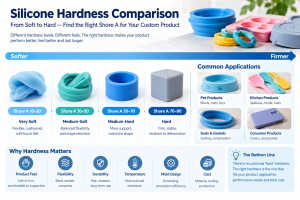
Silicone vs EPDM Hardness
Both silicone and EPDM can be manufactured in different hardness levels.
Hardness affects how the finished product feels and performs.
A softer material may provide:
- Greater flexibility
- Easier compression
- Softer contact
- Better conformability
A harder material may provide:
- Greater shape retention
- Higher resistance to deformation
- Firmer support
However, hardness should never be evaluated separately from product thickness and geometry.
For example, a thin gasket can remain flexible even when made from a relatively firm material.
This is why material selection and product design should be evaluated together.
How Product Design Affects Silicone vs EPDM Selection
Material selection should not happen independently from product design.
Product geometry can affect:
- المرونة
- Compression
- Sealing
- إخراج القالب
- سماكة الجدار
- استهلاك المواد
- Production cost
A complex shape may require a different molding strategy from a simple flat gasket.
For custom silicone products, the product design should therefore be reviewed before finalizing the mold and material specification.
Good silicone product design considers material properties, geometry, manufacturing requirements, and the final application together.
Silicone vs EPDM Mold Design
The molding process and tooling requirements depend on the selected material, product geometry, and production method.
For silicone products, mold design can influence:
- خطوط الفصل
- Venting
- إخراج القالب
- Product appearance
- تسوس الأسنان
- كفاءة الإنتاج
For complex silicone components, these factors should be considered before the mold is manufactured.
The relationship between product geometry and silicone mold design can directly affect tooling cost, product quality, and production efficiency.
Silicone vs EPDM Cost
Cost is one of the most common reasons buyers compare silicone and EPDM.
In many applications, EPDM can provide a cost-effective solution, especially for high-volume industrial sealing applications.
However, material price should not be the only factor considered.
The total product cost can include:
- Raw material
- الأدوات
- الإنتاج
- Scrap
- فحص الجودة
- Secondary processing
- التغليف
- Testing
- حجم الإنتاج
A cheaper material may not necessarily produce the lowest total project cost if it does not meet the required performance.
For custom silicone products, it is useful to evaluate the complete cost of custom silicone products rather than comparing material prices alone.
Which Material Is Better for Mass Production?
Both silicone and EPDM can be suitable for mass production.
The better choice depends on the product and manufacturing process.
For silicone products, common manufacturing methods may include compression molding and injection molding depending on the silicone type and product requirements.
For EPDM and other rubber products, molding and vulcanization processes are commonly used.
Production volume, geometry, automation requirements, tooling cost, and cycle time can all influence the final decision.
The material should therefore be selected before the production process is finalized, but both should be evaluated together.
Silicone vs EPDM for OEM Products
For OEM buyers, material selection should start with the application rather than the supplier’s standard material list.
Before requesting a quotation, define:
- Operating temperature
- Outdoor exposure
- UV exposure
- Chemical exposure
- Water exposure
- Required flexibility
- Required hardness
- أبعاد المنتج
- Expected service life
- كمية الإنتاج
- Target cost
Once these requirements are clear, the manufacturer can recommend whether silicone, EPDM, or another elastomer is more appropriate.
How to Choose Between Silicone and EPDM
A simple decision process can help.
Choose Silicone When:
Silicone may be a strong candidate when you need:
- Wide temperature performance
- Flexible custom products
- Soft-touch surfaces
- Food-contact options
- ألوان مخصصة
- Consumer-facing appearance
- Strong weather and aging resistance
- Electrical insulation
Choose EPDM When:
EPDM may be a strong candidate when you need:
- Outdoor weather resistance
- Ozone resistance
- Water resistance
- Automotive sealing
- Industrial gaskets
- Cost-effective rubber components
These are general guidelines.
The final material should always be selected based on the actual product requirements.
Common Mistakes When Choosing Silicone vs EPDM
Mistake 1: Choosing Only Based on Material Price
The cheapest material is not necessarily the cheapest complete solution.
Performance, tooling, production, and service life should also be considered.
Mistake 2: Assuming Both Materials Are Interchangeable
Silicone and EPDM have different material characteristics.
Replacing one with the other may change product performance.
Mistake 3: Ignoring Temperature Requirements
Temperature can be one of the most important factors in material selection.
Mistake 4: Ignoring Chemical Exposure
A material that performs well in outdoor conditions may not perform well when exposed to specific chemicals.
Mistake 5: Choosing Material Before Product Design
Material and product geometry should be evaluated together.
Mistake 6: Skipping Physical Samples
For custom products, samples can reveal differences in flexibility, hardness, appearance, compression, and overall performance.
How to Test Silicone vs EPDM Before Mass Production

If you are uncertain about the best material, testing samples can be much more useful than comparing specifications alone.
A practical process is:
Step 1: Define the Application
Identify the actual operating environment.
Step 2: Identify Critical Performance Requirements
Determine temperature, flexibility, sealing, chemical exposure, and expected service life.
Step 3: Select Candidate Materials
Compare silicone, EPDM, or other suitable materials.
Step 4: Produce Samples
Use representative product geometry whenever possible.
Step 5: Test the Samples
Evaluate:
- المرونة
- Compression
- Shape retention
- Surface feel
- Temperature performance
- Chemical exposure
- Weathering
- Sealing performance
Step 6: Select the Final Material
Choose the material that provides the best balance between performance, manufacturing requirements, and total cost.
Why Working With an Experienced Silicone Manufacturer Matters
Material selection becomes easier when the manufacturer understands both the material and the manufacturing process.
An experienced manufacturer can help evaluate:
- تصميم المنتج
- Material hardness
- Silicone formulation
- تصميم القوالب
- Manufacturing method
- أخذ العينات
- مراقبة الجودة
- Production consistency
Instead of asking only:
“How much does silicone cost?”
ask:
“Which material is most suitable for my product requirements, and why?”
That question can lead to a much better OEM solution.
Choosing the right silicone manufacturer can help you evaluate material selection, product design, tooling, sampling, and mass production as one complete process.
الأفكار النهائية
Silicone and EPDM are both useful elastomeric materials, but they are designed to solve different types of problems.
Silicone is often a strong choice when temperature range, flexibility, consumer appearance, food-contact options, or soft-touch performance are important.
EPDM can be an excellent choice for outdoor seals, automotive weatherstripping, water-related applications, and cost-effective industrial components.
There is no universal “best” material.
The right choice depends on:
Application → Temperature → Environment → Flexibility → Chemical Exposure → Product Design → Manufacturing → Cost
For OEM buyers, making this decision before tooling and mass production can help reduce development risk and avoid expensive material changes later.
Ready to Develop Your Custom Silicone Product?
If you are developing a custom seal, gasket, flexible component, consumer product, pet product, kitchen product, or other silicone part, choosing the right material is an important first step.
Share your product drawings, 3D files, reference samples, dimensions, operating conditions, and expected production quantity.
An experienced silicone manufacturer can help you evaluate the material, hardness, mold design, production method, and sampling requirements before moving into mass production.
 English
 Chinese
 Japanese
 Spanish
 French
 Arabic
 Russian
 Portuguese
 Belarusian