

When developing a custom silicone product, material selection is one of the most important decisions to make before mass production.
One specification that is often overlooked is silicone hardness.
Two products can use the same type of silicone but feel completely different because they have different hardness levels. One may be soft and flexible, while another may be firm and resistant to deformation.
For OEM and private-label products, choosing the right hardness can affect product feel, flexibility, durability, mold design, production performance, and even the final product cost.
So, how do you choose the right silicone hardness for your custom product?
This guide explains silicone hardness, Shore A ratings, common hardness ranges, product applications, mold considerations, sampling, and the key questions you should discuss with your silicone manufacturer.
What Is Silicone Hardness?
Silicone hardness describes how resistant a silicone material is to indentation or deformation.
In simple terms, hardness helps determine whether a silicone product feels soft, flexible, firm, or relatively rigid.
Напрыклад:
A soft silicone product may bend easily when squeezed.
A medium-hard silicone product may provide a balance between flexibility and shape retention.
A hard silicone product may maintain its shape more effectively and resist deformation.
However, hardness should not be considered by itself.
Product thickness, geometry, material formulation, temperature, and application can all affect how a finished silicone product feels and performs.
This is why selecting the correct hardness during product development is more important than simply choosing a number from a material specification sheet.
What Is Shore A Hardness?
Silicone hardness is commonly measured using the Shore A hardness scale.
Shore A is widely used for elastomeric materials such as silicone and other flexible rubber-like materials.
A lower Shore A number generally indicates a softer material, while a higher Shore A number indicates a harder material.
Напрыклад:
Shore A 20 → very soft and flexible
Shore A 30 → soft and flexible
Shore A 50 → medium hardness
Shore A 70 → relatively hard
Shore A 80–90 → hard and firm
The actual performance of a silicone product depends on more than the Shore A number, but the rating provides a useful starting point when discussing material selection with a manufacturer.
Does Lower Shore A Mean Softer Silicone?
Yes, generally.
A lower Shore A value means the silicone is softer and easier to deform.
A higher Shore A value means the silicone is firmer and more resistant to deformation.
However, you should not assume that a lower hardness is always better.
For example, a pet feeding mat may benefit from flexibility, while a sealing component may require more support and compression resistance.
The correct hardness depends on what the product needs to do.
This is especially important for custom products because product dimensions and geometry can significantly affect the final feel.
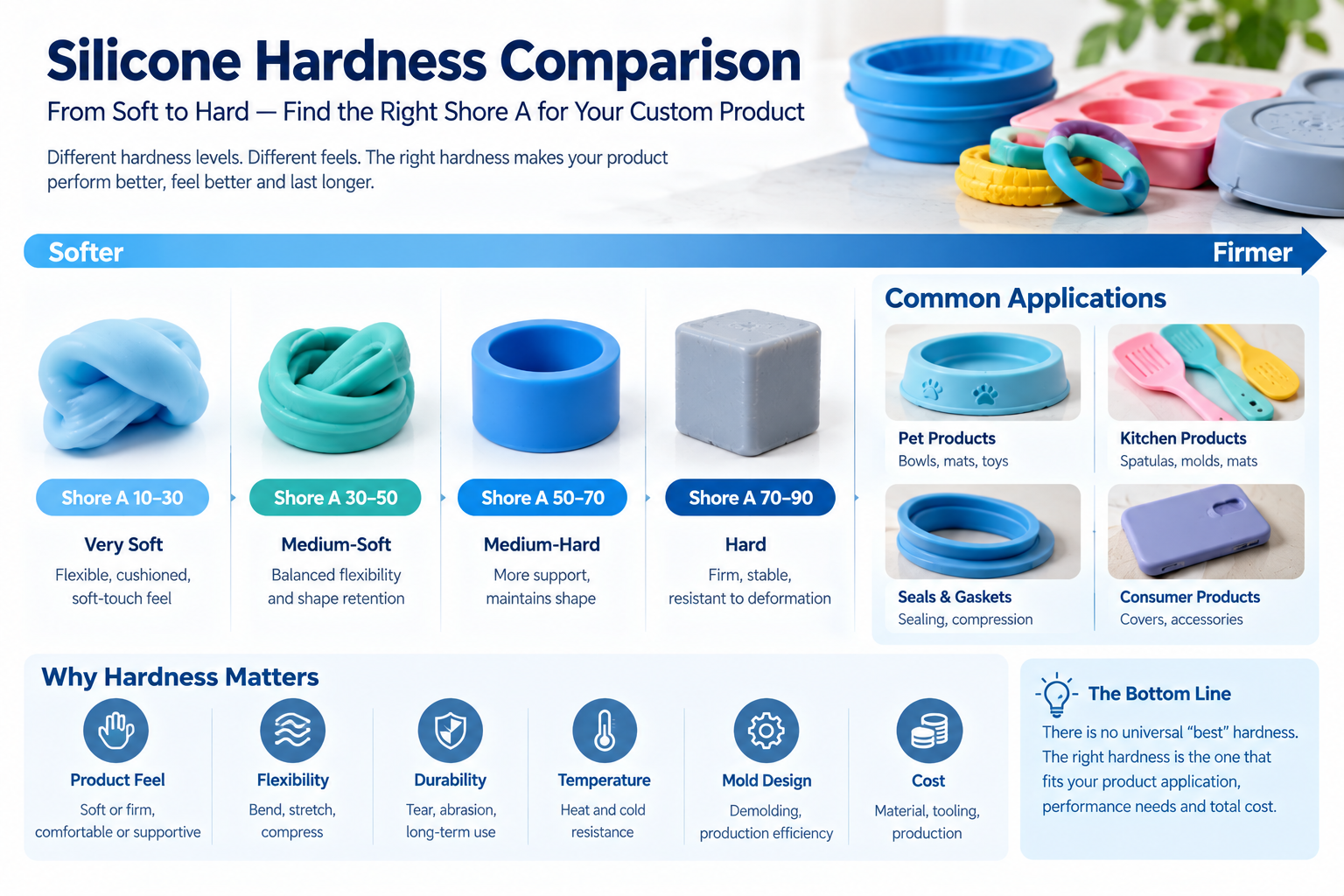
Common Silicone Hardness Ranges
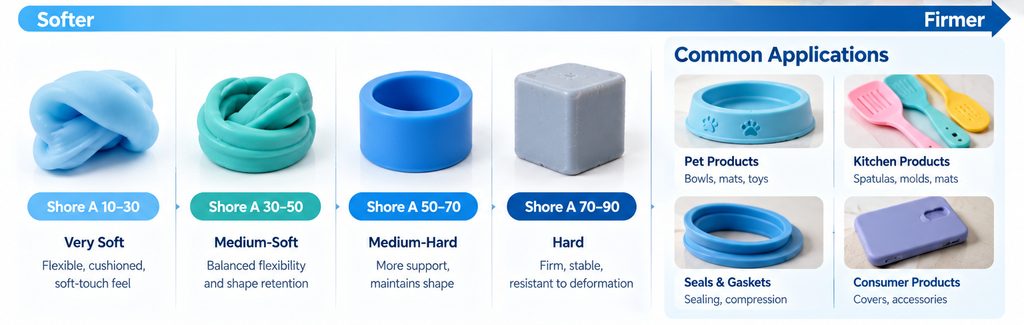
There is no single hardness range that works for every silicone product.
The following ranges can be used as a general reference.
Shore A 10–30: Very Soft Silicone
Very soft silicone provides excellent flexibility and a soft-touch feel.
It may be suitable for:
- Soft-touch products
- Flexible parts
- Cushioned components
- Certain baby or comfort products
- Flexible seals
- Soft promotional products
Very soft silicone can feel pleasant in the hand, but it may not provide enough structural support for products that need to maintain their shape.
Shore A 30–50: Medium-Soft Silicone
This range provides a balance between flexibility and shape retention.
It is commonly considered for products such as:
- Pet products
- Flexible kitchen accessories
- Сіліконавыя дыванкі
- Flexible covers
- Consumer accessories
- Soft promotional products
For many custom silicone products, this range can be a practical starting point for sampling.
Shore A 50–70: Medium-Hard Silicone
Medium-hard silicone provides more support while maintaining a certain level of flexibility.
It may be suitable for:
- Structural silicone components
- Some kitchen tools
- Product housings
- Seals and gaskets
- Consumer accessories
- Custom molded components
This range can be useful when the product needs to maintain its shape while still providing some flexibility.
Shore A 70–90: Hard Silicone
Hard silicone is more resistant to deformation and provides a firmer feel.
It may be considered for:
- Structural components
- Firm seals
- Прамысловыя дэталі
- Certain consumer products
- Components requiring higher shape retention
Harder does not automatically mean stronger in every situation, so material selection should always be based on the actual product requirements.
How Does Silicone Hardness Affect Product Feel?
Product feel is one of the easiest ways for consumers to notice silicone hardness.
A soft silicone product may feel smooth, flexible, and comfortable.
A medium-hard product may feel more supportive and stable.
A hard silicone product may feel firm and more resistant to pressure.
For consumer products, this difference can directly influence the user experience.
For example, a silicone pet bowl, kitchen utensil, phone accessory, or wearable product may need a very different tactile experience from an industrial sealing component.
Therefore, when choosing silicone hardness, it is useful to ask:
How should the finished product feel in the customer’s hands?
That question can be just as important as the technical specifications.
How Does Silicone Hardness Affect Flexibility?
Generally, softer silicone provides greater flexibility, while harder silicone provides greater resistance to deformation.
However, flexibility is also affected by product thickness and geometry.
For example, a thin silicone wall can be flexible even when the material itself has relatively high hardness.
Similarly, a thick product made from soft silicone may still feel relatively firm.
This is why hardness should always be evaluated together with product dimensions and design.
The right silicone product design should consider hardness, thickness, flexibility, geometry, and the intended application together.
How to Choose Silicone Hardness for Pet Products
Pet products are a good example of why silicone hardness needs to be selected according to application.
A pet product may need to be soft and flexible, but it may also need enough structural support to remain stable during everyday use.
Silicone Pet Bowls
A silicone pet bowl usually needs a balance between flexibility and shape retention.
If the silicone is too soft, the bowl may collapse or deform easily.
If it is too hard, the product may lose some of the flexibility that makes silicone attractive for storage and transportation.
For brands developing custom silicone pet bowls, material hardness should be considered together with bowl thickness, rim design, base structure, and intended use.
Silicone Slow Feeder Bowls
Slow feeder bowls usually contain raised sections, channels, or internal structures.
The hardness needs to provide enough support to maintain these shapes while still providing a practical silicone feel.
Silicone Lick Mats
Lick mats often require flexibility so that they can be handled, cleaned, stored, or rolled.
A softer silicone may be appropriate, but the final hardness should still provide enough stability for the product’s intended use.
How to Choose Silicone Hardness for Kitchen Products
Silicone kitchen products also require different hardness levels depending on their function.
For example, a silicone spatula needs flexibility, while a silicone baking mold needs enough structure to hold its shape during handling.
Different custom silicone kitchen products may therefore require different hardness levels depending on flexibility, shape retention, thickness, and application.
Silicone Spatulas
Silicone spatulas usually need enough flexibility to bend against the surface of cookware.
A material that is too hard may make the product less effective during use.
Silicone Baking Molds
Baking molds require a balance between flexibility and structural stability.
The mold needs to release the finished food easily while still maintaining its shape during filling, moving, baking, and cooling.
Silicone Kitchen Mats
Kitchen mats can use different hardness levels depending on whether they are designed primarily for cushioning, heat protection, grip, or structural support.
How to Choose Silicone Hardness for Silicone Seals
Silicone seals and gaskets have different requirements from consumer products.
The material may need to compress effectively while maintaining sealing performance over time.
In this case, hardness can influence:
- Compression behavior
- Sealing performance
- Deformation
- Installation
- Product durability
- Temperature performance
The correct hardness should therefore be selected based on the actual sealing environment rather than simply choosing the softest or hardest available material.
How Does Silicone Hardness Affect Mold Design?
Silicone hardness can influence the way a product behaves during molding and demolding.
Factors such as product geometry, undercuts, wall thickness, draft angles, parting lines, and demolding requirements should be considered during product development.
Silicone hardness can affect demolding, parting lines, draft angles, and other aspects of silicone mold design.
For complex silicone products, material selection and mold design should therefore be discussed together instead of being treated as two completely separate decisions.
Can Changing Silicone Hardness Change the Product Cost?
It can.
Silicone hardness is only one factor affecting the final price.
Material formulation, product size, weight, mold design, tooling requirements, production quantity, colors, packaging, and quality requirements can all influence the final OEM price.
For example, a more complex product may require more expensive tooling regardless of whether the silicone is soft or hard.
The best approach is to evaluate the complete product specification instead of comparing hardness alone.
Material type, product size, tooling, production volume, and other factors can all influence the cost of custom silicone products.
Does Silicone Hardness Affect Product Durability?
Hardness can influence product performance, but harder silicone does not automatically mean a product will last longer.
Durability also depends on:
- Silicone formulation
- Геаметрыя прадукту
- Таўшчыня сцяны
- Tear resistance
- Temperature exposure
- Chemical exposure
- Frequency of use
- Manufacturing quality
For example, a very hard material may provide excellent shape retention but may not be the best choice for a product that needs repeated bending.
The correct material is the one that provides the right combination of flexibility, strength, durability, and application performance.
Silicone Hardness vs Silicone Flexibility
These two properties are closely related, but they are not exactly the same.
A lower hardness usually makes silicone easier to deform.
However, the actual flexibility of a finished product also depends on its:
- Таўшчыня
- Форма
- Геаметрыя
- Structural support
- Material formulation
This means two products made from the same Shore A silicone can feel completely different if their designs are different.
For OEM projects, material testing should therefore be performed on the actual product design rather than relying only on the material specification.
Should You Choose Silicone Hardness Before Mold Design?
Not necessarily.
In many custom projects, hardness and mold design should be developed together.
The product geometry may influence the appropriate hardness, while the selected hardness may influence demolding and production behavior.
For example, a product with very thin walls may require a different hardness from a thick structural component.
The best approach is to discuss:
Product design → material → hardness → mold → sampling → testing → mass production
as one connected development process.
The final manufacturing method may also depend on the material and product design.
For example, different products may be better suited to different silicone molding processes depending on geometry, production volume, and performance requirements.
How to Test Silicone Hardness Before Mass Production

Choosing a hardness number from a specification sheet is not enough.
For a custom product, physical samples should be tested before mass production.
Step 1: Define the Product Requirement
First, determine what the product needs to do.
Ask:
- Does it need to bend?
- Does it need to maintain its shape?
- Does it need a soft-touch feel?
- Does it need compression resistance?
- Will it be exposed to high temperatures?
- Will it be used repeatedly?
Step 2: Select a Preliminary Hardness
Based on the application, choose one or more possible Shore A hardness levels.
For example, you may start with Shore A 30, 50, and 70 for comparison.
Step 3: Produce Samples
Ask your manufacturer to produce samples using the actual product design whenever possible.
Testing a material sample alone may not accurately represent how the finished product will feel.
Step 4: Test the Product
Evaluate:
- Гнуткасць
- Firmness
- Surface feel
- Shape retention
- Compression
- Tear resistance
- Ease of use
- Overall customer experience
Step 5: Adjust the Material
If the sample is too soft or too hard, discuss alternative hardness levels with the manufacturer.
Sometimes a small change in hardness can significantly improve the user experience.
Step 6: Approve the Final Specification
Once the sample meets the product requirements, confirm the final material hardness before mass production.
This specification should then be included in the production requirements so that the material remains consistent between production batches.
7 Questions to Ask Your Silicone Manufacturer About Hardness
Before starting mass production, ask your manufacturer these questions.
1. What Shore A Hardness Do You Recommend?
Ask the manufacturer to explain why a specific hardness is suitable for your product.
2. Can You Provide Different Hardness Samples?
If you are unsure, comparing several samples can be much more useful than choosing one hardness based on a specification sheet.
3. Will Hardness Affect the Mold Design?
Ask whether the selected hardness will influence demolding, parting lines, undercuts, or other tooling considerations.
4. How Will Hardness Affect Product Feel?
Your manufacturer should be able to explain how different hardness levels may change the tactile experience.
5. Will the Hardness Affect Product Performance?
Ask how the selected hardness may influence flexibility, durability, compression, and shape retention.
6. Does the Hardness Affect Cost?
Material selection, tooling, and production requirements can all influence the final quotation.
7. Can the Hardness Be Controlled During Mass Production?
For OEM projects, consistency is important.
The hardness specification should be clearly defined and controlled during production and quality inspection.
Common Mistakes When Choosing Silicone Hardness
Mistake 1: Choosing the Hardness Based Only on a Number
A Shore A number is useful, but it does not tell the entire story.
Always consider the finished product.
Mistake 2: Assuming Softer Is Always Better
Soft silicone may feel comfortable, but it may not provide enough structural support.
Mistake 3: Assuming Harder Means More Durable
Hardness and durability are different properties.
A harder material is not automatically the best material for repeated bending or other demanding applications.
Mistake 4: Ignoring Product Thickness
Product thickness can significantly affect flexibility and perceived hardness.
Mistake 5: Choosing Material Before Product Design
Material and product design should be developed together.
Памылка 6: Прапуск фізічных узораў
This is one of the most common mistakes in custom silicone product development.
A sample allows you to evaluate the actual product rather than relying only on specifications.
How to Choose the Right Silicone Hardness for Your Product
A practical selection process looks like this:
1. Define the application
Understand how the product will be used.
2. Identify the required product feel
Decide whether it should feel soft, flexible, firm, or highly supportive.
3. Consider product geometry
Review thickness, walls, curves, undercuts, and structural features.
4. Select several possible Shore A levels
Instead of choosing only one option, consider two or three candidates when possible.
5. Make physical samples
Test the actual product design.
6. Compare performance
Evaluate flexibility, durability, shape retention, and user experience.
7. Confirm the final specification
Approve the final hardness before mass production.
This process can help reduce the risk of discovering material problems after tooling and mass production have already started.
Why Working With an Experienced Silicone Manufacturer Matters
Choosing silicone hardness is much easier when your manufacturer understands both material properties and product manufacturing.
An experienced manufacturer can help evaluate:
- Геаметрыя прадукту
- Цвёрдасць сілікону
- Material formulation
- Дызайн формы
- Вытворчы працэс
- Збор пробаў
- Кантроль якасці
- Паслядоўнасць вытворчасці
Choosing the right hardness is easier when you work with an experienced silicone manufacturer that can provide material recommendations, samples, testing, and production support.
A good manufacturer should not simply ask you which hardness number you want.
They should also ask what the product needs to do.
Заключныя думкі
There is no universal “best” silicone hardness.
The right hardness depends on the product’s application, geometry, flexibility requirements, durability expectations, user experience, and manufacturing process.
For some products, Shore A 30 may provide the right balance of softness and flexibility.
For others, Shore A 50 or 70 may provide better support and shape retention.
The most reliable approach is to test different hardness levels using actual product samples before moving into mass production.
If you are developing a custom silicone product and are unsure which hardness to choose, working with an experienced OEM manufacturer can help you evaluate the material, product design, mold, and production requirements together.
Ready to Develop Your Custom Silicone Product?
Have a silicone product idea but are not sure which hardness, material, or manufacturing process is right for it?
A professional silicone manufacturer can help you evaluate the product design, recommend suitable material hardness, develop samples, and prepare the project for mass production.
Share your product drawings, 3D files, reference samples, dimensions, or application requirements to start the discussion.
 English
 Chinese
 Japanese
 Spanish
 French
 Arabic
 Russian
 Portuguese
 Belarusian