
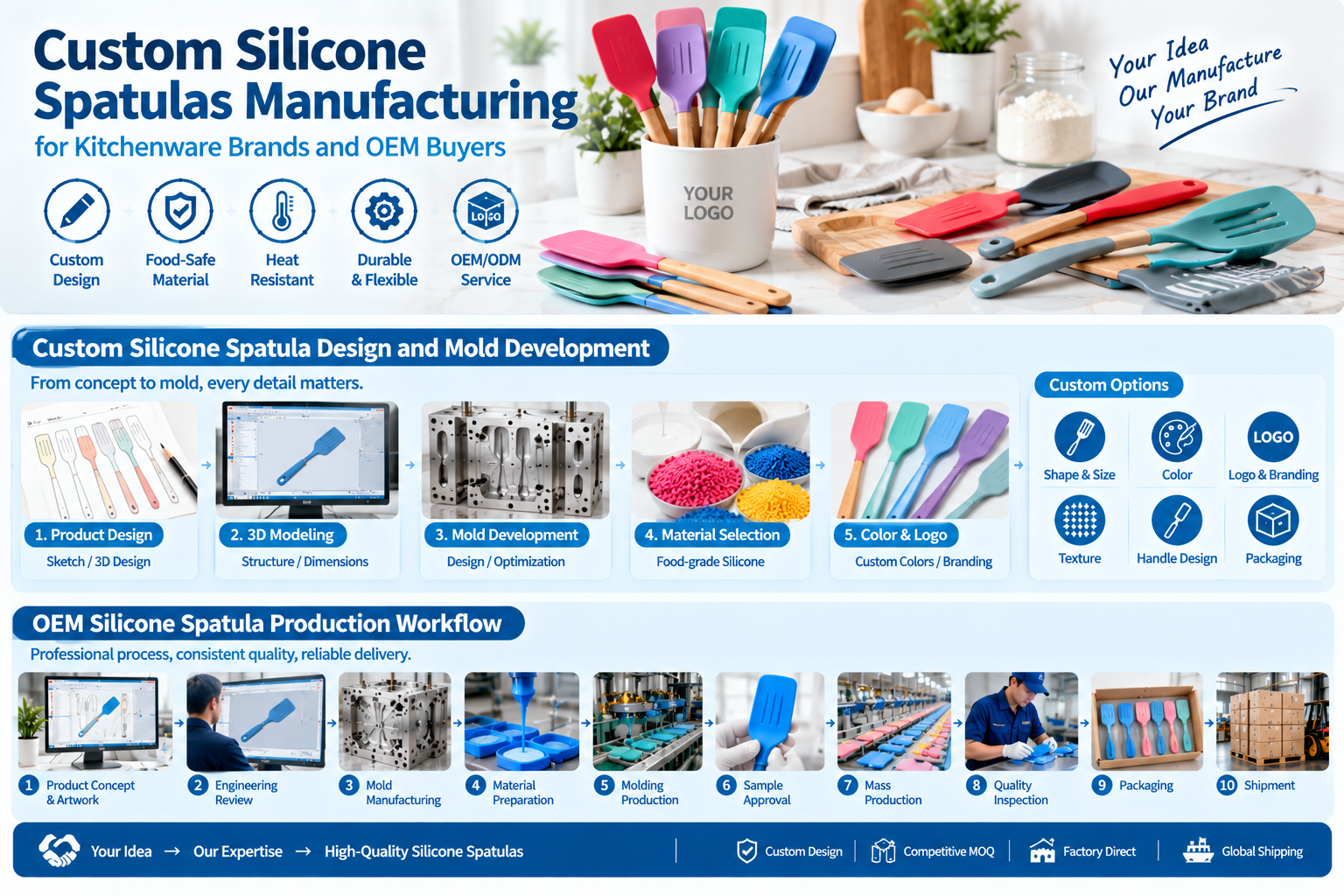
Custom silicone spatulas are a popular choice for kitchenware brands, cookware companies, retailers, and promotional product businesses looking for durable and customizable cooking tools.
Unlike standard stock spatulas, custom silicone spatulas can be developed around a specific brand, product concept, handle design, color system, packaging requirement, or target market.
For brands planning an OEM or private-label kitchenware project, the key questions are usually:
- How are custom silicone spatulas manufactured?
- What silicone material should be used?
- How much does a custom silicone spatula cost?
- What is the MOQ?
- Can the spatula be customized with a logo?
- How does mold design affect the price?
- Can the product be produced in custom colors?
- How long does development take?
This guide explains the complete custom silicone spatula manufacturing process, from product design and mold development to sampling, mass production, quality control, and packaging.
Why Use Silicone for Custom Spatulas?
Silicone is widely used for kitchen utensils because it offers a combination of flexibility, durability, heat resistance, and design versatility.
For brands developing custom spatulas, silicone also provides several manufacturing advantages.
Flexible and Functional
Silicone can be designed with different levels of flexibility depending on the intended application.
For example, a spatula head may need to be flexible enough to scrape a pan while remaining firm enough to lift or turn food.
The flexibility can be influenced by factors such as:
- Product thickness
- Silicone hardness
- Geometry
- Reinforcement structure
- Connection between the handle and spatula head
Easy to Customize
Silicone products can be manufactured in many colors and shapes.
Brands can develop spatulas that match their existing kitchenware collection or corporate brand identity.
Possible customization options include:
- Custom colors
- Custom shapes
- Custom handles
- Embossed logos
- Debossed logos
- Printed branding
- Two-color designs
- Multi-color designs
- Custom packaging
Suitable for Kitchenware Product Lines
A custom silicone spatula does not have to be sold as a standalone product.
It can become part of a larger kitchenware collection containing:
- Spatulas
- Tongs
- Whisks
- Scrapers
- Baking tools
- Cooking spoons
- Kitchen brushes
- Silicone mats
What Types of Custom Silicone Spatulas Can You Develop?
One of the first decisions for an OEM project is choosing the type of spatula you want to manufacture.
Different applications require different shapes, flexibility levels, handle structures, and materials.
1. Silicone Turner Spatulas
Turner spatulas are commonly used for flipping food in frying pans, grills, and cookware.
A custom turner can be designed with:
- Thin flexible edges
- Wide spatula heads
- Slotted openings
- Rounded corners
- Reinforced handles
- Hanging holes
The shape should match the intended cooking application.
2. Silicone Baking Spatulas
Baking spatulas are generally designed for mixing, scraping, and transferring ingredients.
They may feature:
- Flexible silicone heads
- Narrow edges
- Curved profiles
- Long handles
- Heat-resistant silicone construction
For baking brands, the spatula can also be developed as part of a coordinated product collection.
3. Silicone Jar Spatulas
A narrow silicone spatula can be designed for scraping sauces, spreads, creams, and other ingredients from containers.
These products typically require a thinner and more flexible working end.
4. Silicone Scraper Spatulas
Scraper spatulas are designed for removing food or mixtures from bowls, cookware, and containers.
The edge geometry is particularly important because it directly affects how effectively the product can contact the surface.
5. Custom Spatula Sets
Brands can also manufacture multiple spatulas as one product collection.
For example:
- Large cooking spatula
- Small spatula
- Baking spatula
- Jar scraper
- Mini spatula
A unified design language can make the collection look more professional and easier to market.
How to Design a Custom Silicone Spatula
Product design is one of the most important stages of custom silicone spatula development.
A good design should not only look attractive. It should also be suitable for manufacturing.
Before creating the mold, manufacturers normally review several factors.
1. Spatula Size
The overall size affects:
- Product weight
- Material consumption
- Mold size
- Packaging
- Shipping cost
- User experience
A larger spatula may require more silicone and a larger mold, increasing the manufacturing cost.
2. Spatula Head Thickness
Thickness has a direct effect on flexibility and durability.
A very thin spatula may be flexible but may not provide enough structural support for certain applications.
A thicker design may provide greater rigidity but may not work well for scraping or turning certain foods.
The ideal design depends on the intended application.
3. Edge Design
The working edge is particularly important.
For example, a spatula designed to scrape the bottom of a pan may require a relatively thin and flexible edge.
Designers should also consider:
- Rounded corners
- Edge thickness
- Contact area
- Flexibility
- Transition between the head and handle
4. Handle Design
The handle can be one of the most visible branding elements.
Custom handle options include:
- Straight handles
- Ergonomic handles
- Rounded handles
- Textured handles
- Hanging-hole handles
- Branded handles
The handle can also be developed with different materials.
Should the Spatula Be Fully Silicone or Have a Reinforced Core?
This is an important decision for many OEM kitchenware projects.
Fully Silicone Spatula
A fully silicone spatula is manufactured primarily from silicone.
Advantages may include:
- Simple appearance
- Flexible structure
- Easy cleaning
- Unified color
- Simple product design
This approach can work well for certain lightweight kitchen tools.
Silicone Spatula With Internal Core
Another option is to use a rigid internal structure covered by silicone.
The internal core can help provide additional stiffness while the silicone outer layer provides the desired surface and flexibility.
Depending on the design, the internal structure may use a suitable rigid material.
This type of construction can be useful when the product needs greater structural support.
The final material structure should be determined according to the intended application, food-contact requirements, production process, and supplier engineering recommendations.
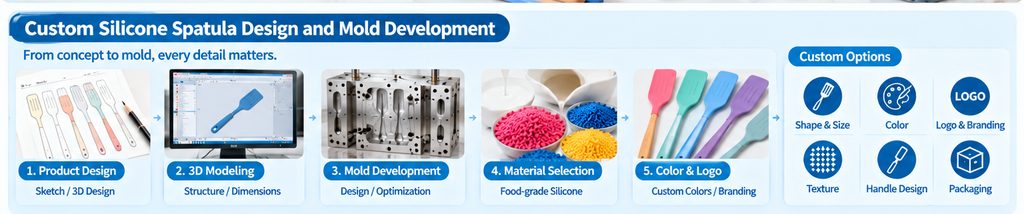
Custom Silicone Spatula Mold Design
The mold is one of the most important parts of the manufacturing process.
A well-designed mold helps improve:
- Product consistency
- Surface quality
- Dimensional stability
- Production efficiency
- Parting-line control
- Production repeatability
Parting Line
The mold parting line should be considered during product development.
Poor parting-line positioning can create visible marks or affect the appearance of the finished spatula.
For consumer kitchenware products, the manufacturer should consider where the parting line will appear and whether it can be minimized through mold design.
Mold Cavities
The number of cavities affects production efficiency.
A single-cavity mold may be appropriate for sampling or lower-volume production.
Higher-volume projects may use multi-cavity tooling when the product design and production process allow it.
However, more cavities can also increase tooling complexity and initial investment.
Undercuts
Complex shapes and undercuts may make the mold more complicated.
Before finalizing the product design, it is useful to review the design with the mold engineer.
What Silicone Material Should Be Used for Custom Spatulas?
Material selection should be based on the intended application rather than simply choosing the cheapest silicone option.
For kitchenware, buyers should discuss:
- Silicone type
- Hardness
- Temperature requirements
- Food-contact requirements
- Color requirements
- Surface finish
- Odor requirements
- Applicable testing standards
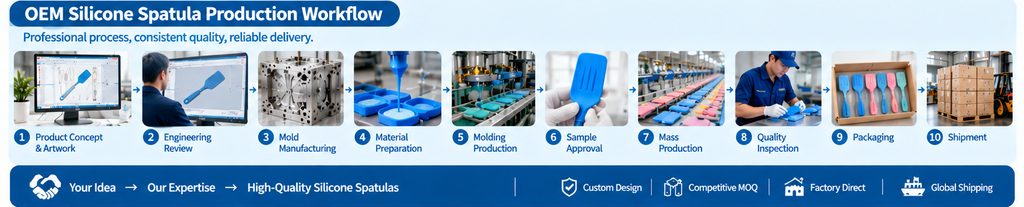
How Are Custom Silicone Spatulas Manufactured?
The production process generally includes several stages.
Step 1: Product Concept
The brand provides the basic product concept.
This may include:
- Drawings
- Dimensions
- 3D files
- Reference samples
- Product photos
- Logo
- Color requirements
The manufacturer reviews the initial concept and identifies potential manufacturing issues.
Step 2: Product Engineering
The engineering team converts the concept into a production-ready design.
They may review:
- Thickness
- Angles
- Draft
- Parting lines
- Handle structure
- Undercuts
- Material distribution
- Moldability
Step 3: Mold Development
After the design is approved, the mold is developed.
The mold design should match the selected production process and expected order quantity.
Step 4: Silicone Material Preparation
The appropriate silicone material is prepared according to the approved specification.
Colorants can be added to achieve the required product color.
For branded products, color matching may be required to achieve a consistent appearance across different production batches.
Step 5: Molding
The silicone material is placed or injected into the mold depending on the selected manufacturing process.
The mold is then processed under controlled production conditions.
Step 6: Trimming and Finishing
After molding, excess silicone may need to be removed.
The products may go through additional finishing processes such as:
- Flash trimming
- Surface inspection
- Logo inspection
- Assembly
- Cleaning
Step 7: Quality Control
Finished spatulas are inspected according to the agreed quality requirements.
Typical checks may include:
- Dimensions
- Color
- Appearance
- Flash
- Surface defects
- Logo position
- Assembly
- Packaging
How Much Does a Custom Silicone Spatula Cost?
There is no single fixed price for a custom silicone spatula.
The final OEM price depends on several factors.
Product Size
Larger products normally require more material and may require larger tooling.
Product Weight
A heavier spatula consumes more silicone per unit.
This can have a significant impact on unit cost in larger production runs.
Mold Design
Simple molds may require less tooling investment than highly complex molds.
The number of cavities and mold structure can also affect the tooling cost.
Silicone Material
Material grade, hardness, color, and specifications can affect the final cost.
Product Complexity
A simple one-piece spatula may be easier to manufacture than a multi-component design with a rigid internal structure.
Logo and Branding
Logo methods can include:
- Embossing
- Debossing
- Printing
- Molded branding
Different methods have different tooling and production requirements.
Quantity
Order quantity has a major impact on unit economics.
Higher production quantities can spread tooling and setup costs across more units.
What Is the MOQ for Custom Silicone Spatulas?
MOQ depends on the manufacturer, product design, mold structure, materials, packaging, and production requirements.
There is no universal MOQ for every silicone spatula project.
For example, a simple standard-shape product with limited customization may have different production requirements from a fully custom spatula with a new mold, custom colors, custom packaging, and multiple components.
When requesting a quotation, buyers should ask the supplier to clearly separate:
- Sample quantity
- Trial order quantity
- Production MOQ
- MOQ per color
- MOQ per design
- Packaging MOQ
Can You Private Label Silicone Spatulas?
Yes.
Private-label silicone spatulas can be developed for kitchenware brands, cookware companies, retailers, and e-commerce businesses.
There are several levels of customization.
Basic Private Label
The manufacturer provides an existing product design.
The brand adds:
- Logo
- Packaging
- Brand colors
- Product labels
This can reduce development time.
Semi-Custom Silicone Spatula
The brand selects an existing structure but changes certain elements.
For example:
- Handle color
- Silicone color
- Logo
- Packaging
- Product dimensions
Fully Custom Silicone Spatula
The manufacturer develops the product according to the brand’s specifications.
This may include:
- New product geometry
- Custom mold
- Custom handle
- Custom colors
- Custom logo
- Custom packaging
Fully custom development generally requires more engineering and tooling work.
Custom Silicone Spatulas for Kitchenware Brands
For established kitchenware brands, a custom spatula can become part of a broader product identity.
For example, a brand may use the same:
- Silicone color system
- Handle shape
- Logo treatment
- Packaging style
- Surface texture
across multiple kitchen products.
This creates a consistent product family.
Instead of selling one isolated spatula, the manufacturer can help develop a complete silicone kitchenware collection.
Custom Silicone Spatulas for Promotional Products
Silicone spatulas can also be used as promotional kitchen products.
Companies may customize them with:
- Corporate logos
- Brand colors
- Event themes
- Packaging
- Campaign messages
They can be used for:
- Food brands
- Cooking brands
- Supermarkets
- Restaurant chains
- Kitchen appliance companies
- Corporate gifts
- Marketing campaigns
How to Choose a Custom Silicone Spatula Manufacturer
Choosing the right manufacturer is important because the supplier needs to handle more than basic molding.
1. Product Development Capability
Look for a manufacturer that can help with product engineering rather than simply producing from an existing mold.
2. Mold Engineering
Ask whether the manufacturer has experience with:
- Silicone molds
- Complex geometries
- Multi-cavity tooling
- Parting lines
- Undercuts
- Product tolerances
3. Material Knowledge
The manufacturer should understand the material requirements for kitchenware applications and provide appropriate documentation.
4. Sampling Capability
Before mass production, you should be able to review samples and confirm:
- Shape
- Size
- Color
- Flexibility
- Logo
- Surface finish
5. Quality Control
Ask how the factory controls:
- Incoming materials
- Production parameters
- Product dimensions
- Appearance
- Color consistency
- Finished goods
6. Communication
A good OEM project requires communication between the brand, designer, engineer, and production team.
Clear communication during the design stage can prevent expensive changes later.
Common Mistakes When Developing Custom Silicone Spatulas
Mistake 1: Designing Only for Appearance
A spatula needs to work properly, not just look attractive.
Consider flexibility, edge geometry, handle strength, and actual cooking applications.
Mistake 2: Ignoring Mold Design
A design that looks good in a 3D model may still create manufacturing problems.
The mold engineer should review the product before the design is finalized.
Mistake 3: Choosing Material Without Considering the Application
Different spatulas may require different hardness and structural characteristics.
Material selection should match the intended use.
Mistake 4: Making the Product Too Complex
Every additional component, undercut, texture, or special feature can increase manufacturing complexity.
Mistake 5: Not Testing the Prototype
A prototype or pre-production sample allows the brand to evaluate the actual product before mass production.
Mistake 6: Focusing Only on Unit Price
The cheapest quotation does not necessarily represent the lowest total project cost.
Tooling, sampling, packaging, quality issues, rework, and production delays can all affect the final project cost.
How to Reduce Custom Silicone Spatula Costs
There are several practical ways to control the overall project budget.
Simplify the Product Geometry
Avoid unnecessary curves, undercuts, and decorative features when they do not add meaningful product value.
Optimize Product Weight
Reducing unnecessary material can lower the silicone consumption per unit.
However, the final design must still provide the required performance.
Optimize the Mold
Discuss cavity quantity, parting-line design, and mold structure with the manufacturer before tooling begins.
Standardize Components
Using common components across multiple products can simplify sourcing and production.
Increase Order Quantity
Higher production quantities may reduce the average tooling cost per unit and improve production efficiency.
Standardize Packaging
Custom packaging can add cost.
If the brand does not require highly specialized packaging, a simpler packaging structure may reduce the total project cost.
What Information Should You Send to a Silicone Spatula Manufacturer?
To receive a more accurate quotation, prepare as much information as possible.
A useful RFQ package can include:
Product Name:
Custom Silicone Spatula
Dimensions:
Length × width × thickness
Material:
Silicone specification or required application
Color:
Pantone or physical color reference
Logo:
Logo file and preferred branding method
Quantity:
Estimated order quantity
Packaging:
Individual packaging or bulk packaging
Target Market:
US / Europe / Japan / Other
Expected Delivery:
Required production timeline
Reference:
Photos, sketches, samples, or 3D CAD files
The more complete the information is, the easier it is for the manufacturer to evaluate tooling, production, and packaging requirements.
From Product Idea to Mass Production
A typical custom silicone spatula development workflow looks like this:
Product Idea
↓
Product Design
↓
Engineering Review
↓
3D Model / Drawing Approval
↓
Mold Design
↓
Tooling
↓
Prototype / Sample
↓
Sample Approval
↓
Mass Production
↓
Quality Inspection
↓
Packaging
↓
Shipment
This process allows the brand to identify design and manufacturing issues before committing to a large production order.
Why Work With an OEM Silicone Spatula Manufacturer?
Working directly with an OEM silicone manufacturer can give brands more control over the product development process.
Instead of purchasing a standard product, the brand can work with the manufacturer to develop a product around its own requirements.
This can include:
- Product engineering
- Mold development
- Material selection
- Color customization
- Logo development
- Sampling
- Mass production
- Quality control
- Packaging
For brands planning multiple silicone kitchen products, working with one experienced manufacturer can also make it easier to maintain consistent product quality and branding across the collection.
Final Thoughts
Custom silicone spatulas can be developed for a wide range of kitchenware brands, retailers, cookware companies, and private-label businesses.
The key to a successful OEM project is not simply choosing silicone as the material.
The product should be designed around its intended application, manufacturing process, mold structure, material requirements, target quantity, and final market.
A well-planned project typically starts with a clear product concept, followed by engineering review, mold development, sampling, quality confirmation, and mass production.
For brands planning a new silicone kitchenware collection, a custom spatula can also serve as one component of a broader product family.
Ready to Develop Your Own Custom Silicone Spatulas?
Whether you already have a finished design or only have a product idea, an experienced silicone manufacturer can help you move from concept to production.
When requesting a quotation, provide your product dimensions, drawings or reference images, material requirements, colors, logo requirements, estimated quantity, and packaging preferences.
The more information you provide, the easier it is to evaluate the mold, production process, MOQ, and overall project cost.
Contact us to discuss your custom silicone spatula project and get an OEM manufacturing solution for your brand.
 English
 Chinese
 Japanese
 Spanish
 French
 Arabic
 Russian
 Portuguese
 Belarusian