
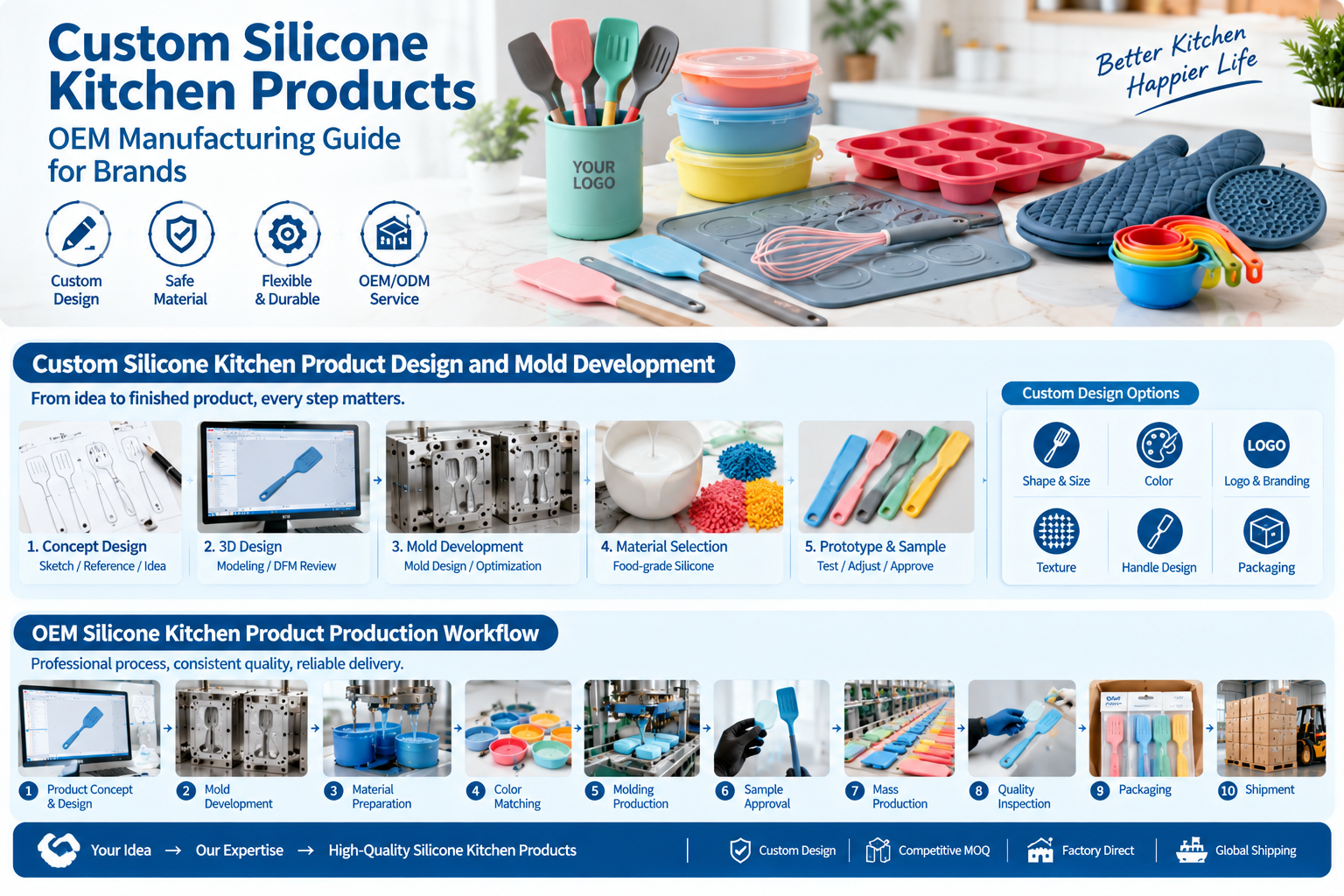
Custom silicone kitchen products are becoming increasingly popular among kitchenware brands, private-label sellers, retailers, promotional product companies, and businesses developing their own consumer product lines.
From silicone spatulas and baking molds to kitchen mats, food storage accessories, and cooking tools, silicone offers manufacturers considerable flexibility in product design, colors, shapes, and branding.
However, developing a successful custom silicone kitchen product involves much more than choosing a product shape and adding a logo.
The product needs to be designed for manufacturing, the appropriate silicone material needs to be selected, molds need to be developed, production parameters need to be controlled, and quality requirements need to be defined before mass production begins.
This guide explains how custom silicone kitchen products are developed and manufactured, including product selection, design, mold development, material considerations, MOQ, cost, quality control, and OEM production.
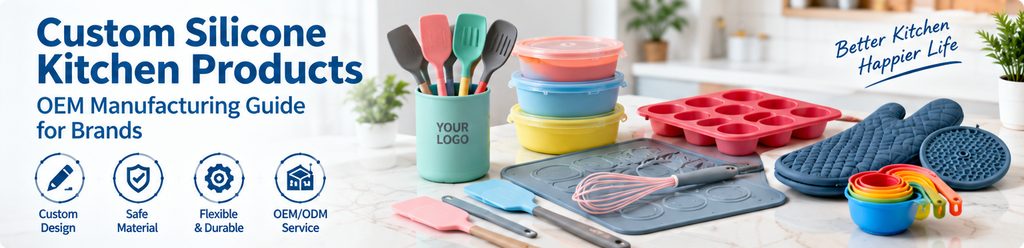
File Name: custom-silicone-kitchen-products-manufacturing.jpg
Alt Text: custom silicone kitchen products manufacturing for brands and OEM buyers
Why Use Silicone for Custom Kitchen Products?
Silicone is widely used in kitchenware because it combines flexibility, durability, heat resistance, and easy cleaning.
For brands, another major advantage is design flexibility.
Silicone kitchen products can be produced in different colors, shapes, thicknesses, textures, and sizes. This makes silicone suitable for both practical kitchen tools and highly customized branded products.
Common advantages include:
- Flexible and comfortable to use
- Good resistance to heat for suitable applications
- Easy to clean
- Suitable for many kitchen product designs
- Available in a wide range of colors
- Can support custom shapes and branding
- Durable for repeated everyday use
- Suitable for private-label product development
However, silicone is not automatically suitable for every food-contact application simply because it is silicone.
The material specification, formulation, manufacturing process, and required testing should be determined according to the product’s intended use and destination market.
What Custom Silicone Kitchen Products Can You Develop?
One of the biggest advantages of silicone is the variety of products that can be manufactured.
Depending on your target market, you may develop a single product or an entire silicone kitchenware collection.
Common examples include:
Silicone Spatulas
Silicone spatulas are popular for cooking, baking, mixing, scraping, and food preparation.
Brands can customize the head shape, handle design, size, color, logo, and packaging.
Silicone Baking Molds
Silicone molds can be designed for cakes, chocolates, desserts, ice cubes, and other applications.
Different cavity shapes can also be developed for seasonal products, character products, or branded collections.
Silicone Kitchen Mats
Silicone mats can be used as countertop mats, heat-resistant mats, baking mats, drying mats, or protective surfaces.
Their large surface area also provides opportunities for custom shapes, patterns, colors, and branding.
Silicone Food Storage Accessories
These can include silicone lids, reusable food covers, storage bags, and other flexible kitchen accessories.
Silicone Cooking Tools
Otras posibilidades son:
- Silicone tongs
- Silicone brushes
- Silicone whisks
- Silicone scrapers
- Silicone spoon rests
- Silicone utensil holders
- Silicone pot holders
- Silicone trivets
- Silicone jar openers
- Silicone measuring accessories
The right product depends on your target customer, selling channel, price range, and brand positioning.
How to Choose the Right Custom Silicone Kitchen Product
Before contacting a silicone kitchenware manufacturer, it is useful to define what you actually want to produce.
A clear product concept can make the quotation and development process much faster.
Consider the following factors.
1. Product Application
First determine how the product will be used.
For example, a baking spatula may require different design considerations from a silicone trivet or food storage lid.
The application affects material requirements, dimensions, flexibility, thickness, and testing requirements.
2. Target Customers
Think about who will use the product.
Your target customers could include:
- Home cooks
- Professional bakers
- Families
- Outdoor cooking users
- Baking enthusiasts
- Restaurant operators
- Gift buyers
- Retail consumers
Understanding the target customer helps determine the product size, appearance, functionality, and packaging.
3. Target Price
Your target selling price can influence the entire product design.
A more complex shape, multi-part construction, special packaging, or additional finishing may increase the final manufacturing cost.
Defining a target price early allows the manufacturer to suggest a more practical design.
4. Expected Order Quantity
Production quantity is also important.
A product designed for a small promotional order may require a different manufacturing approach from a product intended for long-term retail sales.
Custom Silicone Kitchen Product Design
Product design is one of the most important stages of the OEM process.
A product may look simple from the outside, but small design decisions can have a major effect on tooling, production efficiency, and final product quality.
Important design elements include:
- Overall dimensions
- Espesor de la pared
- Peso del producto
- Handle structure
- Áreas flexibles
- Hard and soft sections
- Recortes
- Líneas de separación
- Draft considerations
- Logo position
- Textura de la superficie
- Mold release requirements
For example, an oversized logo placed in a difficult area may create unnecessary mold complexity.
Similarly, extremely thin sections may be difficult to manufacture consistently.
A good silicone product design should therefore consider both appearance and manufacturability.

File Name: silicone-kitchen-product-design-and-molding.jpg
Alt Text: custom silicone kitchen product design and mold development process
How Are Custom Silicone Kitchen Products Manufactured?
Although the exact process varies depending on the product and silicone material, a typical OEM development process includes several stages.
Paso 1: Concepto del producto
The process begins with your product idea.
You may provide:
- Product sketches
- Existing samples
- CAD files
- Dimensiones del producto
- Imágenes de referencia
- Logo files
- Requisitos de empaque
If you only have a basic idea, an experienced manufacturer may also help evaluate whether the concept is practical for silicone production.
Step 2: Product Engineering
The product is then reviewed from a manufacturing perspective.
Engineers may examine:
- Espesor de la pared
- Geometría del producto
- Recortes
- Líneas de separación
- Estructura del molde
- Requisitos de materiales
- Expected production volume
- Ubicación del logotipo
This stage helps identify potential problems before the mold is manufactured.
Step 3: 3D Design and Mold Development
Once the product design is confirmed, the manufacturer develops the mold structure.
The mold design can significantly affect tooling cost, product quality, production efficiency, and lead time.
For complex silicone products, mold design should be reviewed carefully before tooling begins.
Step 4: Mold Manufacturing
The approved mold is manufactured according to the final design.
Depending on the product, the mold may include multiple cavities or more complex structures.
The tooling method depends on the silicone material, product geometry, expected quantity, and production requirements.
Step 5: First Sample
The manufacturer produces initial samples for evaluation.
This is an important stage because the physical sample allows the brand to check:
- Dimensiones
- Forma
- Flexibilidad
- Color
- Logotipo
- Acabado de la superficie
- Montaje
- Functionality
If adjustments are required, the design or mold may need to be modified before mass production.
Step 6: Mass Production
After the sample is approved, the manufacturer moves into production.
Production may include:
- Material preparation
- Molding
- Trimming
- Secondary processing
- Inspection
- Cleaning
- Empaque
Step 7: Quality Control
Finished products are inspected according to the agreed quality requirements.
Depending on the product, inspection may cover dimensions, appearance, color, surface defects, functionality, and packaging.
For food-contact products, the appropriate compliance and testing requirements should also be established according to the destination market and intended application.
How Much Does It Cost to Make Custom Silicone Kitchen Products?
There is no single price for custom silicone kitchen products.
The final cost depends on several factors.
Tamaño del producto
Larger products generally require more silicone material and may require larger tooling.
Peso del producto
A heavier product usually requires more material per unit.
Mold Design
Simple molds are generally easier to manufacture than complex molds with multiple cavities, intricate details, or difficult geometry.
Product Complexity
A simple silicone spatula may have a relatively straightforward structure, while a product with multiple components or complicated geometry may require more engineering and tooling work.
Color
Standard colors may be easier to manage, while specific brand colors may require additional color matching and approval.
Logo and Branding
Embossed, debossed, molded, printed, or other branding methods can have different cost implications.
Cantidad
Production quantity has a direct effect on the unit cost.
A larger order can allow tooling and setup costs to be distributed across more units.
Empaque
Custom packaging can also influence the total landed product cost.
Possible packaging options include:
- Poly bags
- Tarjetas de papel
- Custom boxes
- Retail packaging
- Printed sleeves
- Gift packaging
What Is the MOQ for Custom Silicone Kitchen Products?
MOQ means Minimum Order Quantity.
The actual MOQ for a custom silicone kitchen product depends on the manufacturer, product complexity, mold structure, material requirements, and production process.
A custom product normally requires tooling and production setup, so manufacturers may establish a minimum quantity that makes the project commercially practical.
For example, a small and simple silicone accessory may have different production economics from a large multi-cavity kitchen product.
When discussing MOQ with a manufacturer, ask about:
- Minimum order quantity
- Costo de los moldes
- Sample cost
- Production lead time
- Unit price at different quantities
- Packaging MOQ
- Color MOQ
- Reorder requirements
It can also be useful to request pricing at several quantities instead of asking for only one price.
Por ejemplo:
- 500 units
- 1,000 units
- 3,000 units
- 5,000 units
- 10,000 units
This gives you a clearer understanding of how production volume affects unit cost.
Can Silicone Kitchen Products Be Private Labeled?
Sí.
Private-label silicone kitchen products are commonly developed for brands that want to sell products under their own brand identity.
A private-label project can involve different levels of customization.
Basic Private Label
The manufacturer supplies an existing product design, while the brand adds:
- Logotipo
- Colores de la marca
- Empaque
- Product labels
Semi-Custom Product
The brand modifies an existing product by changing:
- Tamaño
- Forma
- Color
- Handle design
- Logotipo
- Empaque
Fully Custom Product
The manufacturer develops a new product based on the brand’s own design or concept.
This approach provides more control over product differentiation but generally requires more engineering and tooling work.
For brands building a long-term product line, fully custom development can provide more opportunities for unique product positioning.
Custom Silicone Kitchen Products for Promotional Campaigns
Silicone kitchen products can also be used as promotional merchandise.
For example, companies may develop:
- Custom silicone spatulas
- Silicone bottle openers
- Silicone pot holders
- Silicone kitchen mats
- Silicone utensil holders
- Custom silicone accessories
A kitchen product can provide repeated brand exposure because it may be used frequently in the home.
For promotional projects, consider the following:
- Logo visibility
- Product usefulness
- Público objetivo
- Empaque
- Cantidad del pedido
- Distribution method
- Budget per unit
What Silicone Material Should Be Used for Kitchen Products?
Material selection should be based on the intended application rather than simply choosing “silicone” as a general material category.
Different silicone formulations and production methods may be appropriate for different products.
When developing kitchenware, discuss the following with your manufacturer:
- Intended food-contact application
- Temperature conditions
- Flexibility requirements
- Product hardness
- Requisitos de color
- Odor requirements
- Acabado de la superficie
- Applicable testing
- Target market requirements
For products intended to contact food, the manufacturer should clarify the material specification and provide relevant documentation or testing information where applicable.
Do not assume that every silicone product has the same performance or compliance characteristics.
How to Choose a Custom Silicone Kitchen Products Manufacturer
Choosing the right manufacturer is an important part of the project.
A supplier may offer silicone products, but that does not necessarily mean they have the engineering and production capabilities required for your particular design.
Before placing an order, consider the following.
1. Product Development Capability
Ask whether the manufacturer can support product development from concept to production.
2. Mold Engineering
Check whether the supplier has experience designing molds for silicone products.
3. Production Capability
Understand what types of silicone molding and secondary processing the factory can handle.
4. Quality Control
Ask how incoming materials, production processes, finished products, and packaging are inspected.
5. Sampling Process
A clear sample approval process can reduce the risk of unexpected changes during mass production.
6. Communication
For overseas buyers, clear communication is particularly important.
Your supplier should be able to explain:
- Product limitations
- Estructura del molde
- Cantidad mínima de pedido
- Production schedule
- Material options
- Requisitos de calidad
- Empaque
- Shipping preparation
Common Mistakes When Developing Custom Silicone Kitchen Products
Even a simple kitchen product can experience problems if the development process is rushed.
Here are several common mistakes to avoid.
Error n.º 1: Diseñar solo pensando en la apariencia
A product may look excellent in a 3D rendering but be difficult or expensive to manufacture.
Design for manufacturing should be considered from the beginning.
Mistake 2: Ignoring Mold Complexity
Complex geometry can increase tooling cost and production difficulty.
Always review the mold structure before approving the tooling.
Mistake 3: Choosing Material Too Late
Material requirements should be discussed during product development rather than after the product design is finished.
Mistake 4: Not Defining Quality Standards
Terms such as “high quality” are too vague.
Instead, define specific requirements for:
- Dimensiones
- Color
- Surface defects
- Logotipo
- Dureza
- Empaque
- Functionality
Mistake 5: Ordering Too Many Units Before Sample Approval
Always approve the final sample before committing to large-scale production.
Mistake 6: Focusing Only on Unit Price
The cheapest quotation may not represent the lowest total project cost.
Mold quality, product consistency, packaging, defects, lead time, and communication can all affect the actual cost of a project.
How to Reduce Custom Silicone Kitchen Product Costs
If your target budget is limited, there are several ways to control costs without simply choosing the cheapest manufacturer.
Simplify the Product Design
Reducing unnecessary complexity can make mold development easier.
Optimize the Product Size
A smaller product may require less silicone material and a smaller mold.
Reduce Unnecessary Components
A one-piece silicone design may be more economical than a multi-component product when the application allows it.
Optimize the Mold
A properly designed mold can improve production efficiency and reduce unnecessary tooling complexity.
Aumentar la cantidad del pedido
If demand is predictable, larger production quantities may reduce the average tooling and setup cost per unit.
Standardize Packaging
Custom packaging can be valuable for retail products, but simpler packaging may be more appropriate for wholesale or promotional orders.
What Information Should You Send to a Silicone Kitchenware Manufacturer?
The more complete your initial information is, the easier it is for a manufacturer to prepare an accurate quotation.
Try to provide:
- Product name
- Product drawings or sketches
- 3D files if available
- Dimensiones del producto
- Estimated product weight
- Requisitos de materiales
- Requisitos de color
- Logo files
- Acabado de la superficie
- Expected order quantity
- Target market
- Requisitos de empaque
- Delivery requirements
If you do not have a complete CAD file, do not assume that the project cannot move forward.
Many OEM projects begin with a sketch, reference product, or simple concept.
The manufacturer can then evaluate the concept and determine what additional information is required.
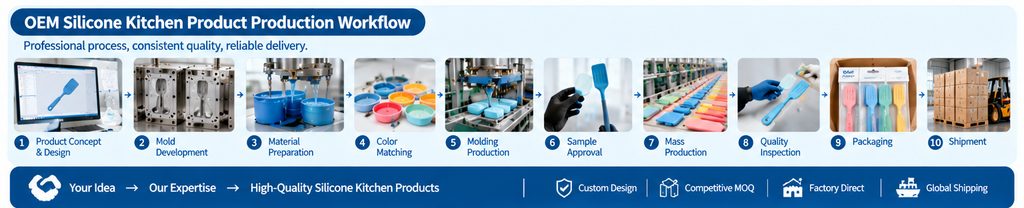
De la idea del producto a la producción en masa
A professional custom silicone kitchen product project can be divided into several major stages:
Concepto del producto
↓
Product Design
↓
Engineering Review
↓
Mold Design
↓
Tooling
↓
Prototipo / Muestra
↓
Aprobación de muestras
↓
Producción en serie
↓
Inspección de calidad
↓
Empaque
↓
Envío
Each stage affects the final result.
For this reason, choosing a manufacturer only after the design has been completed may not always be the most efficient approach.
Involving the manufacturer during the design stage can help identify potential manufacturing problems before tooling begins.
Why Work With an OEM Silicone Kitchen Product Manufacturer?
An experienced OEM manufacturer can provide more than production capacity.
Depending on the supplier, OEM support may include:
- Desarrollo de productos
- Design review
- Mold engineering
- Material recommendations
- Combinación de colores
- Producción de muestras
- Producción en masa
- Control de calidad
- Empaque
- Private labeling
This can be particularly useful for brands that have strong product ideas but do not have an internal manufacturing team.
Instead of managing separate suppliers for design, molds, production, and packaging, an integrated OEM partner can potentially simplify the development process.
Reflexiones finales
Custom silicone kitchen products offer brands many opportunities to create differentiated kitchenware, private-label products, promotional items, and consumer product lines.
The key is to think beyond the final appearance of the product.
A successful silicone kitchen product requires the right combination of:
- Diseño de productos
- Selección de materiales
- Mold engineering
- Proceso de fabricación
- Cantidad de producción
- Control de calidad
- Empaque
- Market requirements
The earlier these factors are considered, the easier it becomes to control cost, production risk, and lead time.
Whether you are developing a custom silicone spatula, baking mold, kitchen mat, food storage accessory, or another silicone kitchen product, working with an experienced OEM manufacturer can help turn your concept into a production-ready product.
Ready to Develop Your Own Custom Silicone Kitchen Products?
Send us your product idea, drawings, reference samples, logo, target quantity, and packaging requirements.
Our team can help evaluate the design, mold requirements, material options, production process, and quotation for your project.
Contact us today to discuss your custom silicone kitchen product project.
 English
 Chinese
 Japanese
 Spanish
 French
 Arabic
 Russian
 Portuguese
 Belarusian
[…] A custom silicone spatula does not have to be sold as a standalone product. […]
[…] brands developing custom food grade silicone products, the manufacturer should understand both the material requirements and the final […]