
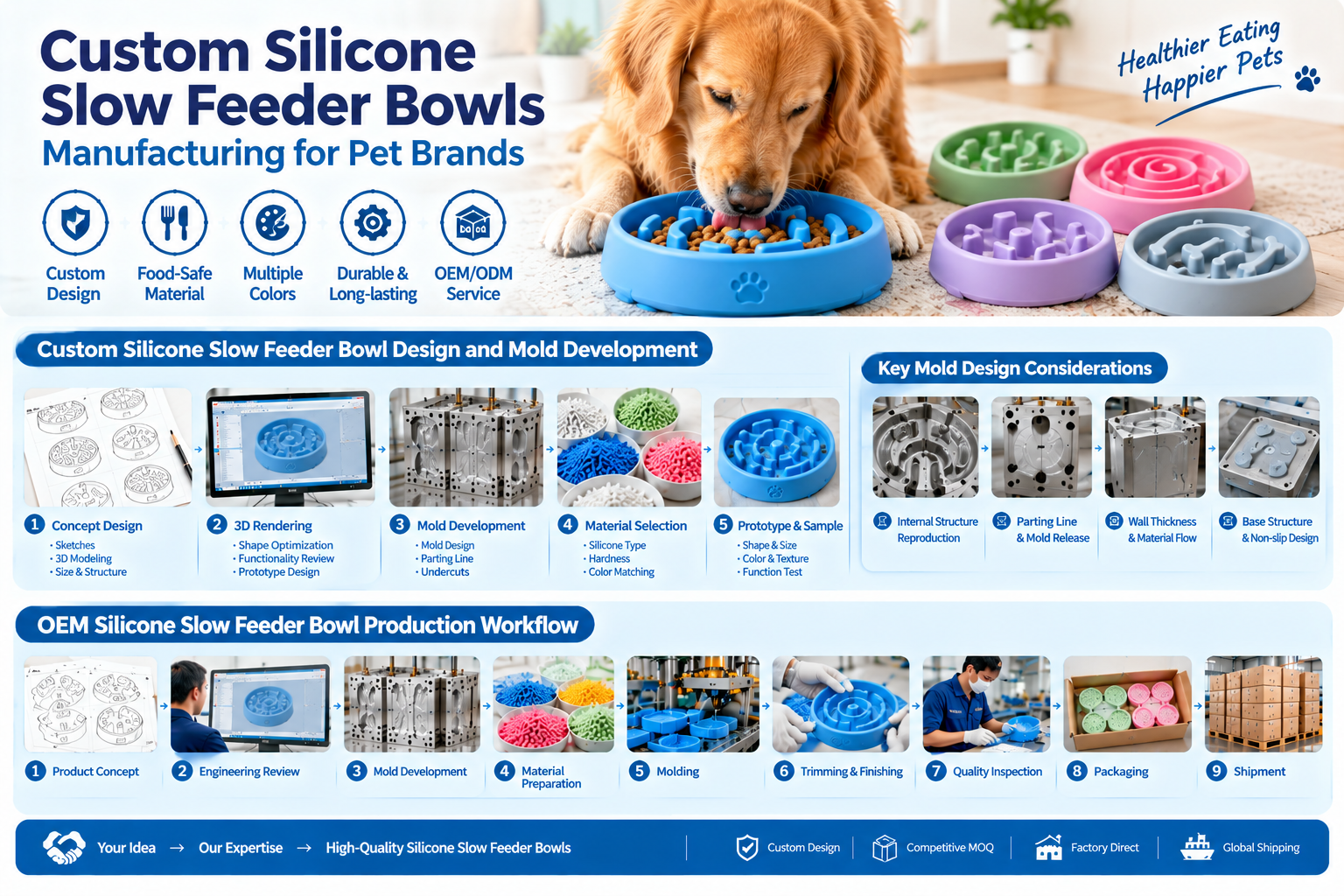
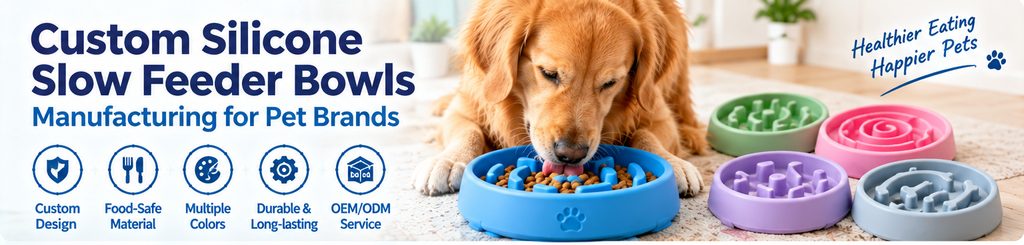
Custom silicone slow feeder bowls are a specialized pet product category for brands looking to develop feeding products with unique shapes, textures, colors, and branding.
Unlike a basic pet bowl, a slow feeder bowl usually contains internal structures designed to make food access more controlled.
For pet brands, this creates more opportunities for product differentiation.
A custom slow feeder bowl can be developed with:
- Custom bowl shapes
- Different internal patterns
- Raised feeding structures
- Multiple compartments
- Colores personalizados
- Molded logos
- Bases antideslizantes
- Private-label packaging
However, the internal structure also makes the product more complicated to design and manufacture than a simple silicone bowl.
This guide explains how custom silicone slow feeder bowls are designed and manufactured, including product structure, mold design, material selection, cost, MOQ, sampling, private labeling, and mass production.
Why Use Silicone for Custom Slow Feeder Bowls?
Silicone gives pet brands a flexible material for developing customized bowl designs.
It can be molded into different shapes, thicknesses, textures, and structures.
Flexible Product Design
Silicone can be used to create bowls with different:
- Shapes
- Heights
- Wall thicknesses
- Bottom structures
- Internal patterns
- Outer textures
This allows brands to create products that look different from standard pet bowls.
Custom Internal Feeding Structures
The internal structure is one of the most important parts of a slow feeder bowl.
Possible structures include:
- Raised ridges
- Rounded bumps
- Grooves
- Spiral patterns
- Dividers
- Maze-like structures
- Multiple feeding sections
The structure can be designed around the overall bowl geometry.
Colores personalizados
Silicone slow feeder bowls can be produced in custom colors.
Brands can develop colors based on:
- Brand identity
- Product collections
- Seasonal launches
- Retail requirements
- Diseños de personajes
Multiple colors can also be used across a complete pet feeding collection.
Flexible Product Line Development
A slow feeder bowl can be developed together with other silicone pet products.
Por ejemplo:
- Silicone pet bowls
- Silicone lick mats
- Silicone dog toys
- Silicone feeding mats
- Tazones de viaje
- Treat accessories
What Types of Custom Silicone Slow Feeder Bowls Can You Develop?
The product structure can vary significantly depending on the target market and intended application.
Basic Slow Feeder Bowls
A basic design can use a relatively simple internal pattern.
This may be suitable for brands looking for a straightforward product with limited mold complexity.
Maze-Style Slow Feeder Bowls
Maze-style designs use more complicated internal structures.
The food is placed around raised sections or channels inside the bowl.
The design can be customized according to the desired product appearance and feeding concept.
Spiral Slow Feeder Bowls
A spiral structure can create a continuous internal path.
The spiral can be:
- Circular
- Ovalado
- Asymmetrical
- Brand-inspired
- Combined with other patterns
Multi-Section Slow Feeder Bowls
The bowl can be divided into several sections.
Different areas can have different internal structures.
This can create a more visually distinctive product.
Flat Silicone Slow Feeder Bowls
Some designs use a relatively low-profile structure.
These products can be developed with a wider surface area and shallow internal patterns.
Custom Character Slow Feeder Bowls
Pet brands can also develop slow feeder bowls around:
- Paw shapes
- Animal shapes
- Brand mascots
- Diseños de personajes
- Custom logos
More complicated shapes require additional mold engineering.
How to Design a Custom Silicone Slow Feeder Bowl
Product design is especially important because the internal structure affects both appearance and manufacturing.
Choose the Bowl Shape
Start with the overall geometry.
Common options include:
- Redondo
- Ovalado
- Cuadrado
- Rectangular
- Paw-shaped
- Custom character shape
The shape should match the intended product positioning and packaging.
Determine the Bowl Height
Bowl height affects:
- Product capacity
- Material consumption
- Empaque
- Estabilidad
- Overall appearance
The correct height depends on the product concept.
Design the Internal Structure
The internal feeding structure is the main feature of a slow feeder bowl.
The design team should consider:
- Pattern height
- Groove width
- Spacing
- Corner radius
- Food access
- Cleaning access
- Mold release
Very narrow or deep structures may increase manufacturing complexity.
Design the Outer Wall
The outer wall affects the overall rigidity and appearance of the bowl.
Possible designs include:
- Thin flexible walls
- Reinforced walls
- Rounded edges
- Raised rims
- Textured exterior surfaces
Design the Base
The bottom of the bowl can be designed with:
- Flat base
- Raised base
- Non-slip structure
- Suction elements
- Reinforced sections
The base should be evaluated together with the overall bowl geometry.
Add Branding
Branding can be added to:
- Bowl exterior
- Bowl bottom
- Outer rim
- Internal surface
- Molded logo areas
- Empaque
Logo placement should be reviewed before mold development.
Custom Silicone Slow Feeder Bowl Texture Design
The internal texture is one of the most important parts of the product.
Unlike a standard bowl, the slow feeder structure can become a major part of the product identity.
Raised Ridges
Raised ridges can divide the feeding surface into different areas.
Rounded Bumps
Rounded structures can create a softer visual appearance.
Grooves
Grooves can be integrated into different geometric patterns.
Spiral Structures
Spiral patterns can create a continuous visual structure inside the bowl.
Custom Brand Patterns
A brand can also develop unique patterns based on:
- Logo elements
- Geometric shapes
- Paw prints
- Character elements
- Brand graphics
The final pattern should always be reviewed from a manufacturing perspective.
Custom Silicone Slow Feeder Bowl Mold Design
Mold development is one of the most important stages of a custom slow feeder bowl project.
The mold needs to reproduce both the outside shape and the internal feeding structure.

Internal Structure Reproduction
The mold must accurately reproduce the internal feeding pattern.
Small changes in:
- Altura
- Width
- Spacing
- Radius
- Profundidad
can affect the final product.
Mold Release
Complex internal structures need to be evaluated carefully for mold release.
Deep or narrow areas can create additional engineering challenges.
Wall Thickness
The wall thickness should be considered together with the internal structure.
Uneven thickness can affect:
- Material distribution
- Product appearance
- Flexibilidad
- Production consistency
Parting Line
The parting line should be positioned carefully.
A poorly positioned parting line may create unwanted visible marks or flash on important product surfaces.
Base Structure
The mold must also reproduce the bottom structure accurately.
If the bowl includes a non-slip or suction feature, this should be included in the mold design.
What Silicone Material Should Be Used for Slow Feeder Bowls?
Material selection should be based on the intended application and target market.
For pet feeding products, brands should discuss the appropriate silicone specification with the manufacturer and request relevant documentation and testing information.
Important considerations can include:
- Silicone specification
- Dureza
- Flexibilidad
- Acabado de la superficie
- Color stability
- Odor
- Intended application
- Applicable market requirements
If the product is intended to come into contact with food or pet food, the material and testing requirements should be confirmed before production.
How Are Custom Silicone Slow Feeder Bowls Manufactured?
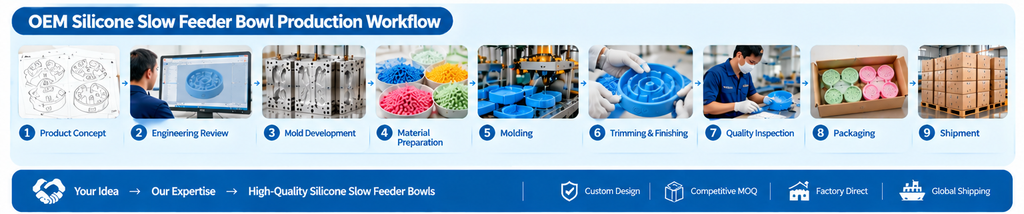
A typical OEM development process includes several stages.
Paso 1: Concepto del producto
The brand provides the initial product idea.
This may include:
- Sketches
- Reference products
- Dimensiones
- CAD files
- Internal pattern references
- Logo artwork
Step 2: Product Engineering
The manufacturer reviews the design.
The engineering team may evaluate:
- Bowl thickness
- Internal structure
- Estructura básica
- Mold release
- Línea de separación
- Material distribution
- Estabilidad del producto
Step 3: Mold Design
After the product design is approved, the manufacturer develops the mold.
The mold must accurately reproduce both the outer bowl and internal feeding structures.
Step 4: Material Preparation
The selected silicone material is prepared according to the approved specification.
Custom colors can also be prepared during production preparation.
Paso 5: Moldeado
The silicone is processed using the appropriate molding method.
The exact production process depends on:
- Geometría del producto
- Material
- Mold design
- Cantidad de producción
Step 6: Trimming and Finishing
After molding, excess silicone may need to be removed.
The product can then be inspected for:
- Flash
- Surface defects
- Pattern quality
- Color
- Dimensiones
Step 7: Quality Control
Finished bowls are inspected according to the agreed specifications.
Typical checks can include:
- Dimensiones
- Peso
- Color
- Surface appearance
- Internal structure
- Estructura básica
- Logotipo
- Empaque
How Much Does a Custom Silicone Slow Feeder Bowl Cost?
There is no universal price for custom silicone slow feeder bowls.
The final cost depends on the product design, mold structure, material usage, order quantity, and packaging.
Tamaño del producto
Larger bowls generally require more silicone material and may require larger tooling.
Peso del producto
A heavier product consumes more silicone.
Weight should be considered during product development because it directly affects material usage.
Internal Structure
More complicated feeding patterns can increase mold complexity.
Mold Design
Tooling cost can vary depending on:
- Tamaño del producto
- Internal structure
- Recortes
- Cavities
- Línea de separación
- Mold complexity
Color
Custom colors may require additional color matching and production preparation.
Logotipo
A molded logo may require additional mold modifications.
Empaque
Packaging can range from bulk packaging to fully customized retail packaging.
Cantidad del pedido
Production quantity has a significant impact on unit cost.
What Is the MOQ for Custom Silicone Slow Feeder Bowls?
MOQ depends on the manufacturer and product specification.
A simple bowl with one color and standard packaging may have different requirements from a fully custom product with:
- New tooling
- Complex internal patterns
- Multiple colors
- Embalaje personalizado
- Multiple sizes
When requesting a quotation, ask about:
- Sample quantity
- Trial order quantity
- Production MOQ
- MOQ per color
- MOQ per size
- MOQ per design
- Packaging MOQ
Can Silicone Slow Feeder Bowls Be Private Labeled?
Sí.
Private-label slow feeder bowls can be developed at different levels of customization.
Basic Private Label
The brand uses an existing bowl design and adds:
- Logotipo
- Empaque
- Label
- Colores de la marca
Semi-Custom Slow Feeder Bowl
The brand modifies selected product features.
Por ejemplo:
- Color
- Tamaño
- Internal pattern
- Logotipo
- Empaque
Fully Custom Slow Feeder Bowl
A fully custom product can include:
- New bowl shape
- Custom internal structure
- Custom mold
- Colores personalizados
- Molded logo
- Embalaje personalizado
This approach gives the brand more control over product appearance and differentiation.
Custom Slow Feeder Bowls for Pet Brands
A slow feeder bowl can become part of a larger pet feeding collection.
For example, a pet brand could develop:
- Custom silicone slow feeder bowls
- Custom silicone pet bowls
- Silicone lick mats
- Silicone feeding mats
- Silicone dog toys
- Tazones de viaje
- Treat accessories
A coordinated collection can use consistent:
- Colores
- Logotipos
- Shapes
- Texturas
- Empaque
This can make different products look like part of the same brand family.
Custom Silicone Slow Feeder Bowls for Private-Label Pet Products
Private-label slow feeder bowls can be developed using an existing product platform or a completely new design.
For smaller brands, an existing design with custom branding may reduce the development requirements.
For brands looking for greater differentiation, a fully custom mold can provide more control over:
- Bowl shape
- Internal pattern
- Tamaño
- Color
- Estrategia de marca
- Empaque
The right approach depends on the brand’s budget, target quantity, product positioning, and development timeline.
How to Choose a Custom Silicone Slow Feeder Bowl Manufacturer
A suitable manufacturer should be able to support both product development and mass production.
Product Design Support
The manufacturer should be able to review:
- Geometría del tazón
- Internal structures
- Espesor de la pared
- Base design
- Ubicación del logotipo
Mold Engineering
Ask about the supplier’s experience with:
- Detailed silicone molds
- Complex internal structures
- Thin-wall products
- Multiple cavities
- Mold release
Material Knowledge
The supplier should understand the material requirements for the intended pet feeding application.
Muestreo
Before mass production, review physical samples carefully.
Pay attention to:
- Bowl dimensions
- Peso del producto
- Flexibilidad
- Internal pattern
- Base stability
- Color
- Calidad de la superficie
- Logotipo
Control de calidad
Ask how the manufacturer controls:
- Raw materials
- Color
- Dimensiones
- Peso
- Calidad de la superficie
- Production consistency
- Empaque
Communication
Clear communication is particularly important when developing the internal structure.
A small change to the pattern may require changes to the mold.
Common Mistakes When Developing Custom Silicone Slow Feeder Bowls
Mistake 1: Making the Internal Pattern Too Complicated
A highly complicated pattern may increase mold complexity and make the product more difficult to clean.
Mistake 2: Making the Grooves Too Narrow
Very narrow areas can create manufacturing and cleaning challenges.
Mistake 3: Ignoring Wall Thickness
Uneven wall thickness can affect product consistency and appearance.
Mistake 4: Ignoring Mold Release
Complex internal structures need to be reviewed carefully before tooling.
Mistake 5: Designing Only for Appearance
The bowl should remain practical for its intended use.
Mistake 6: Skipping Physical Samples
A physical prototype allows the brand to evaluate the actual bowl structure before mass production.
How to Reduce Custom Silicone Slow Feeder Bowl Costs
Simplify the Internal Pattern
A simpler pattern can reduce mold complexity.
Optimizar el peso del producto
Avoid unnecessary material while maintaining the required product structure.
Standardize Colors
Using common colors across several products can simplify production.
Optimize the Mold
Discuss cavity quantity, mold layout, and tooling structure with the manufacturer.
Use a Shared Product Platform
For some product lines, several sizes or variations may be developed around a common design concept.
Standardize Packaging
Simple packaging can reduce total project costs when premium retail packaging is not necessary.
What Information Should You Send to a Slow Feeder Bowl Manufacturer?
Para obtener una cotización más precisa, proporcione toda la información posible.
Product Name: Custom Silicone Slow Feeder Bowl
Product Type: Standard / maze / spiral / multi-section / custom shape
Dimensions: Length × width × height
Capacity: Target capacity if known
Internal Pattern: Reference image, drawing, or 3D file
Material: Required silicone specification if known
Color: Pantone or physical reference
Logo: Logo file and preferred branding method
Quantity: Estimated order quantity
Packaging: Bulk or individual packaging
Target Market: US / Europe / Japan / Other
Reference: Photos, sketches, samples, or CAD files
Expected Timeline: Target sample and production schedule
Providing complete information helps the manufacturer evaluate the mold, production method, MOQ, and estimated project cost.
De la idea del producto a la producción en masa
A typical custom silicone slow feeder bowl development workflow looks like this:
Idea de producto
↓
Product Design
↓
Internal Pattern Development
↓
Engineering Review
↓
3D Model / Drawing Approval
↓
Mold Design
↓
Tooling
↓
Prototipo / Muestra
↓
Aprobación de muestras
↓
Producción en serie
↓
Inspección de calidad
↓
Empaque
↓
Envío
Why Work With an OEM Silicone Slow Feeder Bowl Manufacturer?
An experienced OEM manufacturer can support more than the molding stage.
Depending on the supplier, the development process can include:
- Diseño de productos
- Engineering
- Internal pattern development
- Desarrollo del moho
- Silicone material selection
- Combinación de colores
- Muestreo
- Producción en masa
- Control de calidad
- Empaque
For brands developing several pet products, an experienced supplier can also help maintain consistency across:
- Silicone materials
- Colores
- Calidad del producto
- Logo treatment
- Empaque
This can be particularly useful when developing a complete silicone pet feeding collection.
Reflexiones finales
Custom silicone slow feeder bowls give pet brands an opportunity to create more distinctive feeding products.
The most important considerations are not limited to the outer shape of the bowl.
Brands should carefully consider:
- Internal feeding structure
- Tamaño del producto
- Peso del producto
- Espesor de la pared
- Base design
- Requisitos de materiales
- Mold design
- Color
- Estrategia de marca
- Empaque
- Target quantity
A successful OEM project starts with a manufacturable product concept and continues through engineering review, mold development, sampling, quality control, and mass production.
For brands building a broader silicone pet product collection, slow feeder bowls can also be developed alongside silicone pet bowls, lick mats, dog toys, and other feeding accessories.
Ready to Develop Your Own Custom Silicone Slow Feeder Bowls?
Whether you already have a finished slow feeder bowl design or only have a product concept, an experienced silicone manufacturer can help turn your idea into a production-ready product.
When requesting a quotation, provide your bowl dimensions, internal pattern requirements, reference images or CAD files, material requirements, colors, logo requirements, estimated quantity, and packaging preferences.
The more complete the information is, the easier it is to evaluate the mold, production process, MOQ, and overall project cost.
Contact us to discuss your custom silicone slow feeder bowl project and develop an OEM manufacturing solution for your pet brand.
 English
 Chinese
 Japanese
 Spanish
 French
 Arabic
 Russian
 Portuguese
 Belarusian