
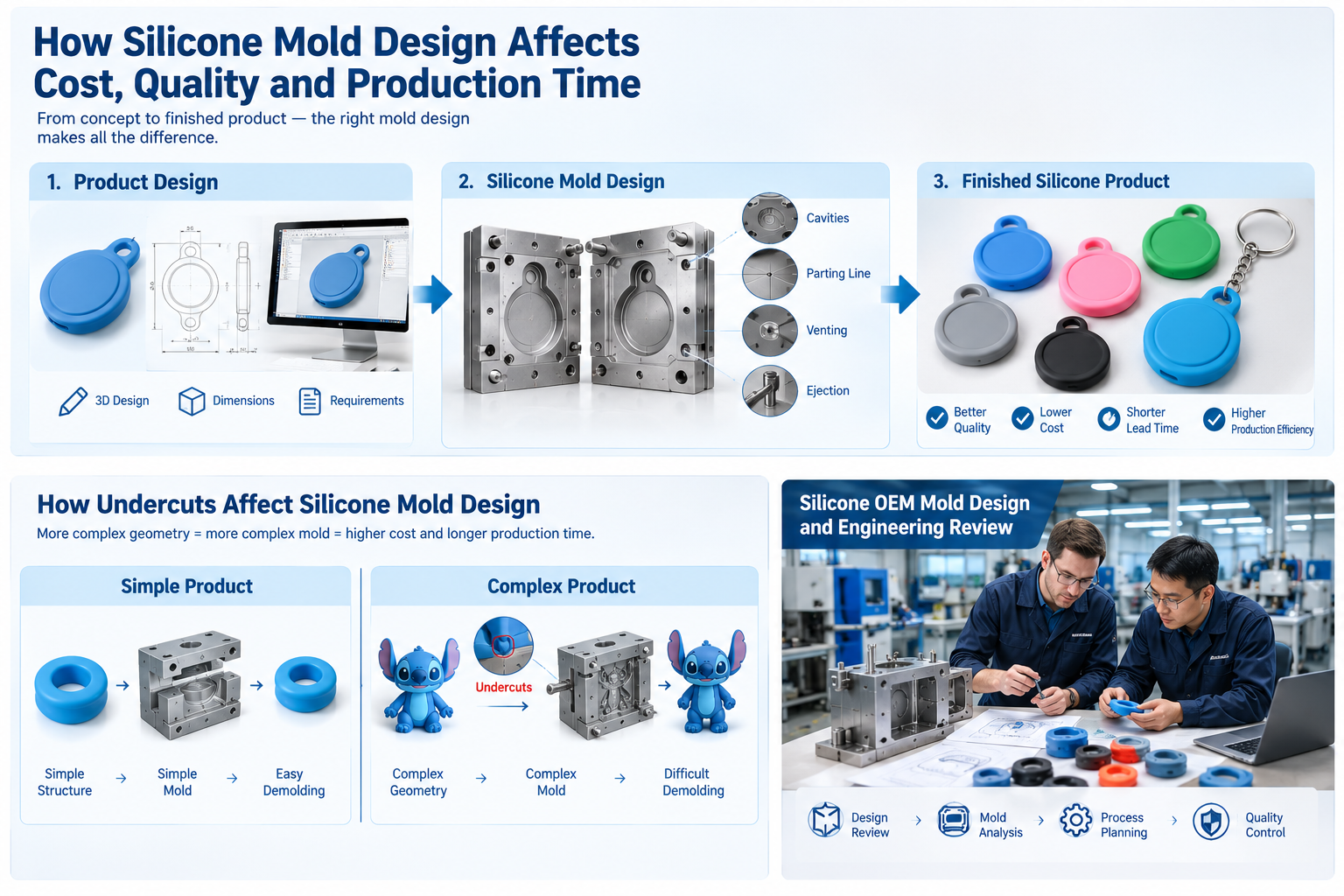
When developing a custom silicone product, many buyers focus on the silicone material, product shape, color, and unit price.
However, one of the most important factors is often overlooked:
The silicone mold design.
A well-designed mold can help reduce production problems, improve product consistency, shorten production time, and control tooling costs.
On the other hand, a poorly designed mold may result in excessive flash, difficult demolding, inconsistent dimensions, longer production cycles, and unnecessary tooling expenses.
For OEM and ODM projects, understanding how silicone mold design affects manufacturing can help buyers make better decisions before production begins.
Why Is Silicone Mold Design Important?
The mold is not simply a tool used to form the silicone product.
It directly affects several aspects of manufacturing, including:
- Tooling cost
- Product appearance
- Dimensional consistency
- Parting line position
- Flash and excess material
- Demolding efficiency
- Production cycle time
- Nombre de cavités
- Production capacity
- Final unit cost
For example, a simple silicone keychain may require a relatively straightforward mold design.
A silicone figurine with multiple undercuts, thin sections, small details, and complex geometry can require a much more complicated mold structure.
This is why two silicone products with similar dimensions can have very different tooling costs.
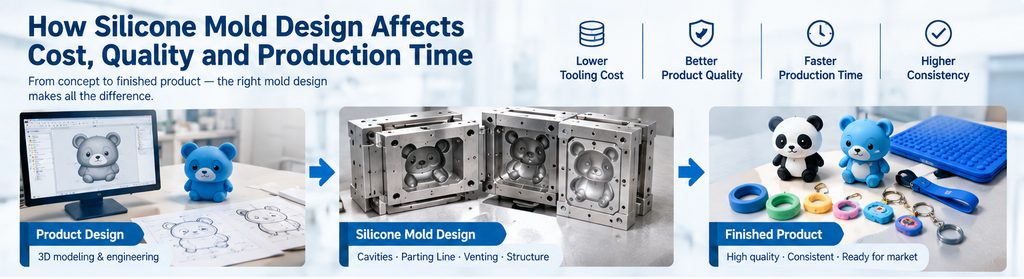
1. Product Geometry Directly Affects Mold Design
The first factor an OEM manufacturer evaluates is the geometry of the product.
Simple shapes are generally easier to mold.
More complicated designs may require additional considerations such as:
- Deep cavities
- Thin walls
- Contre-dépouilles
- Fine surface details
- Small holes
- Internal structures
- Multiple parting lines
- Special demolding solutions
For example, a flat silicone coaster is relatively straightforward to manufacture.
A three-dimensional character figure may require a much more carefully designed mold because the product needs to be removed from the mold without damaging small details.
Example
Consider two custom silicone products:
Product A: Flat silicone coaster
Product B: 3D cartoon character
Although both may use silicone rubber, Product B can require significantly more mold engineering because of its shape and surface details.
This is one reason why product complexity should be evaluated before requesting a tooling quotation.
2. Parting Line Design Can Affect Product Appearance
Le parting line is the area where different sections of a mold meet.
It is a normal part of many molding processes, but its position can have a significant effect on the final appearance of the product.
For consumer products, promotional gifts, and IP merchandise, parting line placement can be especially important.
A poorly positioned parting line may become highly visible on the finished product.
A professional mold design attempts to position the parting line in a location that minimizes its visual impact while still allowing efficient molding and demolding.
Par exemple :
A parting line may be less noticeable when placed along:
- A natural product edge
- The bottom of a product
- A character’s clothing line
- A recessed area
- A structural boundary
For IP products and character merchandise, this can be particularly important because customers often pay close attention to appearance.
3. Mold Cavities Affect Production Capacity and Cost
Another important consideration is the number of cavities in the mold.
A single-cavity mold produces one part per molding cycle.
A multi-cavity mold can produce multiple parts during the same cycle.
Par exemple :
1 cavity → 1 product per cycle
4 cavities → 4 products per cycle
8 cavities → 8 products per cycle
This can significantly affect production efficiency when order volumes are high.
However, increasing the number of cavities usually also increases mold complexity and tooling cost.
Therefore, more cavities are not automatically better.
The appropriate cavity configuration depends on:
- Expected order quantity
- Dimensions du produit
- Volume de production
- Target unit cost
- Available machine capacity
- Required delivery time
- Product geometry
For a small promotional order, a simple mold may be more practical.
For a large recurring order, a multi-cavity mold may make more economic sense.
4. Mold Venting Affects Silicone Product Quality
Silicone needs to fill the mold cavity properly during production.
Air trapped inside the mold can create manufacturing problems.
This is why venting is an important part of mold design.
Proper venting can help reduce issues such as:
- Air bubbles
- Incomplete filling
- Surface defects
- Missing details
- Inconsistent appearance
For products with small details or complicated structures, venting becomes even more important.
An experienced silicone manufacturer will consider how silicone flows through the mold and where trapped air may occur during the design stage.
This is one of the reasons why mold design should not be treated as a simple “make a cavity and produce it” process.
5. Product Thickness Can Affect Production Time
Product thickness is another factor that can influence production.
A silicone product with very thick sections may require different curing considerations compared with a thin product.
If the product design contains large variations in thickness, the manufacturer may need to evaluate:
- Material flow
- Curing behavior
- Production cycle
- Surface appearance
- Dimensional stability
For this reason, product designers should consider manufacturability before finalizing the design.
A product can look excellent in a 3D rendering but still require modifications before it is suitable for efficient mass production.
This is where communication between the product designer and silicone manufacturer becomes important.
6. Undercuts Can Increase Mold Complexity
An undercut is an area of a product that makes it difficult to remove the part directly from a conventional mold.
Undercuts are common in:
- Character figures
- Silicone cases
- Cartoon products
- Decorative products
- Complex consumer products
For example, a character figurine may have:
- Protruding ears
- Arms
- Legs
- Deep facial details
- Curved structures
- Recessed areas
These features can make mold design more complicated.
Depending on the product structure, the manufacturer may need to modify the product geometry or develop a more complex mold solution.
Why does this matter to buyers?
Because complicated mold structures can increase:
Tooling cost + manufacturing time + maintenance requirements
Therefore, if a product is still in the design stage, it is often better to discuss manufacturability with the manufacturer before the design is finalized.

7. Silicone Mold Design Also Affects Tooling Cost
Tooling cost is not determined by mold size alone.
Several factors can influence the final quotation.
These may include:
- Mold dimensions
- Nombre de cavités
- Complexité du produit
- Détails de la surface
- Contre-dépouilles
- Mold structure
- Required precision
- Material and tooling method
- Quantité de production
For example, two molds may have a similar overall size but completely different levels of complexity.
A simple flat product may require a relatively straightforward mold.
A detailed 3D character product may require significantly more engineering work.
This is why comparing tooling quotations only by mold size can sometimes be misleading.
8. Mold Design Can Affect Production Lead Time
Mold manufacturing is only one part of the overall development process.
A typical custom silicone project may include:
Product concept
↓
Conception 3D
↓
Design review
↓
Mold design
↓
Tooling
↓
First sample
↓
Sample inspection
↓
Mold adjustment
↓
Final approval
↓
Production en série
If mold problems are discovered after sampling, the tooling may need to be modified.
This can add additional time to the project.
Therefore, spending more time on mold design before tooling can sometimes help reduce problems later in the production process.
9. Prototype Design and Mass Production Design Are Not Always the Same
A common mistake is to focus only on making the first sample.
A prototype may work perfectly, but that does not necessarily mean the design is optimized for mass production.
For mass production, manufacturers also need to consider:
- Vitesse de production
- Démoulage
- Mold durability
- Consistency
- Cavity layout
- Utilisation des matériaux
- Operator efficiency
- Contrôle de la qualité
The goal is not simply:
“Can we make one sample?”
The more important question is:
“Can we produce thousands of identical products efficiently?”
This is a key difference between product prototyping and OEM manufacturing.
10. Mold Design Should Match the Expected Order Quantity
Order quantity is an important factor when choosing the mold structure.
For example, a buyer ordering a few hundred promotional products may not need the same mold configuration as a brand planning regular production of tens of thousands of units.
This is where MOQ and tooling economics become important.
A manufacturer may recommend different mold configurations depending on the expected production volume.
The right question is therefore not simply:
“What is the cheapest mold?”
Instead, buyers should ask:
“Which mold design provides the right balance between tooling cost, production efficiency, quality, and expected volume?”
11. Mold Design and Material Choice Should Be Considered Together
Mold design cannot always be separated from material and molding technology.
For example, solid silicone compression molding and LSR injection molding have different production characteristics.
LSR injection molding is commonly associated with automated production and high-volume manufacturing, while compression molding can be suitable for many solid silicone products and different production volumes.
The mold structure therefore needs to be compatible with the selected manufacturing process.
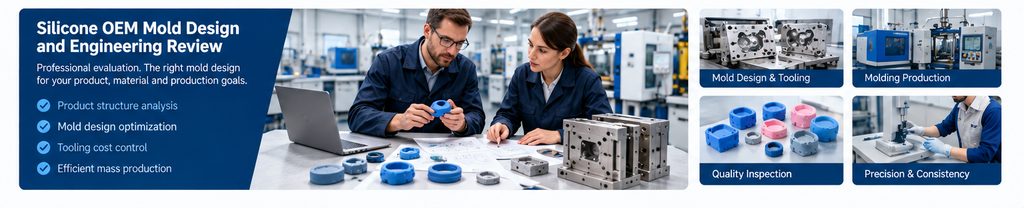
12. How a Silicone OEM Manufacturer Reviews a New Product
When a customer sends a new silicone product design, a professional manufacturer may review several areas before providing a final quotation.
Structure du produit
Is the product easy to mold and demold?
Wall Thickness
Are there areas that may create production difficulties?
Parting Line
Where should the mold separate?
Contre-dépouilles
Are additional mold structures required?
Venting
Where could air become trapped?
Cavities
Would a single-cavity or multi-cavity mold be more suitable?
Volume de production
What tooling configuration makes sense for the expected order quantity?
Surface Details
Can small logos, textures, or character details be reproduced consistently?
Manufacturing Process
Would compression molding, LSR injection molding, or another process be appropriate?
This engineering review is an important part of custom silicone manufacturing.
Common Silicone Mold Design Mistakes
Before starting tooling, buyers should watch for several common problems.
Erreur n° 1 : concevoir uniquement en fonction de l'aspect esthétique
A product may look attractive in a 3D rendering but be difficult to manufacture.
Better approach:
Consider manufacturability during the design stage.
Mistake 2: Ignoring the Parting Line
If the parting line is not considered early, it may end up in a highly visible location.
Better approach:
Discuss parting line placement with the manufacturer before mold production.
Mistake 3: Using Too Many Small Details
Very small details may look good on a screen but may be difficult to reproduce consistently.
Better approach:
Ask the manufacturer which details are suitable for silicone production.
Mistake 4: Choosing a Mold Only by Price
The lowest tooling quotation may not always provide the best production economics.
Better approach:
Compare tooling cost together with expected production volume, quality requirements, and production efficiency.
Mistake 5: Not Considering Future Orders
A mold designed only for a small initial order may not be the most suitable solution if the product later becomes a long-term item.
Better approach:
Tell the manufacturer your expected production volume and future plans before finalizing the tooling structure.
How to Reduce Silicone Mold Costs Without Sacrificing Quality
There are several practical ways to control tooling costs.
1. Simplify unnecessary product details
Remove details that do not contribute significantly to the product’s function or appearance.
2. Optimize the product geometry
Avoid unnecessary undercuts and difficult structures where possible.
3. Choose the cavity number according to actual demand
Do not automatically choose a high-cavity mold for a small-volume project.
4. Confirm the design before tooling
Frequent design changes after mold production can increase development costs and lead time.
5. Work with an experienced OEM manufacturer
Silicone Mold Design Checklist for OEM Buyers
Before approving a silicone mold, buyers can ask the manufacturer:
- Is the product geometry suitable for molding?
- Where will the parting line be?
- Are there any difficult undercuts?
- How many cavities will the mold have?
- How will the mold be vented?
- Is the product thickness suitable for production?
- What molding process will be used?
- What is the expected production cycle?
- What is the estimated mold lifetime?
- How much will tooling cost?
- How long will tooling take?
- Can the mold be modified if the design changes?
- Is the mold configuration suitable for future mass production?
These questions can help prevent unexpected manufacturing problems later.
Réflexions finales
Silicone mold design is one of the most important stages of custom silicone product development.
It can affect:
Coût
Quality
Vitesse de production
Cohérence des produits
Tooling life
Production capacity
Overall project lead time
For simple products, mold design may appear straightforward.
For complex silicone products, IP merchandise, consumer products, and high-volume OEM projects, mold engineering becomes much more important.
The best approach is to consider product design, material, molding process, tooling structure, production volume, and target cost together before starting mold production.
If you are developing a new custom silicone product, an experienced OEM manufacturer can help review the design and recommend a suitable mold and production method before tooling begins.
Need help evaluating your silicone product design?
Send us your product drawings, 3D files, or product concept.
Our team can review the structure, molding requirements, tooling considerations, and production approach for your custom silicone project.
From product concept to mold design and mass production, we support OEM and ODM silicone manufacturing for brands, promotional products, consumer products, and IP-derived products.
 English
 Chinese
 Japanese
 Spanish
 French
 Arabic
 Russian
 Portuguese
 Belarusian
[…] Appearance + Function + Manufacturability + Cost […]
[…] This is why two products with similar dimensions can still have different tooling quotations. […]
[…] The mold is a major part of the development process. […]
[…] relationship between product geometry and silicone mold design can directly affect tooling cost, product quality, and production […]
[…] relationship between product geometry and silicone mold design can affect tooling cost, production time, and finished product […]