
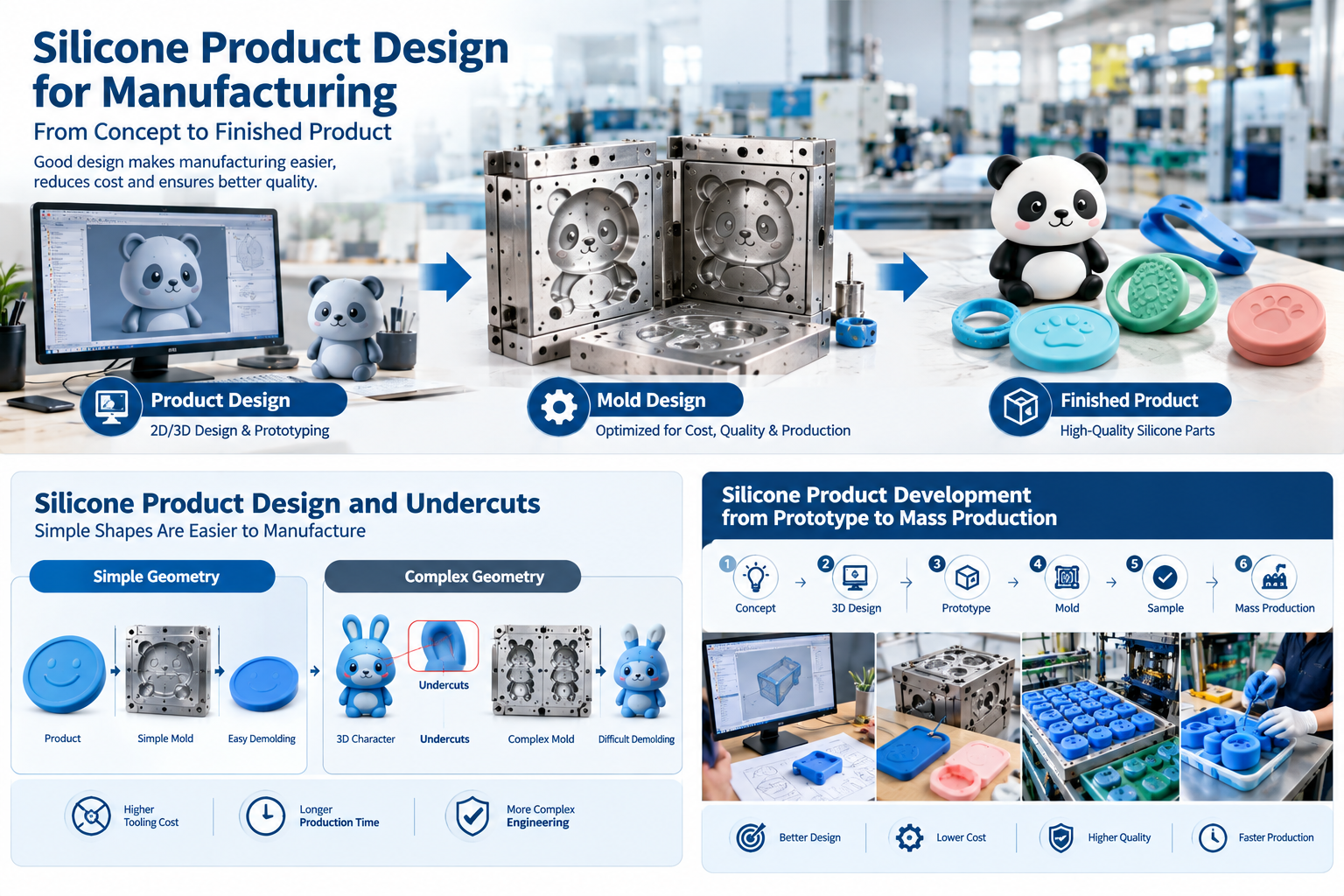
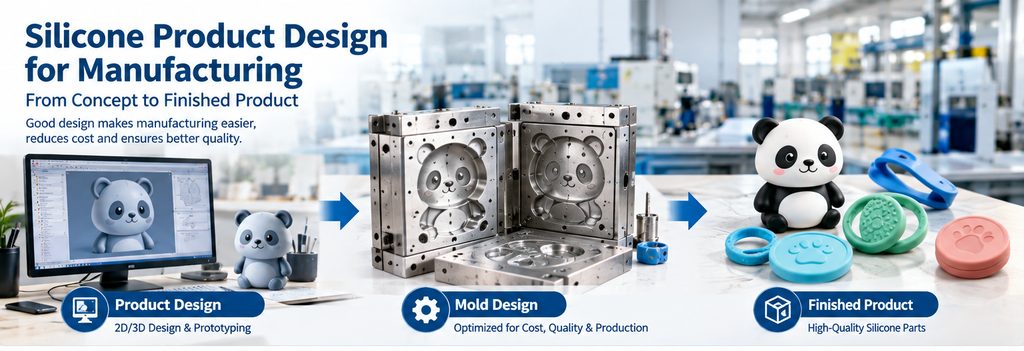
Designing a custom silicone product is more than creating an attractive 3D model.
A product may look perfect on a computer screen, but that does not necessarily mean it is easy to manufacture.
When a silicone product moves from concept to prototype and then into mass production, the original design may affect:
- Tooling cost
- Qualidade do produto
- Mold complexity
- Sampling time
- Eficiência da produção
- Consumo de materiais
- Desmoldagem
- Consistência do produto
- Final unit cost
This is why design for manufacturing is an important part of custom silicone product development.
For brands, promotional product companies, IP owners, and product developers, identifying potential manufacturing problems before tooling can save both time and money.
In this guide, we explain 10 common silicone product design mistakes and how to avoid them.
What Is Design for Manufacturing for Silicone Products?
Design for Manufacturing, often called DFM, means designing a product with the manufacturing process in mind.
For silicone products, this means considering not only how the product looks, but also:
- How the silicone will fill the mold
- How the product will be cured
- How the product will be removed from the mold
- Where the parting line will be located
- Whether air can escape
- Whether the product geometry is suitable for molding
- How the product will be produced at scale
A good silicone product design should balance:
Appearance + Function + Manufacturability + Cost
This becomes especially important for products such as silicone keychains, consumer products, character merchandise, protective cases, promotional gifts, and IP-derived products.
1. Making the Product Too Complex
One of the most common mistakes is adding too much unnecessary complexity to the product.
Complex shapes can require more complicated molds and may increase manufacturing difficulty.
For example, a simple silicone coaster can usually be designed with a relatively straightforward geometry.
A 3D character with:
- Deep recesses
- Thin protrusions
- Multiple undercuts
- Small decorative details
- Complex internal structures
may require significantly more mold engineering.
This does not mean complex products should be avoided.
Instead, the goal is to determine which details are important to the final product and which details can be simplified.
Better approach
Before finalizing the design, ask:
Does this detail improve the product, or does it simply make manufacturing more difficult?
For IP products, some details are essential because they define the character.
Other details may be simplified without significantly changing the overall appearance.
2. Ignoring Parting Lines
The parting line is where mold sections meet during production.
It is a normal part of many molded silicone products, but its location can affect the final appearance.
A common mistake is designing the product first and thinking about the parting line only after the mold quotation has been prepared.
This can create problems when the ideal parting line is difficult to achieve with the original geometry.
Better approach
Consider the parting line during product development.
For consumer-facing products, manufacturers may try to position it:
- Along an existing edge
- On the back of the product
- Along a less visible surface
- Within a natural design boundary
This can help minimize its visual impact.
3. Designing Thin Sections Without Considering Production
Thin silicone sections can create manufacturing challenges depending on the product structure and selected process.
Examples include:
- Thin character ears
- Narrow straps
- Small decorative fins
- Thin walls
- Long narrow extensions
The thinner the structure becomes, the more carefully the manufacturer may need to evaluate material flow, filling, curing, handling, and durability.
A thin section may also be more vulnerable to deformation during demolding or use.
Better approach
Instead of specifying extremely thin structures simply because they look good in a 3D model, discuss the intended thickness with the manufacturer.
The suitable thickness depends on:
- Tamanho do produto
- Geometria
- Material de silicone
- Método de moldagem
- Functional requirements
4. Adding Too Many Tiny Details
Silicone can reproduce many surface details, but extremely small features should be evaluated carefully.
Tiny:
- Text
- Logótipos
- Linhas
- Textures
- Facial details
- Decorative patterns
may not reproduce exactly as they appear in a digital rendering.
This is particularly important for small promotional products.
For example, a logo that looks clear on a large CAD model may become difficult to read after being reduced to a small silicone keychain.
Better approach
Scale important details according to the actual finished product size.
If a logo or character detail is critical, ask the manufacturer to evaluate it before mold production.
A physical prototype or sample can help confirm whether the detail is sufficiently clear.
5. Ignoring Undercuts
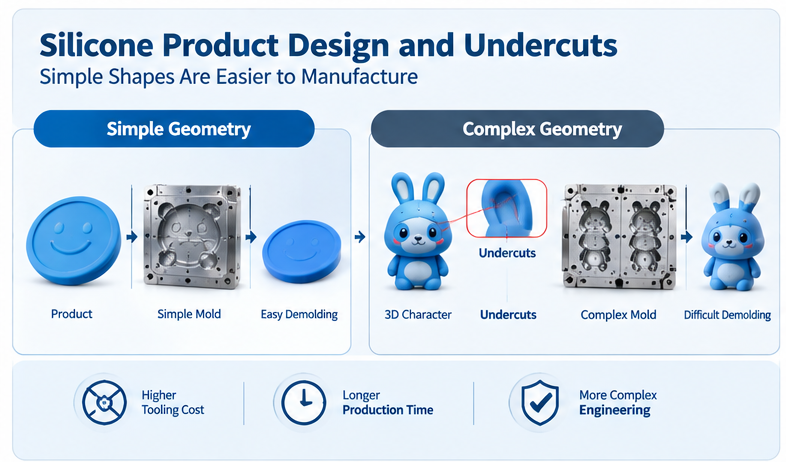
Undercuts are one of the most important design considerations for molded silicone products.
An undercut occurs when part of the product geometry prevents the product from being easily removed from a conventional mold.
They are common in:
- 3D figurines
- Character products
- Silicone cases
- Decorative products
- Complex consumer products
For example, a character’s ears, arms, legs, or recessed structures may create undercuts.
Undercuts do not necessarily make a product impossible to manufacture.
However, they can increase mold complexity and may require a different tooling strategy.
Better approach
6. Forgetting About Demolding
A product is not finished simply because silicone can fill the mold.
The manufacturer also needs to remove the cured product from the mold.
This process is called demolding.
If the product geometry makes demolding difficult, it may lead to:
- Longer production cycles
- Product deformation
- Damage to small details
- Higher labor requirements
- Increased rejection rates
A product that is easy to mold but difficult to remove may still be inefficient for mass production.
Better approach
When reviewing a new product design, consider:
Can the finished product be removed from the mold efficiently and repeatedly?
This is particularly important for products with deep cavities and complicated geometry.
7. Designing for One Prototype Instead of Mass Production
A prototype and a mass-production product have different requirements.
A prototype only needs to demonstrate that the concept works.
Mass production requires the product to be:
- Repeatable
- Consistent
- Efficient to manufacture
- Easy to inspect
- Easy to package
- Economically viable
A design that works for 10 samples may not necessarily be suitable for producing 10,000 units.
This is why OEM manufacturers often review product geometry differently when preparing for mass production.
The key question is:
Can we produce this product repeatedly with consistent quality?
Not simply:
Can we make one sample?
8. Choosing Product Dimensions Without Considering Material Usage
Product size affects more than appearance.
It can also affect:
- Consumo de materiais
- Tamanho do molde
- Cycle time
- Embalagem
- Custos de envio
- Unit cost
For example, making a silicone product slightly thicker may seem insignificant during the design stage.
However, if the product is manufactured in large quantities, the additional silicone material can affect total production cost.
For larger consumer products, material usage can become particularly important.
Better approach
Optimize the product dimensions according to:
Function + Appearance + Strength + Material Efficiency
This is especially useful when the product will be manufactured in high volumes.
9. Changing the Design After Mold Production Starts
Late design changes are one of the easiest ways to increase project cost and lead time.
Imagine a project following this process:
3D Design
↓
Conceção de moldes
↓
Ferramentas
↓
First Sample
↓
Customer Changes Product
↓
Mold Modification
↓
New Sample
Every additional modification can potentially affect the development schedule.
Some changes may be simple.
Others may require significant mold modification or even a new mold structure.
Better approach
Before approving tooling, confirm:
- Dimensões do produto
- Logo placement
- Cor
- Textura da superfície
- Linha de separação
- Product details
- Functional requirements
- Requisitos de embalagem
A detailed design review before tooling can reduce unnecessary modifications later.
10. Choosing the Manufacturing Process Too Late
Another common mistake is finalizing the product design without considering how it will actually be manufactured.
Different silicone molding processes have different characteristics.
For example, solid silicone compression molding and LSR injection molding are not interchangeable in every application.
The appropriate process can depend on:
- Geometria do produto
- Requisitos de material
- Volume de produção
- Automation requirements
- Tooling considerations
- Custo-alvo
- Product specifications
How to Design a Silicone Product for Easier Manufacturing
Before sending a product to tooling, use the following checklist.
Estrutura do produto
Is the overall shape suitable for silicone molding?
Wall Thickness
Are there extremely thin or unusually thick sections?
Cortes por baixo
Are there areas that may make demolding difficult?
Linha de separação
Where should the mold separate?
Surface Details
Are logos, textures, and small details large enough to reproduce clearly?
Dimensões
Are the product dimensions optimized for function and material efficiency?
Volume de produção
Is the design suitable for the expected order quantity?
Molding Process
Has the appropriate silicone molding process been considered?
Future Production
Can the same design be produced consistently at larger volumes?
How OEM Manufacturers Can Help During the Design Stage
A good silicone OEM manufacturer should not only produce the product after receiving a finished drawing.
The manufacturer can also provide input during the development stage.
Depending on the project, this may include reviewing:
- Geometria do produto
- Estrutura do molde
- Linhas de separação
- Cortes por baixo
- Seleção de materiais
- Processo de produção
- Tooling requirements
- Expected production volume
Early communication can help identify potential problems before tooling begins.
Silicone Product Design: Prototype vs Mass Production
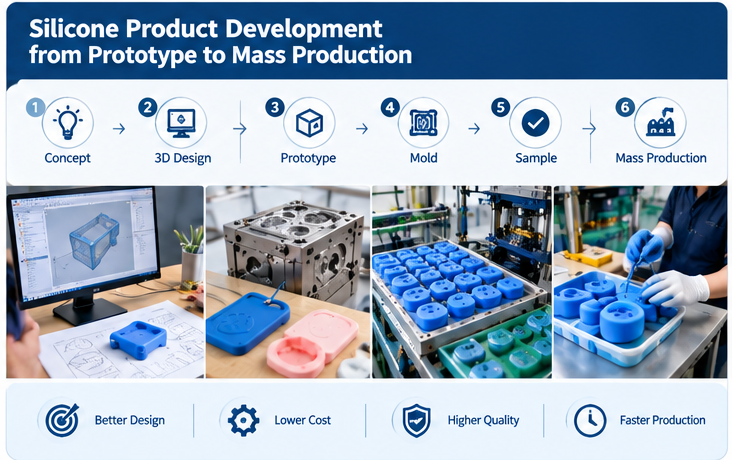
A useful way to think about silicone product development is:
| Development Stage | Main Goal |
|---|---|
| Concept | Ideia de produto |
| 3D Design | Shape and appearance |
| Análise de DFM | Viabilidade de fabrico |
| Conceção de moldes | Tooling structure |
| Protótipo | Verify product |
| Aprovação da amostra | Confirm requirements |
| Produção em massa | Consistent manufacturing |
The DFM review sits between product design and tooling for a reason.
It helps turn a product concept into a design that can actually be manufactured efficiently.
How Better Design Can Reduce Silicone Product Costs
Good product design does not necessarily mean making the product simpler or cheaper.
Instead, it means eliminating unnecessary manufacturing difficulty.
Por exemplo:
Unnecessary undercuts
→ More complex tooling
Excessively small details
→ Difficult reproduction
Poor parting line placement
→ Visible mold marks
Very thin sections
→ Potential production challenges
Unoptimized dimensions
→ More material usage
Late design changes
→ Additional tooling work
By addressing these issues before production, brands can potentially reduce unnecessary development costs and production delays.
Considerações finais
Good silicone product design is not only about making a product look attractive.
It is about creating a product that can be:
Designed → Molded → Demolded → Inspected → Produced → Scaled
efficiently.
For OEM and ODM projects, considering manufacturing requirements early can help reduce tooling problems, improve product consistency, and make the transition from prototype to mass production smoother.
Whether you are developing a silicone keychain, consumer product, promotional gift, protective case, character figure, or IP-derived product, it is worth reviewing the design from a manufacturing perspective before starting tooling.
Have a silicone product idea?
Send us your drawings, 3D files, or product concept.
Our team can help review the product structure, mold requirements, material options, and manufacturing process before production begins.
We support OEM and ODM silicone product development from concept and tooling to mass production.
 English
 Chinese
 Japanese
 Spanish
 French
 Arabic
 Russian
 Portuguese
 Belarusian
[…] Silicone Product Design for Manufacturing […]
[…] Silicone Pet Bowl Design OptionsThe design of a custom pet bowl can go far beyond simply choosing a color.ShapePossible options […]
[…] Final costThis is why it is useful to involve the manufacturer before the design is finalized. […]
[…] Engineers convert ideas into production-ready designs. […]
[…] A good silicone product design should therefore consider both appearance and manufacturability. […]
[…] For consumer kitchenware products, the manufacturer should consider where the parting line will appear and whether it can be minimized …. […]
[…] For complex products, material selection should therefore happen together with product design and mo… […]
[…] right silicone product design should consider hardness, thickness, flexibility, geometry, and the intended application […]
[…] is why silicone product design and material selection should be evaluated […]