
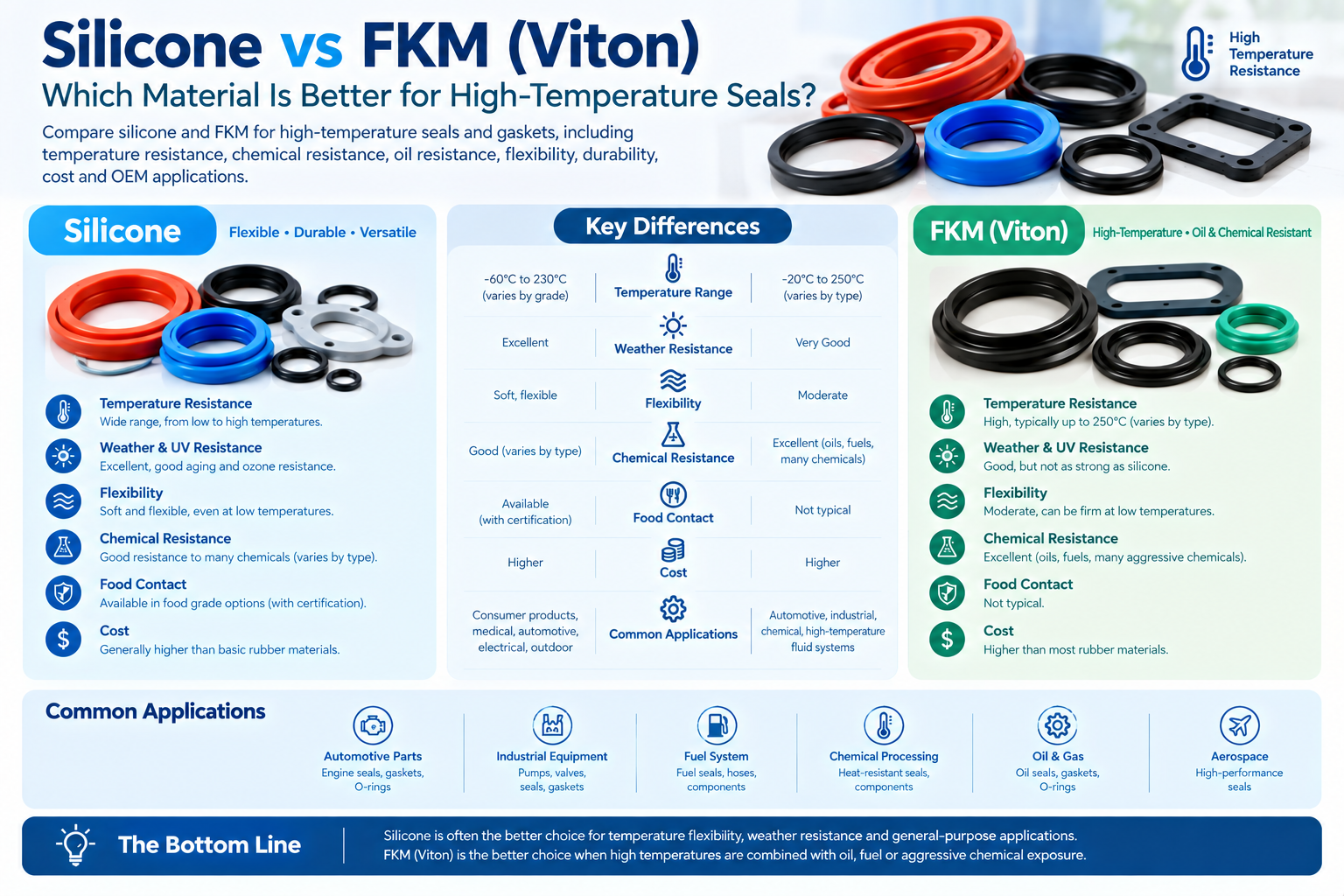

When developing a high-temperature seal, gasket, O-ring, or flexible industrial component, material selection can have a major impact on product performance.
Silicone and FKM are both high-performance elastomers, but they are designed for different operating environments.
Silicone is widely known for its flexibility, broad temperature performance, weather resistance, and availability in different grades.
FKM, commonly known by the trade name Viton, is well known for its strong resistance to high temperatures, oils, fuels, and many aggressive chemicals.
So which material is better for a custom seal?
Silicone or FKM?
The answer depends on the actual operating environment.
Temperature, oil exposure, chemical exposure, flexibility, compression, outdoor conditions, pressure, product geometry, and cost can all influence the final material decision.
In this guide, we compare silicone vs FKM for high-temperature seals and flexible components, including temperature resistance, chemical resistance, oil resistance, flexibility, durability, cost, and OEM applications.
What Is Silicone?
Silicone is a versatile elastomer used in consumer products, industrial components, electrical products, automotive parts, seals, gaskets, and many other applications.
One of silicone’s major advantages is its ability to maintain useful flexibility across a relatively wide temperature range.
Depending on the formulation, silicone can provide:
- Good high-temperature performance
- Good low-temperature flexibility
- Excellent weather resistance
- Good UV resistance
- Good ozone resistance
- Good aging resistance
- Customizable hardness
- Electrical insulation
- Soft-touch performance
Silicone is also available in different grades for different applications.
For example, certain silicone formulations can be developed for food-contact applications, while others are intended for industrial or technical applications.
For OEM products, silicone can also be customized in different colors, hardness levels, textures, shapes, and surface finishes.
What Is FKM?
FKM is a family of fluoroelastomers known for strong resistance to high temperatures, oils, fuels, and many chemicals.
In some markets, FKM is commonly associated with the brand name Viton.
FKM is widely used in applications such as:
- Automotive seals
- Oil seals
- Fuel-system components
- O-rings
- Industrial gaskets
- Chemical-processing equipment
- High-temperature sealing components
One of the main reasons manufacturers select FKM is its combination of high-temperature performance and chemical resistance.
However, FKM is not automatically the best choice for every high-temperature application.
The actual temperature, chemical environment, flexibility requirements, and cost target still need to be evaluated.
Silicone vs FKM: Quick Comparison
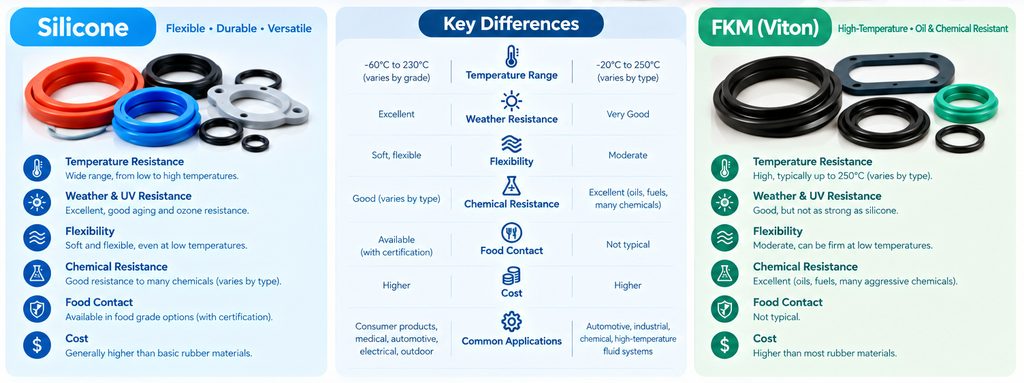
Silicone and FKM can both be used in demanding sealing applications, but their strengths are different.
Силикон
Silicone is often attractive when you need:
- Wide temperature performance
- Good low-temperature flexibility
- Strong weather resistance
- UV and ozone resistance
- Flexible sealing
- Soft-touch performance
- Electrical insulation
- Food-contact options for suitable grades
- Custom colors and appearance
FKM
FKM is often attractive when you need:
- High-temperature sealing
- Strong oil resistance
- Fuel resistance
- Resistance to many chemicals
- Automotive applications
- Industrial sealing
- Aggressive fluid environments
A simple way to understand the difference is:
Silicone is often chosen for temperature flexibility and environmental resistance, while FKM is often chosen when high temperature is combined with oil, fuel, or chemical exposure.
Silicone vs FKM Temperature Resistance
Temperature is one of the most important factors when comparing these materials.
Silicone can perform across a broad temperature range and is particularly useful when flexibility needs to be maintained under changing temperatures.
FKM is also designed for demanding temperature environments and can perform well in many high-temperature applications.
However, the practical temperature range depends on:
- Состав материала
- Exposure time
- Mechanical load
- Воздействие химических веществ
- Pressure
- Дизайн продукта
Therefore, buyers should not select a material based only on a general temperature number.
The manufacturer should evaluate the actual operating conditions.
For a custom silicone product, understanding the предельная температура силикона is an important part of material selection.
Silicone vs FKM for High-Temperature Seals
Both materials can be considered for high-temperature seals.
The key question is what else the seal must withstand.
If the seal is exposed primarily to heat and requires good flexibility, silicone may be a suitable option.
If the seal is exposed to high temperatures together with oils, fuels, or aggressive chemicals, FKM may offer an advantage.
For example, a high-temperature seal in a relatively clean environment may have very different material requirements from a high-temperature automotive seal exposed to fuel or engine fluids.
This is why the operating environment should be defined before selecting the material.
Silicone vs FKM for Low-Temperature Applications
Low-temperature flexibility is an area where silicone can be attractive.
Some silicone formulations can remain flexible under low-temperature conditions.
This can be useful for:
- Outdoor equipment
- Cold environments
- Refrigeration-related products
- Temperature cycling
- Гибкие уплотнения
FKM can also be used in demanding environments, but low-temperature flexibility depends heavily on the specific FKM formulation.
If your product must remain flexible at low temperatures, the manufacturer should evaluate the actual temperature requirement rather than comparing generic material specifications.
Silicone vs FKM Oil Resistance
Oil resistance is one of the biggest differences between silicone and FKM.
FKM is widely recognized for strong resistance to many oils, fuels, and petroleum-based fluids.
This makes it a common choice for:
- Oil seals
- Fuel-system seals
- Automotive gaskets
- O-rings
- Industrial equipment
- Fluid-handling components
Silicone can perform well in many applications, but it is generally not the first material selected when strong resistance to petroleum-based oils is the primary requirement.
Therefore, if your custom seal is continuously exposed to oil or fuel, FKM may be worth considering.
However, the exact fluid, temperature, concentration, and exposure time should always be confirmed.
Silicone vs FKM Chemical Resistance
Chemical compatibility is another major consideration.
FKM is commonly selected for applications involving many aggressive chemicals, oils, fuels, and industrial fluids.
Silicone has good resistance to many environmental conditions, but it does not have the same chemical resistance profile as FKM for every application.
The actual performance depends on:
- Chemical type
- Concentration
- Temperature
- Exposure time
- Pressure
- Состав материала
For a critical sealing application, the exact chemical environment should be provided to the manufacturer.
Do not simply tell the manufacturer that the seal will be exposed to “chemicals.”
The exact substance is much more useful.
Silicone vs FKM for Fuel Applications
Fuel exposure is another application where FKM is often considered.
FKM can provide strong resistance to many fuels and petroleum-based fluids.
This makes it useful for applications such as:
- Fuel-system seals
- Автомобильные компоненты
- Fuel-related gaskets
- Industrial equipment
- Fluid-handling systems
Silicone may not be the preferred choice when continuous fuel exposure is the primary requirement.
However, the correct material still depends on the exact fuel, temperature, pressure, and expected service life.
Silicone vs FKM for Automotive Applications
Both silicone and FKM are used in automotive applications, but they can be selected for different reasons.
Silicone may be considered for:
- Flexible automotive components
- High-temperature areas
- Electrical components
- Weather-exposed parts
- Certain hoses and seals
FKM may be considered for:
- Fuel-system seals
- Oil seals
- Engine-related sealing
- High-temperature fluid exposure
- Chemical-resistant components
The location of the component inside the vehicle is extremely important.
An exterior weather seal and a fuel-system seal may require completely different materials even if both operate at elevated temperatures.
Silicone vs FKM for Outdoor Applications
Silicone has strong resistance to outdoor environmental exposure.
It is generally well suited to applications involving:
- UV exposure
- Ozone
- Rain
- Humidity
- Temperature changes
- Long-term weathering
FKM can also provide useful environmental resistance, but if the main challenge is long-term outdoor weathering rather than chemical or fuel exposure, silicone may be a more attractive option in some applications.
Again, the actual environment should determine the final decision.
Silicone vs FKM UV and Ozone Resistance
UV and ozone can gradually affect elastomeric materials.
Long-term exposure can lead to:
- Hardening
- Cracking
- Потеря гибкости
- Surface deterioration
- Reduced sealing performance
Silicone is well known for its resistance to UV and ozone.
This can make silicone attractive for outdoor seals and components where environmental aging is an important concern.
FKM may be preferred when chemical and fluid resistance is more important than long-term outdoor exposure.
Silicone vs FKM Flexibility
Silicone is often selected when flexibility is a major requirement.
Its material characteristics allow manufacturers to produce soft and flexible components in different hardness levels.
FKM can also be flexible, but the material is often selected primarily for its resistance to demanding chemical, oil, fuel, and temperature environments.
The final flexibility of either material depends on:
- Твердость
- Толщина изделия
- Геометрия
- Толщина стенки
- Размер изделия
- Состав материала
- Проектирование пресс-форм
Therefore, material type alone does not determine how flexible the finished part will feel.
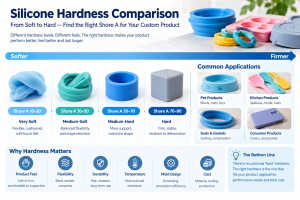
For custom silicone products, silicone hardness should be selected according to the required flexibility, compression, product geometry, and application.
Silicone vs FKM for Gaskets
Both silicone and FKM can be used to manufacture custom gaskets.
The better choice depends on the operating environment.
Silicone Gaskets
Silicone gaskets may be suitable when you need:
- Wide temperature performance
- Low-temperature flexibility
- Weather resistance
- UV resistance
- Ozone resistance
- Flexible sealing
- Food-contact options for suitable grades
FKM Gaskets
FKM gaskets may be suitable when you need:
- Strong oil resistance
- Fuel resistance
- High-temperature performance
- Chemical resistance
- Industrial sealing
- Automotive sealing
The gasket geometry also matters.
A material that works well in one gasket design may not provide the same performance in another.
Silicone vs FKM for O-Rings
O-rings are another common application where material selection is critical.
Silicone O-rings may be considered when:
- Temperature flexibility is important
- Low-temperature performance is important
- Outdoor exposure is significant
- Soft sealing is required
FKM O-rings may be considered when:
- Oil exposure is significant
- Fuel exposure is expected
- High temperatures are involved
- Chemical resistance is important
For dynamic applications, pressure conditions and friction should also be considered.
The correct O-ring material depends on the complete application rather than one property.
Silicone vs FKM for Food Contact
Food-contact applications require a different material-selection approach.
Certain silicone formulations are available for food-contact applications when they meet the applicable requirements.
FKM should not automatically be considered suitable for food contact simply because it has strong chemical resistance.
If the finished product directly contacts food, the required material grade and applicable regulatory requirements should be confirmed before production.
For food-contact products, choosing the correct food grade silicone specification is an important part of the development process.
How Product Design Affects Silicone vs FKM Selection
Material selection should always be considered together with product design.
The product geometry can affect:
- Сжатие
- Гибкость
- Sealing
- Расход материалов
- Demolding
- Толщина стенки
- Эффективность производства
For example, a thin flexible seal may require very different material characteristics from a thick structural gasket.
A complex seal may also require additional attention to parting lines, flash, and demolding.
Good дизайн изделий из силикона takes material properties, geometry, sealing requirements, and manufacturing requirements into account before the mold is finalized.
Silicone vs FKM Mold Design
The selected material can influence tooling and production considerations.
For custom silicone parts, mold design can affect:
- Линии разъединения
- Venting
- Flash
- Demolding
- Cavities
- Product appearance
- Эффективность производства
For seals and gaskets with complex geometry, mold design should be reviewed before tooling begins.
The relationship between product geometry and проектирование силиконовых форм can affect tooling cost, production time, and finished product quality.
Silicone vs FKM Cost
Cost is an important consideration when comparing silicone and FKM.
FKM is generally considered a higher-cost elastomer than many common rubber materials.
Silicone can also have a higher material cost than basic rubber materials, depending on the formulation.
However, material price should not be the only factor used to compare the two.
The total product cost may include:
- Raw material
- Стоимость плесени
- Производство
- Scrap
- Testing
- Проверка качества
- Упаковка
- Количество продукции
- Expected service life
A more expensive material can sometimes be the more economical choice if it provides the required performance and service life.
When developing a custom silicone component, the стоимость изделий из силикона на заказ should be evaluated together with tooling, material requirements, production volume, and product complexity.
Is FKM Always Better Than Silicone for High Temperatures?
No.
This is a common misunderstanding.
Both silicone and FKM can be suitable for high-temperature applications.
The important question is:
What other conditions exist besides temperature?
If the product needs high-temperature flexibility and strong outdoor resistance, silicone may be a good option.
If the product needs high-temperature performance together with strong resistance to oil, fuel, or aggressive chemicals, FKM may be more suitable.
Therefore, simply choosing the material with the highest temperature specification is not always the correct approach.
Silicone vs FKM for Long-Term Durability
Durability depends on the actual environment.
A seal can fail because of:
- Excessive heat
- Воздействие химических веществ
- Oil exposure
- Сжатие
- Mechanical stress
- UV exposure
- Ozone
- Incorrect material selection
- Poor product design
Silicone can provide excellent long-term performance in many environmental and temperature conditions.
FKM can provide excellent durability when exposed to demanding oils, fuels, chemicals, and high temperatures.
The best material is therefore the one that remains stable in the actual environment where the product will be used.
How to Choose Between Silicone and FKM
A simple decision framework can help.
Choose Silicone When:
Silicone may be a strong candidate when you need:
- Wide temperature performance
- Good low-temperature flexibility
- Strong UV resistance
- Ozone resistance
- Outdoor durability
- Flexible sealing
- Food-contact options
- Electrical insulation
- Custom colors and appearance
Choose FKM When:
FKM may be a strong candidate when you need:
- High-temperature sealing
- Strong oil resistance
- Fuel resistance
- Chemical resistance
- Automotive fluid exposure
- Industrial sealing
- Demanding fluid environments
These are general guidelines rather than universal rules.
The final material should always be selected according to the actual product requirements.
Common Mistakes When Choosing Silicone vs FKM
Mistake 1: Choosing Only Based on Maximum Temperature
A material’s maximum temperature capability is only one part of its performance.
Mistake 2: Ignoring Oil and Fuel Exposure
A high-temperature seal may also encounter oils or fuels.
This can completely change the material recommendation.
Mistake 3: Assuming FKM Is Always Better
FKM can be excellent for demanding chemical and oil environments, but that does not make it the best material for every high-temperature product.
Mistake 4: Ignoring Low-Temperature Flexibility
A seal may need to operate at both high and low temperatures.
Mistake 5: Ignoring Product Geometry
Thickness, compression, and shape can significantly affect sealing performance.
Mistake 6: Skipping Samples
A physical prototype can reveal flexibility, compression, surface quality, and fit problems before mass production.
How to Test Silicone vs FKM Before Mass Production

If the material choice is uncertain, representative samples should be evaluated before committing to large-scale production.
Step 1: Define the Operating Environment
Identify:
- Minimum temperature
- Maximum temperature
- Oil exposure
- Fuel exposure
- Воздействие химических веществ
- UV exposure
- Ozone exposure
- Pressure
- Expected service life
Step 2: Select Candidate Materials
Compare silicone, FKM, and any other potentially suitable materials.
Step 3: Produce Representative Samples
Use the actual product geometry whenever possible.
Step 4: Test the Samples
Оцените:
- Гибкость
- Сжатие
- Sealing
- Температурные характеристики
- Oil resistance
- Chemical resistance
- Weather resistance
- Стабильность размеров
Step 5: Compare the Results
Check whether the samples meet the actual product requirements.
Step 6: Approve the Material Specification
Once the material is confirmed, document the approved specification before mass production.
Почему важно сотрудничать с опытным производителем силикона
Material selection becomes much easier when the manufacturer understands both material properties and manufacturing requirements.
Опытный производитель может помочь оценить:
- Material grade
- Твердость
- Геометрия изделия
- Проектирование пресс-форм
- Метод производства
- Отбор проб
- Контроль качества
- Стабильность производства
For a high-temperature sealing project, the manufacturer should also understand the difference between choosing a material for temperature alone and choosing one for temperature plus chemical exposure.
Instead of asking:
“Which material is cheaper?”
ask:
“Which material is most suitable for my operating environment?”
Choosing the right производитель силикона can help you evaluate material selection, product design, mold development, sampling, and mass production as one complete process.
Заключительные размышления
Silicone and FKM are both high-performance elastomers, but they are best suited to different types of demanding applications.
Silicone is often attractive when flexibility, low-temperature performance, weather resistance, UV resistance, and environmental durability are important.
FKM is often attractive when high temperatures are combined with oil, fuel, or aggressive chemical exposure.
The right choice should therefore be based on the complete operating environment rather than one material property.
A useful way to approach the decision is:
Application → Temperature → Oil Exposure → Chemical Exposure → Flexibility → Product Design → Manufacturing → Cost
For OEM buyers, making this decision before tooling and mass production can help reduce development risk and prevent expensive material changes later.
Ready to Develop Your Custom Silicone Seal or Gasket?
If you are developing a custom silicone seal, gasket, O-ring, high-temperature component, or other molded silicone product, material selection should be considered early in the development process.
Share your product drawings, 3D files, dimensions, operating temperature, chemical exposure, expected production quantity, and application requirements.
An experienced silicone manufacturer can help you evaluate the material, hardness, product design, mold, sampling process, and mass-production requirements before production begins.
 English
 Chinese
 Japanese
 Spanish
 French
 Arabic
 Russian
 Portuguese
 Belarusian