
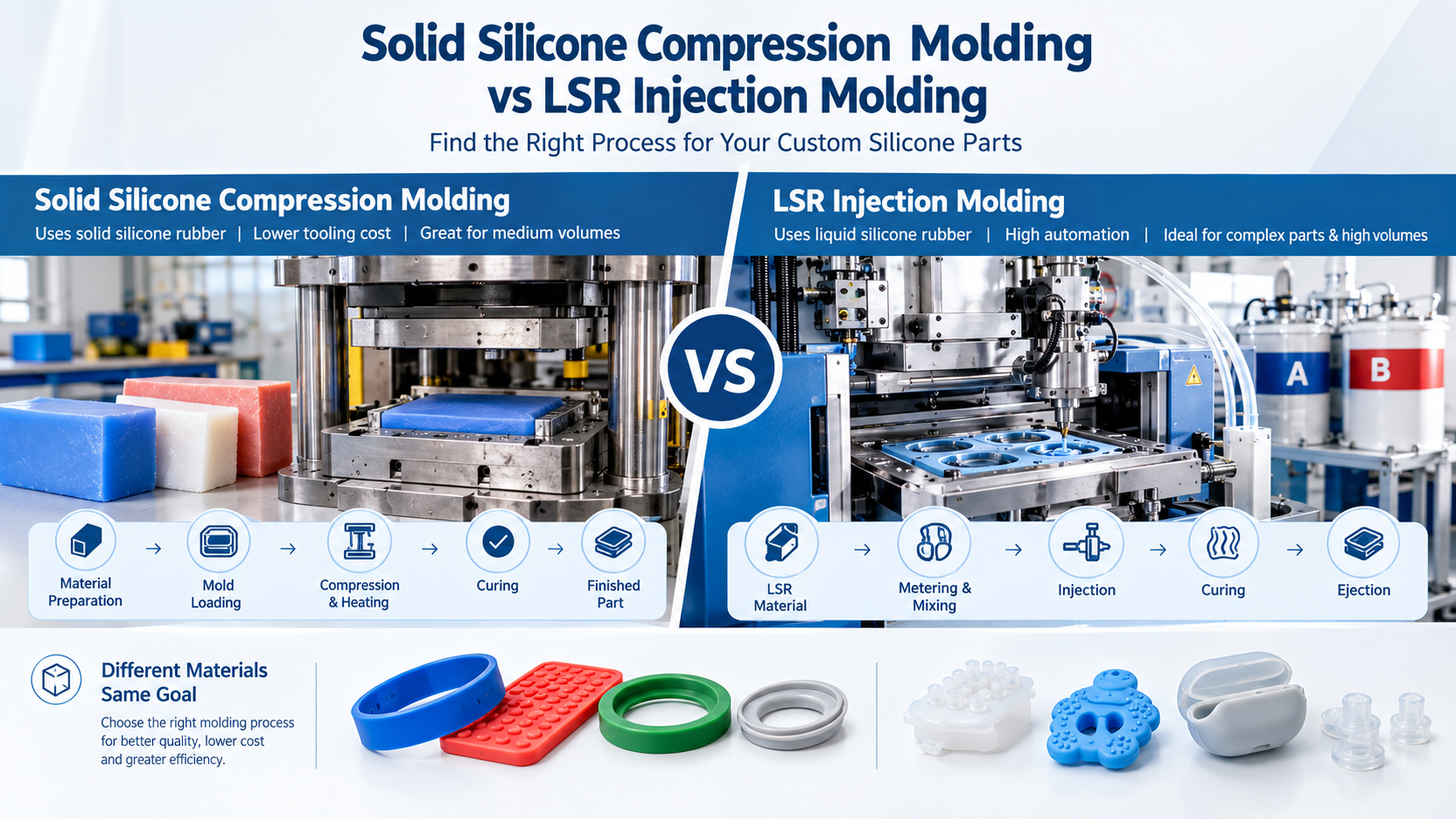
When developing a custom silicone product, the molding process you choose can affect much more than the appearance of the final part.
It can influence tooling investment, production efficiency, material usage, consistency, lead time, and overall manufacturing cost.
For OEM and ODM buyers, two common options are solid silicone compression molding и LSR injection molding.
Although both processes are used to manufacture silicone parts, they work in very different ways and are suited to different production requirements.
Solid silicone compression molding is commonly used with solid silicone rubber and is suitable for a wide range of custom molded products.
LSR injection molding, on the other hand, uses Liquid Silicone Rubber and is particularly suitable for highly automated and repeatable production.
So, which process should you choose for your product?
The answer depends on your material, product design, order quantity, tooling budget, and production requirements.
This guide explains the practical differences between solid silicone compression molding and LSR injection molding to help OEM buyers make a more informed manufacturing decision.
Solid Silicone Compression Molding vs LSR Injection Molding at a Glance
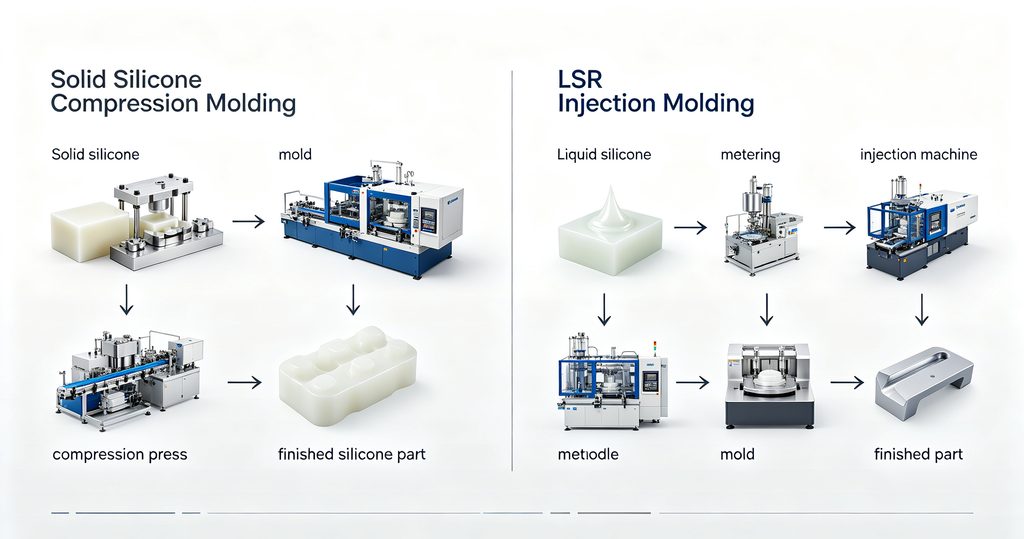
Before going into the technical details, it helps to understand the basic differences between the two processes.
| Solid Silicone Compression Molding | LSR Injection Molding | |
|---|---|---|
| Silicone material | Solid silicone rubber | Liquid Silicone Rubber |
| Material preparation | Pre-measured material | Automated metering and mixing |
| Automation | Low to high, depending on setup | High |
| Tooling complexity | Generally simpler | Generally more complex |
| Скорость производства | Moderate | High |
| Suitable volume | Small to large | Medium to very large |
| Сложность конструкции | Simple to moderately complex | Moderately to highly complex |
| Typical advantage | Flexible and cost-conscious production | High-volume, consistent production |
There is no universal winner between the two.
The right manufacturing process is the one that matches your product requirements and expected production volume.
What Is Solid Silicone Compression Molding?
Solid silicone compression molding is a well-established process for manufacturing molded silicone products from solid silicone rubber.
A measured amount of silicone material is prepared and placed into a mold cavity. The mold is then closed and heated under controlled pressure.
As the material cures, it takes the shape of the mold cavity.
A typical production cycle includes:
Material preparation → weighing → mold loading → compression → heating and curing → demolding → trimming → inspection
Because the material is prepared before entering the mold, the process requires careful control of material weight, placement, curing temperature, and molding time.
Compression molding is commonly considered for products such as silicone accessories, seals, gaskets, mats, keychains, and other molded silicone components.
For many OEM projects, it can provide a practical balance between tooling investment and production requirements.
What Is LSR Injection Molding?
LSR injection molding uses Liquid Silicone Rubber, commonly referred to as LSR.
Instead of placing solid material directly into the mold, the liquid silicone components are accurately metered, mixed, and injected into a closed mold.
The material is then cured inside the heated mold.
A typical LSR manufacturing cycle looks like this:
LSR material → metering → mixing → injection → mold filling → curing → ejection → inspection
One of the main advantages of this approach is the high level of process control that can be achieved.
Material feeding, injection, and other production parameters can be controlled by the molding system, making LSR injection molding suitable for applications where repeatability and production efficiency are important.
The Key Difference: Solid Silicone vs LSR
The difference between these processes begins with the material itself.
Solid silicone rubber is handled as a solid material before molding, while LSR is processed as a liquid material.
This difference affects the equipment, mold design, production workflow, and automation level required.
If you are still deciding between these two silicone material systems, our future guide on Силикон LSR против твердого силикона will provide a more detailed material comparison.
For now, keep this as a planned internal-link location because the LSR vs solid silicone article has not yet been published on your site.
How Does Mold Design Differ?
The mold is one of the most important parts of any custom silicone manufacturing project.
A silicone mold does more than determine the external shape of the product.
The manufacturer also needs to consider:
- Линии разъединения
- Material flow
- Venting
- Толщина изделия
- Demolding
- Flash control
- Cavities
- Gates and runners
- Ejection
- Production cycle
For compression molding, the mold structure can be relatively straightforward for many product designs.
LSR injection molding may require a more sophisticated mold design because the liquid material must be distributed through the injection system before curing.
For small, detailed, or complex components, mold engineering becomes particularly important.
Tooling Cost: Which Process Requires More Investment?
Tooling cost is often one of the first concerns for an OEM buyer.
In many applications, compression molding can require a lower initial tooling investment than a highly automated LSR injection system.
However, comparing mold prices alone can give a misleading picture.
A mold with a lower initial cost may require more manual labor during production.
An injection mold may require greater initial investment but support faster and more automated production.
This means the real comparison should be:
Tooling cost + production cost + labor + expected production volume
rather than simply asking which mold is cheaper.
If you are planning a custom silicone project, see our guide to custom silicone product cost for a broader breakdown of the factors that influence the final manufacturing price.
Production Volume Can Change the Best Choice
Your expected order quantity is an important part of the decision.
For smaller or medium production runs, compression molding can be a practical option when the product design is suitable and initial tooling investment needs to remain controlled.
For larger production volumes, LSR injection molding can become increasingly attractive because of its automation and repeatability.
For example, a manufacturer may evaluate a project differently if the expected production is:
1,000 units → 10,000 units → 100,000+ units
The manufacturing method that makes sense for an initial test order may not be the same method that is most efficient after the product becomes a long-term SKU.
This is why OEM buyers should discuss both the initial order quantity and expected future demand before finalizing the mold.
For more information about production quantities, see our guide to MOQ for custom silicone products.
Production Speed and Automation
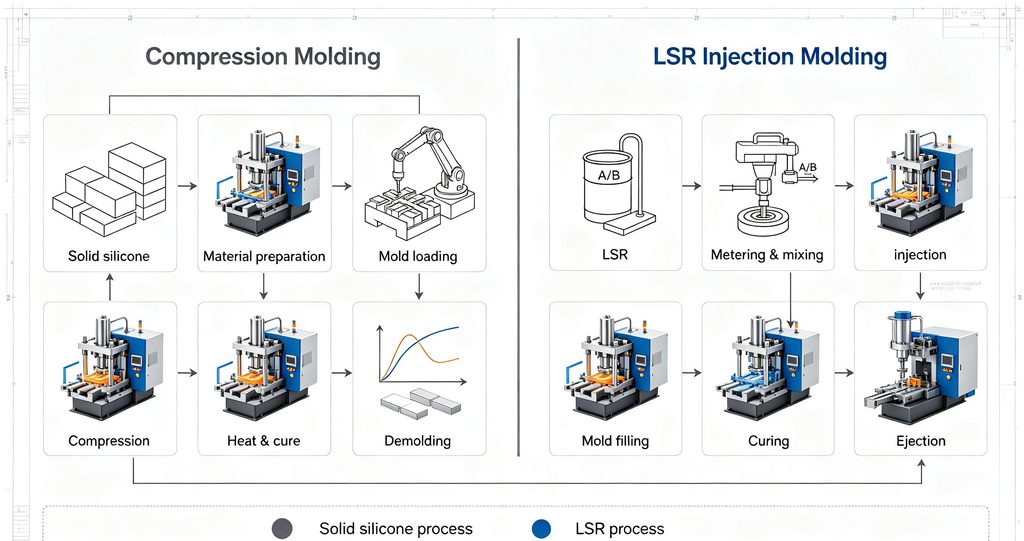
Production speed is another important difference between compression molding and LSR injection molding.
Compression molding often involves more manual operations.
Depending on the product and factory setup, operators may need to prepare and weigh the silicone material, load the mold, remove finished parts, and perform trimming or other post-processing.
LSR injection molding can automate many of these steps.
The system can control material metering, mixing, injection, and other production parameters with a high degree of consistency.
This makes LSR injection molding particularly suitable for applications where production efficiency and repeatability are important.
However, automation is not automatically the best solution for every product.
The expected volume and product requirements still need to justify the additional tooling and equipment investment.
Which Process Is Better for Complex Silicone Parts?
Product geometry should be considered before selecting the molding process.
Compression molding can work well for many products with relatively straightforward structures, including:
- Silicone keychains
- Flexible accessories
- Mats
- Seals
- Gaskets
- Promotional silicone products
LSR injection molding can be advantageous for products that require:
- Сложные геометрические формы
- Small components
- Тонкие срезы
- Detailed features
- High dimensional consistency
- Large production quantities
However, the final decision should be based on the actual product design rather than simply its category.
A small product does not necessarily require injection molding, and a large product does not automatically require compression molding.
Silicone Keychains: A Practical Example
Custom silicone keychains are a good example of how the same product category can use different manufacturing approaches.
For relatively straightforward designs, compression molding can be a practical manufacturing solution.
For more complex structures or large-volume production, other molding configurations may be considered depending on the design.
Factors such as:
product thickness + number of colors + 3D details + mold structure + order quantity
can all affect the final process selection.
If you are developing a branded or promotional keychain, see our detailed guide to изготовление силиконовых брелоков на заказ.
How Silicone vs PVC Affects Your Product Decision
Material selection should not be confused with molding process selection.
Silicone and PVC have different material characteristics, and the right choice depends on the intended product application.
Silicone may be considered when flexibility, soft-touch feel, temperature resistance, or a particular tactile experience is important.
PVC can be suitable for many promotional and character-based products where cost, color effects, and product structure are key considerations.
If you are still deciding between the two materials, read our guide:
Silicone vs PVC: Which Material Is Better for Custom Products?
This comparison should ideally happen before the final mold structure is approved.
How MOQ Affects the Molding Decision
MOQ can also influence the economics of your molding project.
A manufacturer may consider different production methods depending on:
- Tooling investment
- Expected quantity
- Сложность продукта
- Требования к материалам
- Production capacity
- Required finishing
For example, a smaller initial order may require a different cost structure from a long-term high-volume production program.
Understanding your expected purchasing volume before tooling begins can therefore help avoid unnecessary manufacturing costs.
For more information, see our MOQ guide for custom silicone products.
How a Professional Silicone OEM Manufacturer Selects the Process
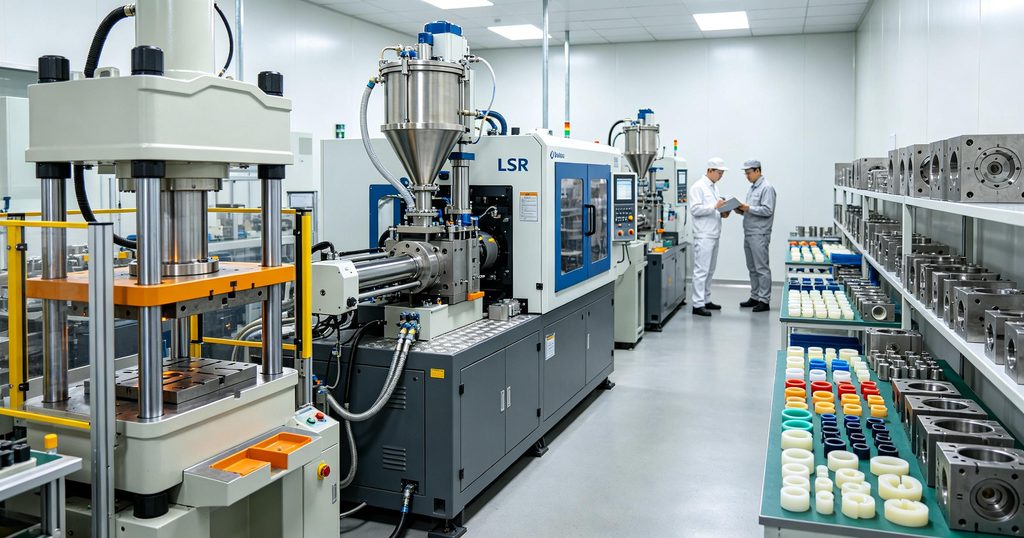
Choosing a molding process should not be based solely on equipment availability or the lowest quoted mold price.
A professional OEM manufacturer should first review the complete product requirements.
These may include:
Дизайн продукта
2D drawings, 3D files, dimensions, wall thickness, and structural details.
Материал
Silicone type, hardness, color, and required physical properties.
Количество продукции
Initial order quantity as well as expected future demand.
Surface and appearance
Texture, gloss level, color matching, printing, coating, and other finishing requirements.
Target cost
Expected unit price and acceptable tooling investment.
After reviewing these factors, the manufacturer can determine which manufacturing approach is more appropriate for the project.
If you are currently comparing suppliers, our guide on how to find a reliable silicone manufacturer in China may also be useful.
Common OEM Mistakes When Choosing a Silicone Molding Process
Choosing Only by Unit Price
The lowest quoted unit price does not necessarily represent the lowest overall project cost.
Tooling, labor, finishing, packaging, MOQ, and production efficiency can all affect the final cost.
Designing Without Considering Manufacturing
A product may look excellent in a 3D model but require complicated tooling during actual production.
Early communication between the product designer and manufacturer can help identify these issues before mold production.
Ignoring Future Production
If a product is expected to become a long-term SKU, the future production volume should be considered before selecting the molding method.
Choosing Material Too Late
Solid silicone and LSR are processed differently.
Material selection should therefore be discussed before the final mold structure is confirmed.
Solid Silicone Compression Molding vs LSR Injection Molding: Which One Should You Use?
The answer depends on the project.
Solid silicone compression molding may be suitable when:
- The product uses solid silicone rubber
- The design is suitable for compression molding
- Production volume is small to medium
- Initial tooling investment is an important consideration
- Highly automated production is not essential
LSR injection molding may be suitable when:
- The product uses LSR
- Production volume is medium to high
- Automated production is important
- Complex or detailed components are required
- Consistent production cycles are important
The most effective approach is to evaluate the material, design, quantity, tooling, cost, and production requirements together.
Заключительные размышления
There is no single molding process that is ideal for every custom silicone product.
Solid silicone compression molding offers a practical solution for many molded silicone products and can be suitable for projects where flexibility in production volume and tooling investment are important.
LSR injection molding provides a highly controlled and automated approach that can be particularly valuable for suitable complex, detailed, and high-volume silicone components.
For OEM buyers, the most important step is to select the manufacturing process before investing in tooling.
Share your product design, silicone requirements, estimated order quantity, and target application with your manufacturer. A detailed project review can help determine the appropriate molding method before production begins.
Looking for a Silicone OEM Manufacturer?
We support overseas brands, promotional companies, IP owners, and product developers with custom silicone manufacturing from product concept through mass production.
Our capabilities include:
Product development → 3D rendering → Mold development → Sampling → Mass production → Quality inspection → Assembly → Packaging
If you already have a product drawing, reference sample, or simple concept, send it to our team.
Contact us for a custom silicone manufacturing consultation and quotation.
 English
 Chinese
 Japanese
 Spanish
 French
 Arabic
 Russian
 Portuguese
 Belarusian
[…] The manufacturing process should therefore be considered during product development rather than only… […]
[…] Product design → material → hardness → mold → sampling → testing → mass production […]